

More news on this day
U.S. air travelers are confronting a new reality at airports this week as Immigration and Customs Enforcement agents begin appearing alongside Transportation Security Administration personnel, a visible response to deepening staffing shortages and an unresolved Department of Homeland Security funding lapse during the busy spring break travel period.
Get the latest news straight to your inbox!
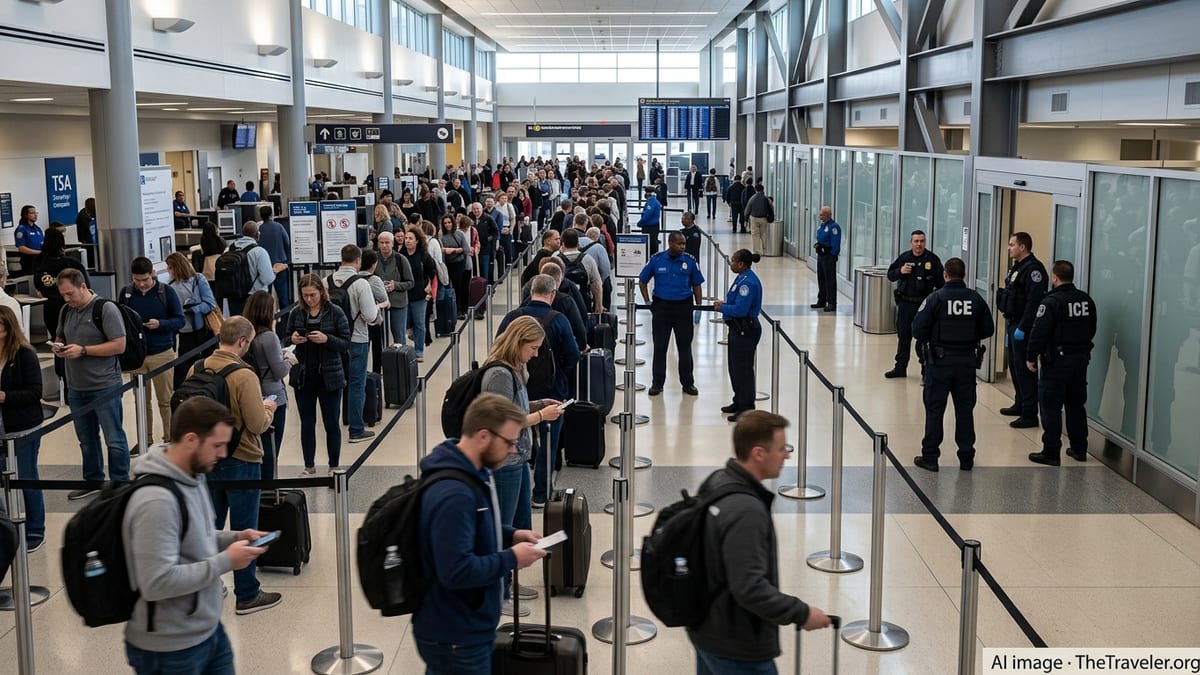
ICE Presence Expands Across Major Airport Hubs
Publicly available information indicates that ICE officers have been directed to more than a dozen large U.S. airports, including major hubs in New York, Los Angeles, Atlanta, Chicago, Houston and Miami. The deployments began in the wake of mounting security wait times and reports of three hour lines at some terminals as spring break demand collided with a partial shutdown of the Department of Homeland Security.
Online travel advisories and legal briefings describe the move as an effort to shore up basic airport operations while thousands of TSA officers continue working without pay. The deployments are being framed as temporary, but there is little clarity on how long ICE personnel will remain in airport roles or how extensive the expansion could become if the shutdown continues into April.
Commentary from former Homeland Security and immigration officials in national broadcasts and news coverage suggests that ICE staff are expected to focus on limited functions that do not require specialized screening certification, such as monitoring exit lanes or supporting crowd management in secure areas, rather than conducting full passenger or baggage screening.
At Seattle Tacoma International Airport, statements from the local airport authority reported in regional coverage emphasized that security screening remained under TSA control, with Port of Seattle employees, rather than ICE officers, assigned to some non regulatory duties so that trained screeners could remain on the checkpoints.
TSA Staffing Crunch Deepens Under DHS Shutdown
The ICE deployments come against the backdrop of a severe TSA workforce crunch fueled by the DHS funding standoff that began on February 14, 2026. According to recent national and aviation focused reporting, TSA officers at airports across the country have missed multiple paychecks, driving up unscheduled absences and increasing the number of employees who resign or seek other work.
Coverage from outlets including CBS News and specialist travel publications notes that several hundred TSA employees separated from the agency in the first weeks of the shutdown, at the same time that new hires face four to six months of training before they can independently operate checkpoints. That lag has left the agency with few immediate options to boost capacity even as passenger volumes reach or surpass pre pandemic records.
Travel industry updates describe the impact in concrete terms. Some large hubs have consolidated checkpoints, opened fewer screening lanes during peak hours or shifted officers between terminals, resulting in sharply uneven wait times depending on time of day and gate location. In Houston, for example, local reports earlier this year described periods when only two checkpoints were operating for an entire multi terminal airport, prompting warnings of multi hour lines.
Analysts drawing on Federal Aviation Administration data have also linked security staffing issues to broader operational stress. When checkpoints slow boarding and push back times, aircraft can miss departure slots, which in turn compounds existing air traffic controller shortages and contributes to cascading delays across the network.
Passenger Experience: Longer Lines and Heightened Anxiety
For travelers moving through airports this week, the most immediate effects remain visible in longer queues, more crowded concourses and a heightened law enforcement presence near security. Travel advisories issued by assistance companies and consumer outlets recommend arriving significantly earlier than the traditional guidance, in some cases three hours ahead for domestic flights and even more for international departures.
Spring break travelers have shared images and accounts of snaking lines on social media, with recent coverage highlighting wait times of three hours or more at busy coastal and Sun Belt airports. Some terminals have resorted to impromptu line management, sending staff to walk the queues, answer questions and direct passengers toward underused lanes in an effort to keep throughput from stalling completely.
The appearance of ICE officers at airports already experiencing high tension has added a new layer of anxiety for some international visitors and mixed status families. Immigration attorneys and advocacy organizations cited in recent articles are advising noncitizen travelers to carry all required documentation, avoid carrying prohibited items that could trigger secondary screening and build in extra time in case of additional questioning at checkpoints or boarding gates.
At the same time, airport officials quoted in local statements stress that the basic rules for air travel have not changed. TSA remains responsible for security screening, while Customs and Border Protection continues to handle immigration checks on arrival. The presence of ICE personnel, they note, does not alter entry eligibility, visa conditions or routine customs processing, even if it changes the atmosphere in some parts of the terminal.
Operational and Civil Liberties Questions Emerge
Policy analysts and former security officials interviewed in national media coverage have raised concerns about relying on ICE agents to fill gaps created by TSA staffing shortfalls. ICE officers are trained primarily for immigration enforcement and investigative work, rather than for the specific procedures and customer facing protocols used in passenger screening.
Commentary in legal and civil liberties reporting warns that placing immigration enforcement officers in close proximity to domestic security checkpoints risks blurring the line between routine aviation security and immigration control. Advocates argue that this could discourage some travelers from flying, particularly those from immigrant communities who may perceive an increased risk of arrest or targeted questioning when they encounter ICE uniforms at the airport.
There are also operational questions about accountability and oversight when multiple DHS components share responsibility in the same physical space. Publicly available guidance indicates that only TSA officers are authorized to conduct standard passenger screening, but the specifics of how ICE personnel are integrated into terminal operations, briefed on limits to their authority in that context and supervised on a day to day basis remain largely undefined in open reporting.
Members of Congress from both parties have begun to call for more transparency about the scope and duration of the deployments, according to recent political coverage. Some lawmakers are pressing for written assurances that ICE activity inside airports will be narrowly focused on safety functions unrelated to immigration status and that any long term solution to the TSA staffing crisis will involve hiring and paying trained screeners, rather than substituting enforcement personnel from other parts of DHS.
Outlook for Travelers as Peak Season Approaches
With the DHS funding impasse still unresolved as of late March, aviation analysts expect the pressure on airport security operations to continue at least through the end of the spring break season. Forecasts contained in earlier TSA budget documents anticipated steady passenger growth in 2025 and 2026; the current combination of higher volumes and constrained staffing is now testing those assumptions in real time.
Travel risk assessment firms and airline advisories are encouraging passengers to build flexibility into their plans, avoid tight connections at congested hubs and monitor both airline messages and airport social media feeds for checkpoint specific updates. Some travel planners are steering clients toward early morning or late evening departures, when lines may be shorter, or suggesting secondary airports where possible.
Industry observers note that the ultimate resolution will depend on congressional action to restore DHS funding and, over the longer term, on whether TSA can recruit and retain enough officers to keep pace with demand. Until then, the presence of ICE officers at terminals is likely to remain a visible symbol of an aviation security system stretched by fiscal and political strain, even as millions of passengers continue to pass through U.S. airports each week.