

More news on this day
South Korea will restore direct flights between Incheon International Airport and Jeju Island in April 2026, reopening a strategic air corridor that officials and industry leaders say could reshape domestic and international travel patterns across the country.
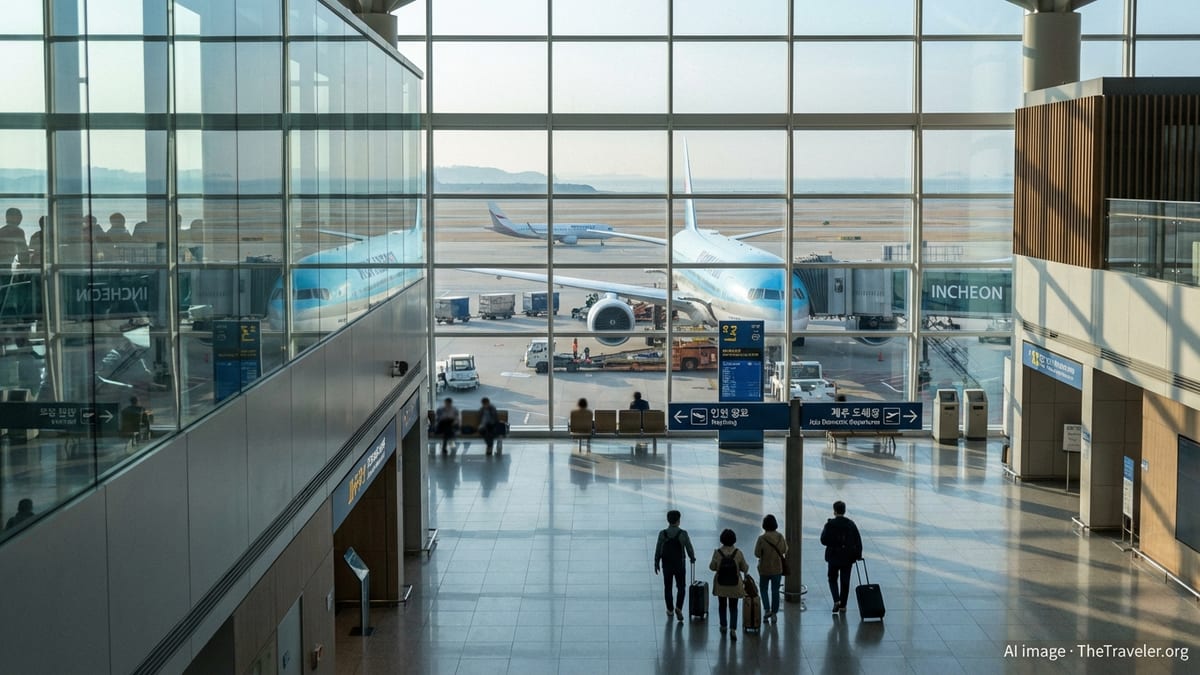
A Long-Awaited Reconnection Between Gateway and Island
The Incheon–Jeju route, once a niche service overshadowed by the busy Seoul Gimpo–Jeju shuttle, was suspended a decade ago amid low demand and overlapping capacity. Its planned return in April 2026 comes at a very different moment for Korean aviation, defined by post-pandemic demand, a consolidated flag carrier and a government pivot toward regional tourism growth.
According to recent announcements from South Korean transport officials and airline executives, the revived link is expected to launch with multiple daily frequencies operated by Korean Air and selected low-cost carriers, timed to connect with major long-haul and regional arrivals at Incheon. Capacity will be adjusted seasonally to match Jeju’s peaks in spring blossoms, summer beach travel and autumn hiking.
Unlike previous iterations of the route, the 2026 restart has been designed from the outset as a through-connection product rather than a stand-alone domestic flight. Passengers arriving on international services into Incheon will be able to clear immigration and customs there, then transfer to Jeju-bound departures within the secure domestic area, cutting out an additional airport transfer in Seoul.
Jeju authorities have welcomed the move as a turning point in the island’s efforts to rebalance away from a heavy dependence on short-haul traffic from mainland China and the Seoul metropolitan area, and toward more diverse, higher-spend international visitors.
Faster, Simpler Journeys for International Visitors
For many foreign travelers, reaching Jeju today still involves a multi-step journey: land at Incheon, transfer to Seoul’s Gimpo Airport by rail or road, then board a domestic shuttle flight south. Travel planners say this double-airport transfer adds complexity and uncertainty, particularly for first-time visitors or those arriving after long-haul overnight flights.
From April 2026, most of those travelers will instead be able to connect directly at Incheon, reducing total journey times to Jeju by one to two hours in many cases. It will also remove the risk of missing domestic connections because of traffic delays between the two Seoul airports, a frequent concern in peak season.
Industry analysts note that Incheon’s role as a North Asian hub is central to the plan. With an expanding network of routes to North America, Europe and Southeast Asia, and new access to secondary cities in China and Japan, the airport is increasingly positioned as a one-stop gateway to South Korea’s regional destinations. Adding a robust Jeju connection gives airlines more flexibility to sell combined city-and-island itineraries and to package Jeju as an easy add-on to business travel in Seoul.
Airlines serving Incheon are already signaling that Jeju will feature more prominently in their schedules and marketing from late 2025, with some carriers planning code shares and through-checked baggage agreements that make the domestic hop feel like a seamless continuation of international itineraries.
Jeju Tourism Braces for a New Wave of Demand
Jeju’s tourism sector is preparing for what hotel groups describe as a “structural step-up” in visitor numbers once the Incheon link is restored. Local authorities and industry associations expect a particular surge from North America and Europe, markets in which Jeju’s volcanic landscapes and slow-travel appeal are increasingly featured in 2026 destination rankings and long-haul travel guides.
Large hotel brands with existing footprints on the island are expanding room inventories, renovating older properties and repositioning some resorts to target longer-stay, higher-spend guests. Boutique hoteliers and family-run pensions, meanwhile, are investing in multilingual staff, digital booking platforms and transport partnerships in anticipation of a broader mix of independent travelers.
Tour operators are also reshaping their product lines. Where Jeju once appeared mainly as a two-night add-on to Seoul, itineraries for 2026 are being redesigned around five- to seven-night island stays focused on hiking, coastal drives and food culture. Direct Incheon access makes it easier to build open-jaw trips in which visitors arrive via Seoul and depart via Jeju, or vice versa, without backtracking.
Local officials stress that the expansion must remain aligned with Jeju’s environmental goals and capacity limits. After years of debate about overtourism and infrastructure strain, the island is using the relaunch as an opportunity to steer demand toward shoulder seasons, promote public transport and develop lesser-known inland and eastern routes away from already crowded coastal hotspots.
Strategic Boost for Korea’s Aviation and Regional Policy
The return of Incheon–Jeju flights dovetails with broader aviation and regional development strategies unveiled by the South Korean government in late 2025. Those plans call for diversifying international routes, strengthening hub functions at Incheon and improving connectivity to outlying regions and island communities.
Officials see Jeju as a flagship case study in how better air links can distribute the benefits of rising inbound tourism beyond Seoul. In parallel with the new route, infrastructure investments on and around Incheon International Airport, including a newly opened road bridge connection and terminal enhancements, are designed to shorten transfer times and support higher passenger throughput without compromising on safety and service standards.
The timing also overlaps with the continuing integration of Korea’s full-service carriers following the merger of Korean Air and Asiana Airlines. As the combined airline rationalizes overlapping routes and redeploys aircraft, Jeju emerges as a natural beneficiary: a high-profile domestic destination with strong brand recognition abroad and the potential to anchor new regional flows linking Japan, China and Southeast Asia through Incheon.
Aviation analysts say that success on the Incheon–Jeju corridor could encourage similar “gateway-to-island” models on other Korean routes in the longer term, especially if the government moves ahead with further airport upgrades and incentives for regional connectivity.
New Opportunities for Travelers and the Wider Economy
For travelers, the most visible change in April 2026 will be convenience. Package tourists will be able to step off long-haul flights and board Jeju-bound services with shorter minimum connection times, while independent travelers can plan more flexible itineraries that combine city breaks, national parks and coastal escapes without complex transfers.
Travel agencies expect to see growing demand for twin-center holidays pairing Seoul’s cultural and culinary attractions with Jeju’s volcanic scenery and beaches. Corporate and incentive travel planners are also eyeing Jeju as a more accessible venue for regional meetings and retreats, with the Incheon link making it easier to host participants from across Asia-Pacific without requiring an overnight in Seoul.
On the economic front, the new air link is expected to stimulate investment in Jeju’s hospitality and service sectors, from hotels and restaurants to transport operators, guiding services and local producers. Enhanced cargo capacity on passenger flights may also benefit Jeju’s agriculture and seafood industries by improving access to export markets and premium domestic customers.
While precise traffic and revenue forecasts will depend on final schedules and market conditions in 2026, both government and industry stakeholders describe the Incheon–Jeju relaunch as a symbolic and practical milestone: proof that South Korea’s aviation and tourism recovery has entered a new phase, and a signal that Jeju is ready to take its place as a world-class island destination connected directly to the country’s primary global gateway.