

More news on this day
India has inaugurated the Noida International Airport at Jewar as Delhi’s second major air gateway, marking a significant expansion of capacity for one of the country’s busiest aviation markets.
Get the latest news straight to your inbox!
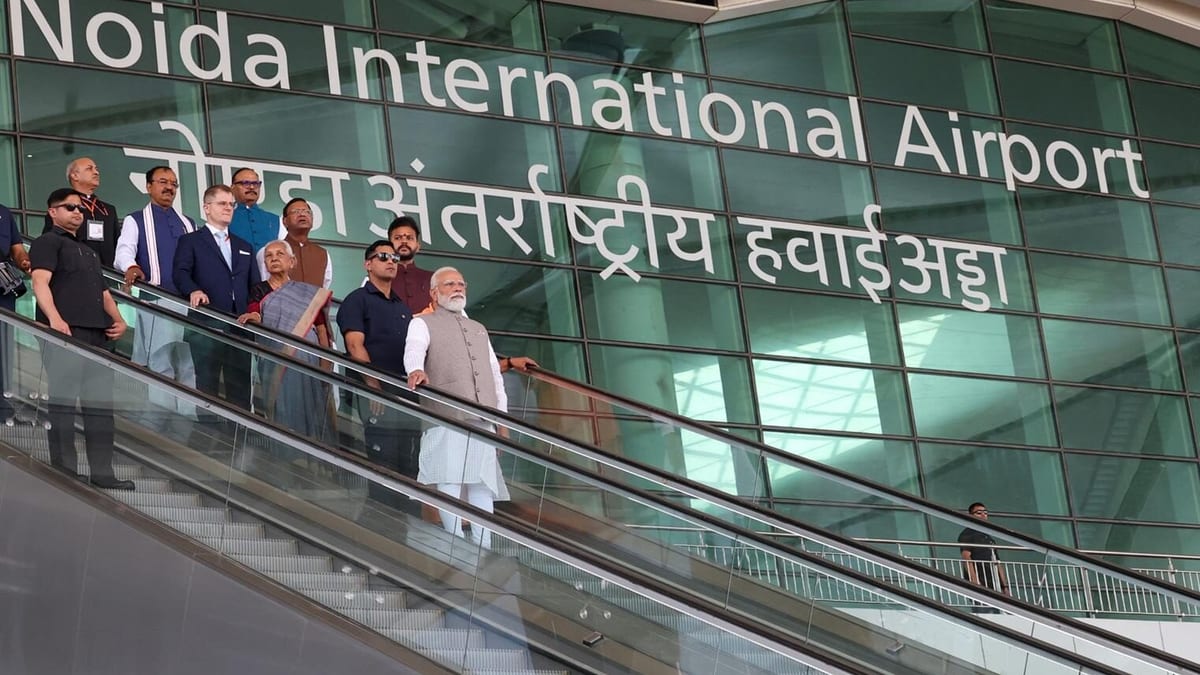
Image by AeroTime
New Greenfield Gateway for the Capital Region
The Noida International Airport, located in Jewar in Uttar Pradesh’s Gautam Buddh Nagar district, was formally inaugurated on 28 March 2026. Publicly available information shows that the greenfield facility has been planned as a multi-phase hub designed to relieve congestion at Delhi’s Indira Gandhi International Airport and serve the rapidly growing population and industry in the National Capital Region.
The first phase of the airport includes a single runway and a passenger terminal sized to handle an estimated 12 million passengers annually. According to published coverage and official briefings in recent months, further phases are expected to expand capacity substantially, adding additional runways and terminal space as demand grows.
The project has been in the works for more than two decades, with the site at Jewar repeatedly discussed and reconfigured before construction finally gathered pace in the late 2010s. Recent reports indicate that the inauguration follows a series of missed operational deadlines, reflecting both the scale of the undertaking and the complexity of regulatory and infrastructure clearances.
With the ribbon now cut, attention is shifting from construction milestones to the timing of regular commercial services, which are expected to commence after final rounds of safety checks, route allocations and airline scheduling.
Capacity Relief for Indira Gandhi International Airport
The launch of Noida International Airport effectively gives Delhi a twin-airport system, pairing Jewar with the existing Indira Gandhi International Airport on the western side of the metropolis. Indira Gandhi International has grown into one of Asia’s busiest hubs, with multiple terminals and a constrained urban footprint that limits future expansion options.
A second airport in the region is expected to ease slot pressure, particularly on domestic routes and short-haul international services, and provide airlines with additional operating choices. Aviation analysts cited in recent coverage suggest that some low-cost and point-to-point traffic may gradually migrate to Jewar, freeing capacity at Indira Gandhi International for long-haul and premium connectivity.
The geographical distribution of the two gateways also has implications for passengers. Travelers from Noida, Greater Noida, parts of Ghaziabad and the industrial clusters along the Yamuna Expressway are likely to find Jewar significantly closer than the existing Delhi airport, potentially cutting surface travel times and congestion on key arterial roads.
For airport operators and regulators, the challenge will lie in balancing traffic between the two hubs, coordinating airspace management over the dense Delhi region and ensuring that ground transport links keep pace with expected passenger volumes.
Connectivity, Infrastructure and Regional Development
The new airport has been positioned as a catalyst for large-scale infrastructure and economic development across the eastern flank of the National Capital Region. Publicly available plans highlight multi-modal connectivity, including links to the Yamuna Expressway, an under-construction expressway to Faridabad and proposals for metro and rapid rail extensions to integrate Jewar with existing urban networks.
Regional planning documents indicate that logistics parks, warehousing zones and commercial districts are being mapped around the airport to create an aviation-led economic corridor. The site’s proximity to industrial areas in Uttar Pradesh is expected to support time-sensitive manufacturing and export activity, making air cargo an important component of the facility’s long-term strategy.
The inauguration also reinforces ongoing efforts by the Uttar Pradesh government to position the state as a key beneficiary of India’s broader infrastructure and manufacturing push. Reports indicate that authorities expect the airport and associated development to attract significant private investment and generate large numbers of direct and indirect jobs in construction, services, tourism and logistics.
Environmental considerations have featured in the project narrative as well. Public information on the design of the terminal and airside systems points to energy-efficient features and digital processes aimed at reducing resource use, while the greenfield location has prompted continued discussion over land use, rehabilitation and long-term sustainability.
Phased Operational Rollout and Airline Interest
Although the airport has now been inaugurated, commercial operations are set to begin in a phased manner. Recent coverage suggests that domestic services will start first, once final operational clearances and navigational checks are completed, with international flights to follow after initial ramp-up.
Indian carriers, particularly low-cost airlines, have previously signaled interest in serving Jewar as a way to tap into new catchment areas and diversify their presence in the Delhi region. Industry reports ahead of the inauguration pointed to expectations of point-to-point routes connecting key cities, alongside potential cargo operations that leverage the airport’s greenfield design and available land.
Observers note that passenger acceptance will be a crucial factor in the airport’s early performance. Travel time to the terminal, reliability of ground transport, and the ease of transfers for those connecting via Delhi’s existing hub will all shape how quickly traffic builds. The experience of other multi-airport cities suggests that clear communication about airlines, terminals and surface links is essential during the initial years.
The timing of Jewar’s entry into service coincides with a broader recovery in air travel demand within India, where domestic traffic has rebounded strongly and international connections are expanding. This creates both opportunity and pressure for the new gateway to establish itself quickly in airline schedules and traveler preferences.
Implications for India’s Aviation Network
The inauguration of Noida International Airport adds another high-profile project to India’s expanding network of new and upgraded airports. Over the past decade, the country has commissioned or modernised a series of regional and metropolitan facilities as part of a strategy to widen access to air travel and support economic growth.
For the Delhi region, a second full-scale airport is expected to strengthen its role as a northern hub, enabling additional connections across South Asia, the Middle East and beyond. Industry commentators suggest that, over time, Jewar could evolve into a complementary hub for specific carriers or traffic segments, particularly if planned surface transport links are delivered on schedule.
The project also illustrates the growing role of public–private partnerships and international operators in India’s airport sector. The concession model at Jewar aligns with similar arrangements at other major Indian airports, reflecting a policy preference for leveraging private capital and expertise while retaining public oversight of strategic infrastructure.
As India pursues its ambition to become one of the world’s largest aviation markets, the successful ramp-up of Noida International Airport will be closely watched by airlines, infrastructure investors and regional planners. Its performance in the coming years is likely to influence how future multi-airport strategies are framed in other fast-growing urban regions across the country.