

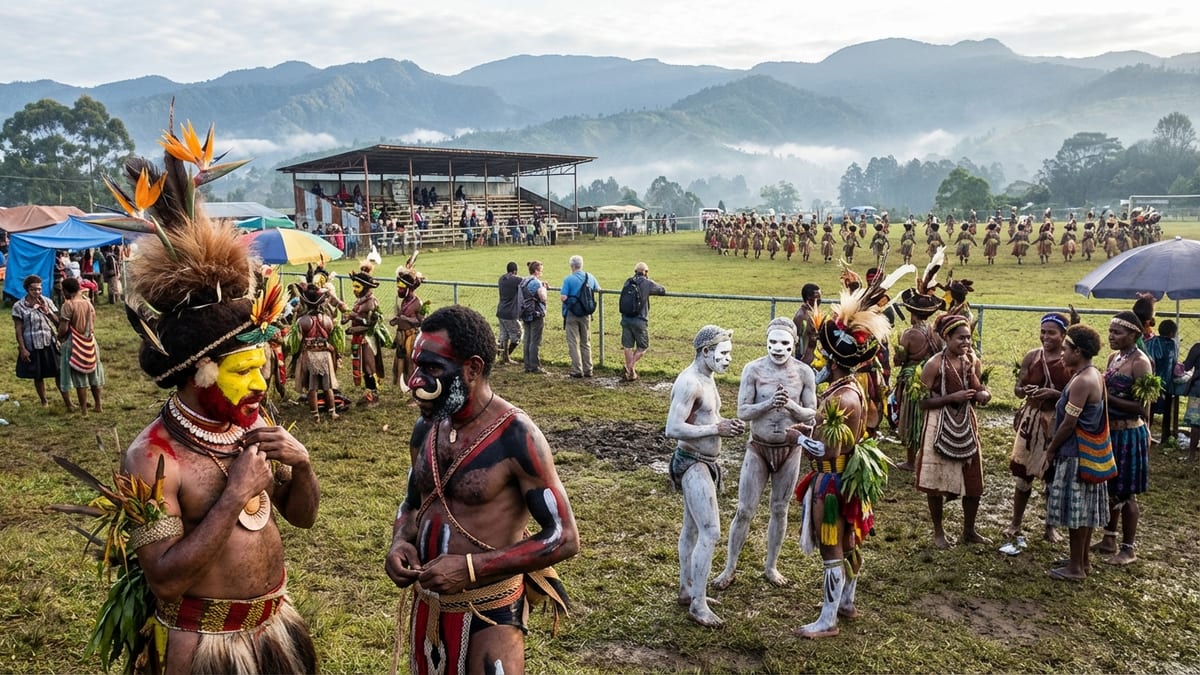
Papua New Guinea is often described as one of the most culturally diverse places on earth, a mountainous green puzzle of more than 800 languages, countless clans and customs, and some of the most visually striking festivals in the Pacific.
For travelers, it offers a rare chance to see living traditions that are not museum pieces but part of everyday life, from highlands sing-sing gatherings to river rituals along the Sepik and canoe pageants on the coast. Understanding the people and their ways is essential not only for meaningful travel, but also for moving safely and respectfully through a country where clan ties, customary law and modern nationhood all exist side by side.
The Cultural Landscape of Papua New Guinea
Culture in Papua New Guinea begins with land. Most Papua New Guineans trace identity back to a particular valley, river bend or reef, and that connection shapes everything from gardening techniques to initiation ceremonies and decoration. The country’s rugged terrain has historically isolated communities, allowing hundreds of distinct languages, belief systems and artistic styles to develop in parallel. Even within a single province, a short drive or boat journey can take you into a place with different dress, different stories and a different way of greeting visitors.
Anthropologists describe Papua New Guinea as one of the world’s most linguistically diverse nations, with hundreds of Austronesian and Papuan languages spoken alongside Tok Pisin, Hiri Motu and English. In practice, language is more than communication; it signals clan, marriage possibilities, alliances and old rivalries. Travelers quickly notice that people will switch fluidly between tongues, using Tok Pisin as a bridge language while slipping into a local dialect for private jokes or serious negotiations.
Traditional belief systems remain powerful, even in towns and settlements where churches and mobile phone towers are now familiar sights. Many communities see the landscape as animated by ancestral spirits that can bless gardens or bring misfortune. Objects such as masks, drums and carved figures are not merely decorative; they are seats of spiritual power, used to call up ancestors or mark transitions in a person’s life. At the same time, contemporary Papua New Guinea is dynamic. Young people absorb global music and fashion, city elites navigate global markets, and many communities negotiate how to keep core traditions while adapting to cash economies and the pressures of resources development.
Tribes, Clans and the Wantok System
The word “tribe” is often applied loosely in Papua New Guinea, but on the ground identities are layered and specific. A “tribe” may consist of multiple clans sharing a wider territory and a set of origin stories, while each clan traces descent from a founding ancestor and controls particular stretches of land or forest. These social units organize everything from warfare to bride price exchanges, and they remain more meaningful in many people’s lives than the relatively new administrative borders of provinces and districts.
One of the most important concepts for visitors to understand is the wantok system. “Wantok” literally means “one talk” in Tok Pisin and refers to people who speak the same language and so are considered extended kin. In practice, wantok obligations involve mutual help, whether in finding work, paying school fees or contributing to ceremonial exchanges. The system creates a social safety net and gives people a sense of belonging, but it can also complicate modern institutions when, for example, public funds or jobs are expected to benefit wantoks first.
For travelers, these kinship networks explain why gaining the support of one local guide or host can suddenly open doors to entire communities. Access to sacred sites, men’s houses or family ceremonies is usually negotiated through such relationships. It is rarely appropriate to simply turn up uninvited in a village and start photographing. Good cultural experiences almost always flow through the permission and hospitality of a particular clan, mediated by guides who understand both local expectations and visitor curiosity.
Highlands Culture and the Power of the Sing-Sing
The highlands region, with its misty valleys and sweet potato gardens, is the heartland of Papua New Guinea’s famed sing-sing culture. Sing-sings are large gatherings where groups from different areas come together to perform dances, display special feathered headdresses and body paint, and reaffirm relationships that are sometimes cooperative and sometimes tense. Historically, such gatherings allowed rival groups to size each other up, settle disputes and forge alliances without open warfare. Today, they have also become powerful stages for asserting identity in the national and global gaze.
The Goroka Show is one of the best-known highlands festivals, held annually around Independence Day in September in the Eastern Highlands town of Goroka. It brings together around a hundred groups, each with its own rhythm, costume designs and choreography. Performers may spend weeks preparing, gathering bird of paradise plumes, wild pig tusks, shells and ochres, and carefully arranging them into elaborate headdresses and necklaces. The atmosphere is part competition, part celebration, with dancers moving in tight formation while onlookers, including foreign tourists, circle with cameras.
Farther west, the Mount Hagen Show in the Western Highlands was created in the 1960s as a way to encourage peace by channeling inter-tribal rivalry into cultural performance rather than conflict. It has since grown into one of the country’s biggest cultural spectacles, with more than a hundred groups performing each year at the Kagamuga showground and additional smaller events such as the Kumunga Festival highlighting local traditions. While contemporary bands and political speeches now share the program, the beating heart remains the drum-led dances that express pride in tribal identity and continuity with ancestors.
Within these festivals, individual groups are known for signature looks. The Huli Wigmen from Hela Province, for instance, grow and cut their own hair to craft impressive wigs that they adorn with parrot feathers, flowers and cuscus fur. Men of the Melpa groups of the Western Highlands often use black, red and white body paint, pig tusks and layered shell ornaments. The Asaro Mudmen from near Goroka wear ghostly white clay masks, a performance that has become an iconic motif of Papua New Guinea’s tourism imagery. Seen up close, each group’s regalia tells a story of the birds, forests and spiritual beings of its home territory.
Rivers, Masks and Coastal Traditions
Beyond the highlands, Papua New Guinea’s river and coastal cultures have their own distinctive artistry and ceremonial life. Along the Sepik River in the north, villages are known worldwide for their woodcarving traditions. Carvers shape crocodiles, hornbills and abstract ancestral figures from hardwoods, imbuing them with spiritual significance. In traditional belief, such creatures are often seen as clan totems or manifestations of powerful ancestors. Men’s houses along the Sepik are adorned with carved posts and lintels, while canoes become moving canvases for sculpted designs.
The Sepik region is also home to initiation practices in which young men undergo elaborate scarification rituals, their skin cut to create raised patterns that resemble crocodile scales. These rites, carried out in spiritually charged houses away from women and children, mark a transition from boyhood to adulthood and symbolize the initiate’s rebirth through the body of a crocodile ancestor. While not all communities continue such practices in their full traditional form, many retain elements of the rituals, and travelers may encounter art and stories that reference them.
On the islands and coastal areas to the east, masking traditions dominate. New Ireland’s Malagan carvings, created for complex funerary ceremonies, are famed both locally and in museum collections abroad. On East New Britain, the Tolai and Baining peoples maintain ceremonies involving tall, elaborate masks, fire dances and night rituals that form the centerpiece of major cultural festivals. In these performances, dancers often appear as spirits emerging out of the dark, swirling around bonfires while crowds chant and drum.
Port Moresby, the national capital, sits within the territories of the Motu and Koita peoples, whose heritage is celebrated in the Hiri Moale Festival. This event recalls ancient trading voyages by sail-powered lakatoi canoes between the Motu villages and communities to the west. Canoe races, dance competitions and the selection of the Hiri Queen retell the story of maritime skill and exchange that laid the foundations for the region’s prosperity. For visitors, Hiri Moale offers a window into coastal life that is often overshadowed by the iconic highlands imagery.
Signature Festivals and When to Experience Them
Papua New Guinea’s annual calendar is dense with cultural events, many of which combine traditional forms with a growing focus on tourism, national pride and contemporary concerns such as conservation. The Goroka Show in September and the Mount Hagen Show in August are the best known, drawing large numbers of performers and domestic and international visitors. Both typically run over several days, with main performance days when tribes enter the field in full costume and spend hours dancing, singing and circulating for photographs.
Other regional shows offer more intimate windows into specific cultures. The Enga Cultural Show in Wabag, usually held in August, focuses on Enga Province’s particular songs, courtship dances and craft traditions. In East Sepik, an annual Crocodile Festival near the Sepik River highlights the spiritual and ecological importance of crocodiles through dance performances, educational displays and river tours. Far to the east in East New Britain, the National Mask and Warwagira Festival held around mid-year brings Tolai, Baining and other groups together for nights of fire dances, spectacular masked processions and ceremonies linked to the spirits of the bush and sea.
Port Moresby’s Hiri Moale Festival in September combines historical re-enactment with urban pageantry, while emerging events such as the Kumunga Festival near Mount Hagen showcase local groups in less crowded settings. Dates can shift for logistical or security reasons, and major events may be postponed or consolidated, so it is essential to confirm timing with local tourism authorities or reputable tour operators when planning a trip. Government and foreign travel advisories also emphasize that large gatherings can occasionally be affected by political tensions or local disputes, and that visitors should stay alert and follow local guidance.
Travelers who wish to build a trip around a particular show usually fly first into Port Moresby, then onward to regional centers such as Goroka, Mount Hagen, Wewak or Rabaul. Because accommodation is limited during major events, booking well in advance is common practice. Many lodges and tour companies package festival attendance with village visits, birding or trekking, giving travelers a chance to see both the grand public performances and quieter aspects of daily life away from the arenas.
Social Customs, Tradition and Everyday Life
While festivals dazzle, much of Papua New Guinea’s cultural richness is expressed in everyday routines and seasonal rituals. In rural areas, subsistence gardening underpins life, with families cultivating sweet potato, taro, banana and greens in carefully managed plots. Gardening is not only practical but also spiritual, with planting and harvesting often accompanied by small offerings or words spoken to ancestral spirits and land guardians. Pigs are highly valued, both as a source of food and as key assets in ceremonial exchange networks that bind families and clans together.
Customary exchanges, sometimes known as “payback” in a positive sense, take place at life events such as births, marriages and deaths. At a marriage, the groom’s family may present bride price to the bride’s relatives in the form of pigs, cash, shell valuables and store goods. Opinions within Papua New Guinea are divided about how this practice has changed. Some argue that inflated payments and a focus on cash can worsen gender inequality, turning marriage into a financial transaction and making divorce difficult. Others emphasize that bride price once symbolized respect and a commitment to support the bride within her new family, and they advocate for reforms rather than abolition.
Gender roles also remain strongly marked in many regions, with women often bearing the main responsibility for gardening, child-rearing and market trading, and men more visible in formal leadership and public ceremonial roles. However, the picture is evolving. Urban women are increasingly active in business and education, and organizations across the country are working to address gender-based violence and expand opportunities. Travelers can support positive change by seeking out women-owned guesthouses, crafts cooperatives and tours, and by being sensitive to local norms about photography, dress and conversation.
Christianity, introduced during the colonial era, is widely practiced and interwoven with older beliefs. Many communities attend church on Sunday and hold prayer meetings, yet also maintain rituals for land spirits, use divination to settle disputes, or attribute misfortune to sorcery. These layered beliefs can be challenging for outsiders to parse, but they make sense within local histories of missionization, colonial administration and the struggle for independence. When in doubt, it is best to ask open, nonjudgmental questions and allow local people to define their own faith and values.
Culture, Change and the Realities of Travel
In recent years, Papua New Guinea has been the focus of growing global attention for both its cultural treasures and its social challenges. News reports and government travel advisories highlight high levels of crime in certain urban centers, ongoing tribal violence in parts of the highlands, and health risks such as malaria and outbreaks of vaccine-preventable diseases. Some highlands provinces have been singled out for heightened caution due to clashes connected to elections, resource projects or local land disputes.
At the same time, tourism officials, lodge owners and community leaders describe cultural tourism as a “sleeping giant” with the potential to bring income, infrastructure and pride to remote areas if developed carefully. Well-established lodges in regions such as Hela and the Mount Wilhelm area have shown that long-term relationships with local clans, employment of local guides, and respect for customary landownership can create relatively secure environments for visitors even in provinces that otherwise experience unrest. These operations often integrate cultural encounters into broader nature-based itineraries, for example combining visits to Huli Wigmen communities with birdwatching or highlands trekking.
For travelers, the reality lies between the extremes of danger and idyll. It is entirely possible to have rewarding, safe cultural experiences in Papua New Guinea, but doing so generally requires more planning and flexibility than in many other destinations. Traveling with reputable local operators, heeding local advice about where and when to move, and avoiding unnecessary night travel are common-sense precautions. It is also wise to keep a low profile in crowded markets, carry minimal valuables, and understand that unexpected roadblocks or community meetings can delay journeys or change plans at short notice.
Culturally, visitors should be prepared for a country that is proud but not always polished from a tourism perspective. Paths may be muddy, ceremonies may start late and language barriers may surface. Yet these same conditions often allow for deep, unscripted encounters: sharing a meal of taro and greens in a village house, sitting with elders as they explain clan histories, or watching youths rehearse dances for a festival that means far more to them than any external audience can grasp.
How to Experience Culture Respectfully
Engaging well with Papua New Guinea’s cultures begins with humility. Many communities are still adjusting to the idea of regular foreign visitors, and customs around privacy, sacredness and gender can differ sharply from those in Western countries. Always seek permission before photographing individuals, particularly children and older people. In some settings, such as men’s houses or ceremonies involving sacred objects, cameras may be restricted or banned. A local guide is invaluable for reading what is appropriate and for introducing you in a way that honors local protocol.
Dress codes matter. In urban centers, people often wear Western clothing, though dressing modestly is still advisable. In rural areas and at festivals, shoulders and knees should be covered, and flashy or revealing outfits can be seen as disrespectful. For women, a long skirt or loose trousers and a T-shirt are usually appropriate. For men, long shorts or trousers and a shirt are standard. Removing your hat when entering houses or speaking with elders may be appreciated, depending on the region.
Gift-giving and purchasing local crafts are tangible ways to support communities. Handwoven bilum string bags, carved masks, ancestor figures and bark paintings are widely sold, particularly around festival grounds and village visit points. Buying directly from makers or from cooperatives that are transparent about how proceeds are shared helps keep skills alive and ensures that the benefits of tourism are more evenly distributed. Avoid purchasing objects that community members indicate are sacred or should not leave the area, and be wary of artifacts that appear to have been recently stripped from shrines or graves.
Above all, remember that you are moving through living societies, not open-air museums. Traditions change; young people may remix old songs with hip-hop beats or want to talk more about football than initiation rituals. Asking people about their current lives, aspirations and concerns can lead to conversations that are just as illuminating as questions about ancient customs. Respect includes listening to how local people themselves describe what matters most about their culture today.
The Takeaway
Papua New Guinea’s cultural mosaic is one of the planet’s great human treasures, an intricate weave of languages, art forms, rituals and social systems that have endured into the twenty-first century while negotiating rapid change. For travelers willing to go beyond the familiar beach destinations of the Pacific, it offers a chance to witness living cultures that still revolve around clan ties, ancestral land and ceremonial exchange, even as mobile phones, mining projects and urban ambitions reshape the landscape.
Understanding the basics of tribes and clans, the wantok system, highlands sing-sings, Sepik carving traditions and coastal mask festivals allows visitors to move with more awareness and appreciation. Layering that cultural curiosity with realistic expectations about security, infrastructure and health safeguards turns what might otherwise be a risky leap into a manageable adventure. In return, guests are rewarded with moments of connection that are hard to find elsewhere: the shimmer of bird of paradise plumes in early-morning light, the thunder of drums across a highlands field, or a quiet conversation beneath a thatched roof about what it means to keep old ways alive in a changing world.
FAQ
Q1: Is it safe to travel to Papua New Guinea for cultural festivals?
Safety conditions vary by region and can change over time. Some highlands provinces experience periodic tribal violence and crime, and foreign governments currently advise a high degree of caution or reconsidering travel to certain areas. Many travelers attend major festivals with reputable tour operators who work closely with local communities to manage risk. Checking up-to-date travel advisories, planning with experienced local partners and remaining flexible with itineraries are essential.
Q2: Which cultural festival is best for a first-time visitor?
For a first visit focused on culture, the Goroka Show in September or the Mount Hagen Show in August are strong choices. Both bring together dozens of highlands groups in one place, making it possible to see a wide variety of dances and costumes over a few days. Goroka is often considered slightly more accessible logistically, while Mount Hagen has a reputation for especially dramatic performances. Whichever you choose, plan well in advance and consider combining the show with village visits for more personal encounters.
Q3: Do I need a guide to visit villages and attend festivals?
While it is sometimes possible to move independently in larger towns, a knowledgeable local guide is strongly recommended for village visits and festival experiences. Guides understand local languages, customs and clan politics, and they can secure permissions that outsiders could not obtain on their own. They also help negotiate photo opportunities, explain what you are seeing, and navigate security or logistical issues that may arise.
Q4: What should I wear to be respectful in rural areas?
In rural communities and at festivals, modest dress is appreciated. Women should generally wear skirts or loose trousers that cover the knees and tops that cover the shoulders and chest. Men typically wear long shorts or trousers and shirts. Avoid tight, revealing or flashy clothing, and consider bringing a light scarf or extra layer that can be used to cover up in more conservative settings. Practical footwear for mud and uneven ground is also important.
Q5: Can I photograph people in traditional dress?
Photography is usually welcomed at major public festivals, but it is still good practice to ask before taking close-up portraits and to offer a small thank-you or engage in conversation rather than treating performers as displays. In villages and everyday situations, always request permission before taking photos of individuals, homes or ritual objects. Some ceremonies, sacred spaces and initiation-related items are not meant to be photographed, and your guide can advise when it is inappropriate.
Q6: How do bride price and other traditional practices affect women?
Bride price and similar customs play complex roles. Historically, bride price was meant to honor the bride and formalize the union between families, with obligations running in both directions. In modern contexts, high bride price demands and a focus on cash can reinforce unequal power dynamics and make it harder for women to leave abusive marriages. Many Papua New Guineans, including women leaders and church groups, are debating how to reform or reinterpret these practices to protect women’s rights while respecting cultural values.
Q7: Are cultural performances at lodges and in cities “authentic”?
Performances staged at lodges, hotels or urban festivals are authentic in the sense that they are created by real community groups drawing on their own traditions, but they are often adapted for time limits, mixed audiences and safety rules. Some elements may be shortened or combined for visitors, and sacred aspects may be omitted. Seeing such shows can still give valuable insight, but those who spend longer periods in communities may experience more intimate versions of ceremonies that are primarily intended for local participants.
Q8: What languages will I encounter, and how can I communicate?
Tok Pisin is widely spoken and functions as a lingua franca across much of the country, while English is used in schools, government and tourism. In addition, each region has its own local languages, and people may switch between them easily. Learning a few basic phrases in Tok Pisin, such as greetings and thanks, goes a long way in breaking the ice. In remote areas where English is less common, your guide will be essential for deeper conversations.
Q9: How can I support local communities through my visit?
You can support communities by hiring local guides and porters, staying in village guesthouses or community-linked lodges, buying crafts directly from artisans, and respecting community decisions about access and photography. Paying agreed fees on time, tipping fairly where appropriate, and giving feedback that emphasizes what you valued culturally all help demonstrate that respectful tourism has tangible benefits. Avoid handing out cash or gifts randomly, as this can create tension and expectations; instead, work through your hosts or community leaders.
Q10: What health and practical preparations should I make before traveling?
Before traveling, consult a travel health clinic about vaccinations, malaria prophylaxis and other preventive measures. Comprehensive travel insurance that covers medical evacuation is highly advisable due to limited health facilities outside major towns. Pack any prescription medicines you need, plus insect repellent, sunscreen and basic first-aid supplies. Expect intermittent power, patchy mobile coverage and simple facilities in many rural areas, and bring a flexible attitude alongside your camera and curiosity.