

More news on this day
In Scottsboro, Alabama, the world’s only permanent store dedicated to selling unclaimed airline luggage is quietly rewriting what travelers think they pack, where luxury and the downright strange surface every day from suitcases that never made it home.
America’s Lost Luggage Capital Turns Curiosity Into Commerce
For more than half a century, Unclaimed Baggage in Scottsboro has turned abandoned suitcases into a sprawling retail experience, drawing more than a million visitors a year to this northeast Alabama town. The company buys orphaned bags from airlines and travel companies only after months of tracing efforts have failed and customers have been compensated, then unpacks, sorts and resells what is inside. The result is part outlet, part museum, part social experiment in what people really carry when they fly.
Recent national coverage has underscored how big the pipeline of misplaced belongings has become as air travel rebounds. Federal data show hundreds of thousands of mishandled bags in a single peak month, and only a fraction end up here after reunions and reimbursements are exhausted. At Scottsboro’s facility, pallets of luggage arrive sight unseen, before teams open each case, authenticate valuables and decide whether items should be sold, donated, recycled or discarded.
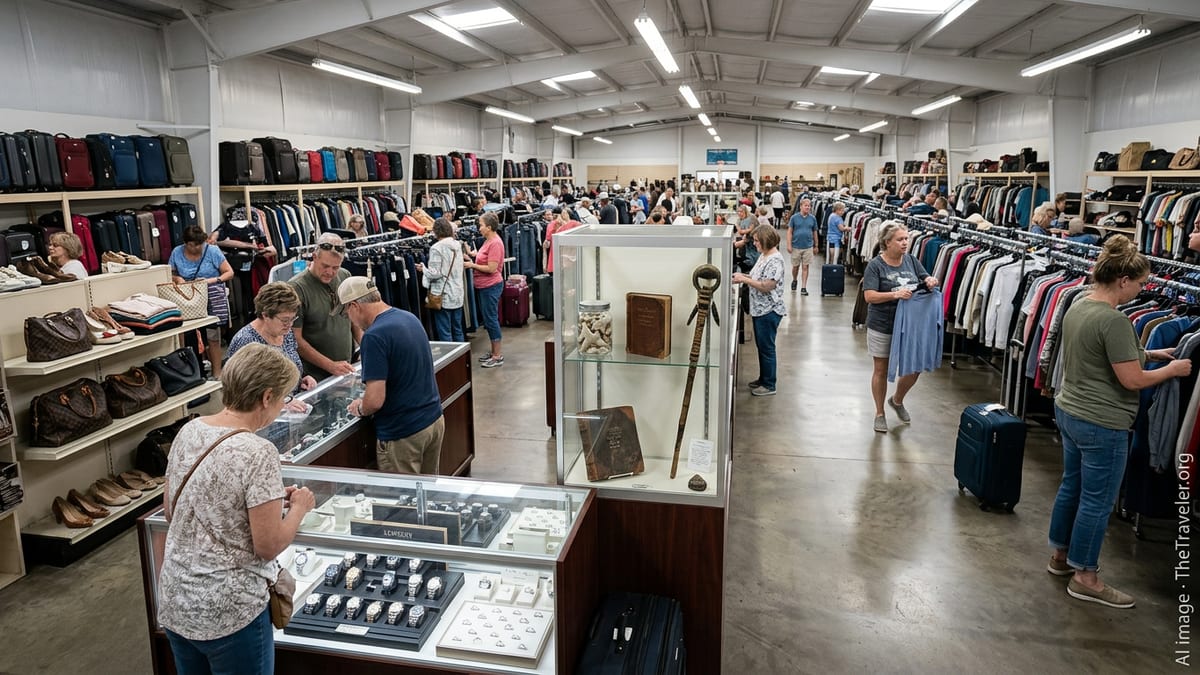
The scale has made Unclaimed Baggage a tourism anchor in its own right. Tour buses stop in the parking lot, families schedule road trips around a shopping day, and travelers who have never lost a bag still come to hunt for bargains and stories. Inside, racks of discounted clothing sit beside glass cases of jewelry, electronics counters and a small “museum” of oddities pulled from past hauls.
That mix of routine and rare is what keeps people flowing through the doors. A lost suitcase might yield nothing more exotic than jeans and sneakers, but the one next to it could hide couture gowns, a high-end camera kit or an object staff say they never imagined would show up in checked baggage.
Rolex Watches, Couture Gowns and a $64,000 Platinum Showpiece
While the store is famous for its weirdest finds, it is the concentration of luxury goods that often surprises first-time visitors. Over the years, Unclaimed Baggage has handled designer pieces from brands such as Chanel, Louis Vuitton, Balenciaga and Gucci, along with a steady flow of high-end watches, handbags and fine jewelry. Some of those pieces are highlighted in the company’s annual Found Report, a snapshot of memorable discoveries from the previous year.
Among the standout items cited in recent reports and media coverage are a platinum Rolex appraised at more than $60,000, later sold in Scottsboro at roughly half its retail value, and diamond earrings valued in the tens of thousands of dollars. Limited-edition luxury handbags, leather jackets with four-figure price tags and couture evening wear have all surfaced in unclaimed suitcases, some still with original receipts tucked inside.
The store treats these star pieces with the rigor of a high-end jeweler. Specialized staff authenticate designer labels, test precious metals and gemstones, and route fakes to the discard pile instead of the sales floor. For shoppers, that vetting process helps justify prices that, while deeply discounted from retail, are still significant purchases. A luxury watch may be marked down compared with a boutique counter, but it is rarely the cheapest item in the case.
These big-ticket finds have helped define Scottsboro’s reputation as a place where once-in-a-lifetime bargains might be hiding in a display case. They also raise perennial questions among travelers about how such valuable items become permanently separated from their owners, a mystery the store can rarely solve beyond knowing that airlines have already written the claims checks.
From Shrunken Heads to Live Snakes: The Museum of the Truly Odd
If the luxury section explains why fashion lovers make the trek to rural Alabama, the store’s unofficial museum of curiosities explains why so many visitors simply come to gawk. Over decades of sorting through other people’s luggage, staff have encountered items that veer from eccentric to unsettling. A medicine-man staff topped with what appeared to be a shrunken head, a leather-bound 1930s French newspaper collection and a trove of antique Asian spirit lock necklaces are among the artifacts Unclaimed Baggage now holds up as emblematic of its strangest finds.
Animals, alive and otherwise, figure prominently in the lore. Staff recount opening bags to find live rattlesnakes and rat snakes, carefully contained but still very much a surprise, along with a jar stuffed full of shark teeth. Other cases have revealed taxidermy mounts, exotic seashell collections and ceremonial objects whose backstories can only be guessed at. None of these items go onto the regular sales floor; instead, many end up in an in-store exhibit that functions as a snapshot of human quirkiness at 30,000 feet.
Recent years have added a new category of oddity rooted in modern technology. One of the more attention-grabbing discoveries was a camera system later linked to NASA, a reminder that not all scientific hardware travels under the watchful eye of mission control. Specialty medical equipment, bespoke prosthetics and rare musical instruments have also passed through the processing center, each raising eyebrows among staff who wonder how such personal or specialized gear was ever left behind.
Security protocols and privacy standards mean that identifying information is removed and sensitive items are handled with extra care, but the stories these objects imply are an undeniable part of the draw. Visitors pause in front of the museum cases, imagining the travelers who once checked these items in and never saw them again.
Found Report and Unclaimed Auctions Turn Lost Items Into Events
To channel public fascination into something more organized than rumor, Unclaimed Baggage has leaned into storytelling. Its annual Found Report, most recently highlighting discoveries from 2025, curates a list of standout items across categories such as most valuable, most unusual and most trend-revealing. Alongside luxury watches and couture, the report has spotlighted pop-culture novelties, rare collectibles and family keepsakes that, despite their sentimental weight, arrived without enough identifying information to go home.
The report reads like a yearbook of American travel habits, capturing everything from the rise of certain tech gadgets to the persistence of analog hobbies. It has also become a marketing tool, picked up by national outlets that relish the juxtaposition between mundane toiletries and bizarre one-offs like vintage political memorabilia or peculiar art pieces. For Scottsboro, the publicity fuels a steady stream of new visitors curious to see what might be unpacked next.
The company has also introduced in-store Unclaimed Auctions, where select items and even entire mystery suitcases are sold off in a series of timed bidding rounds. At recent events, shoppers have jockeyed for everything from high-end sunglasses and designer handbags to unusual collectibles pulled straight from the latest intake. Winning bidders sometimes watch staff open sealed bags on-site, revealing the full contents for the first time in front of a crowd.
These events turn the behind-the-scenes work of unpacking and sorting into a kind of live theater, blurring the line between retail and entertainment. For travelers, they offer a reminder that every lost bag carries a narrative, even if the ending unfolds in a small Alabama town rather than at a baggage carousel somewhere across the country.
What Scottsboro’s Lost Luggage Says About Travel Today
Beneath the spectacle of platinum watches and shrunken-head lore, Unclaimed Baggage provides a window into how people move through the world. The sheer volume of athleisure wear, budget electronics and everyday toiletries points to a culture of frequent, routine travel. Yet the appearance of heirloom jewelry, bespoke clothing and niche gear suggests that many passengers still trust airlines with items a decade ago they might never have checked.
Interviews with store representatives often circle back to a few recurring themes. Labels and contact cards tucked inside bags remain one of the simplest tools for helping airlines reunite travelers with their belongings before they ever reach Scottsboro. At the same time, the rise of tracking devices has made it easier for owners to know exactly where their lost items ended up, occasionally prompting public debate over the fate of goods that have already been written off and resold by carriers.
For visitors, the ethical questions tend to be balanced against the visible effort to reuse and donate as much as possible. Unclaimed Baggage promotes a model in which a portion of items are given to charity or repurposed, positioning the business as a participant in the broader push toward circular fashion and reduced waste. In an era when sustainability has become a defining travel concern, the idea that a suit, laptop or musical instrument might find a second life instead of languishing in a warehouse resonates with many shoppers.
What remains constant is the allure of the unknown. In Scottsboro, every newly arrived case has the potential to shift from personal loss to public curiosity, revealing once again that when bags go missing, it is often the contents that tell the most surprising stories.