

Staying online in Japan is easier than ever, but the sheer number of options can be confusing. Between airport SIM counters, QR-code eSIMs, and pocket WiFi rentals, the best choice depends on how long you are staying, how much data you use, and whether you travel solo or in a group. This guide walks you through today’s main options, typical costs, and what actually works on the ground so you can land in Japan with a clear plan for reliable internet access.
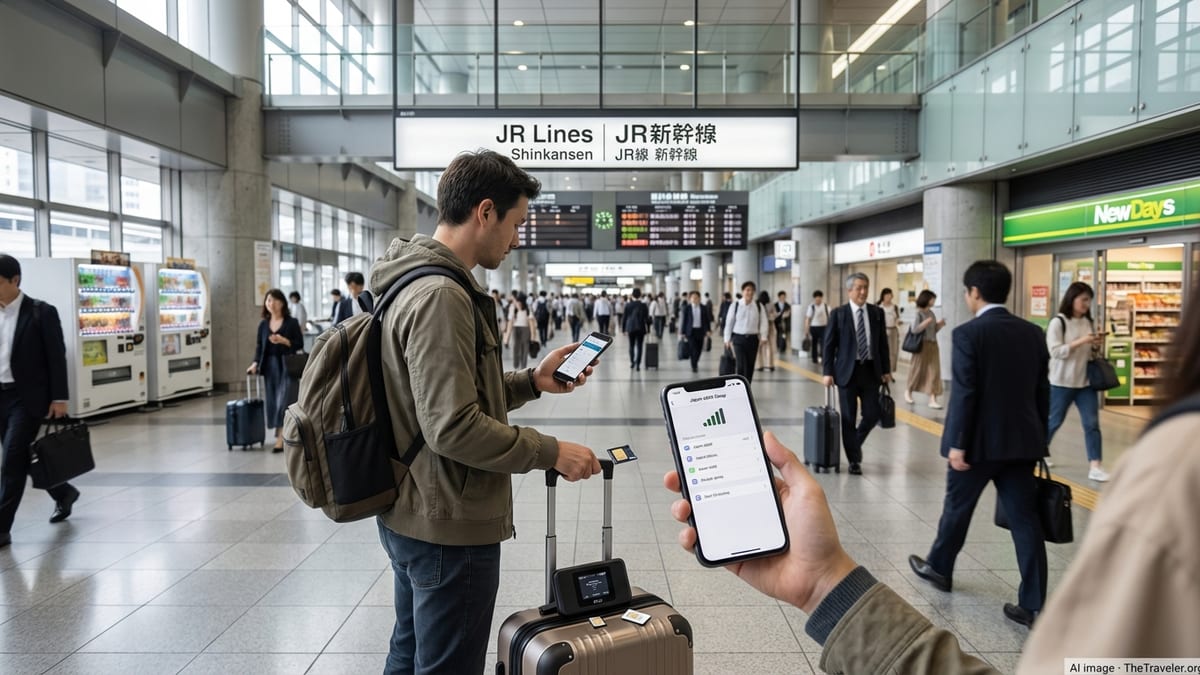
How Mobile Internet Works in Japan Today
Japan has one of the most advanced mobile networks in the world, with widespread 4G and extensive 5G coverage in cities and along major transport routes. The big three operators are NTT Docomo, KDDI au, and SoftBank, and most tourist-focused products are built on top of one of these networks. That means even if you buy a SIM or eSIM from a brand you have never heard of, your phone usually connects to a familiar Japanese carrier behind the scenes.
For visitors, the key point is that you do not need a long-term contract or a local address to get connected. Prepaid data SIM cards, short-term eSIMs and pocket WiFi rentals are all designed for travelers and can be purchased with a passport and a credit card. Long-stay residents and working holiday travelers will find more complex options, but for trips of a few days to a couple of months, dedicated travel products are usually cheaper and simpler than trying to open a full domestic line.
Public WiFi exists in train stations, some buses, convenience stores and many hotels, but coverage is patchy once you start moving between cities, exploring smaller towns or relying on navigation on trains. In practice, most visitors still need their own data connection for maps, translations, restaurant searches and digital tickets. The real decision is not whether to get mobile data, but which format suits your travel style.
When comparing options, look beyond headline phrases like “unlimited” or “5G.” Fair usage policies, hotspot rules, and how easily you can get support matter at least as much as peak download speeds. The strongest network on paper will not help you if the provider’s app is confusing or support is slow to respond when your connection fails on a busy travel day.
Choosing Between SIM Card, eSIM and Pocket WiFi
For most travelers, the choice comes down to three main formats: a physical SIM card, an eSIM that you activate by QR code or app, or a portable pocket WiFi router. All of them can deliver solid 4G or 5G data in Japan, so your decision is more about convenience, device compatibility and how many people need to share the connection.
Physical SIM cards remain popular for visitors with unlocked phones and a single main device. You remove your home SIM, insert the Japanese SIM and use it like normal mobile data. This is a good choice if you prefer something tangible, do not want to rely on an app, and are comfortable swapping SIM trays. It is also useful if your phone does not support eSIM, which is still the case for some budget Android models and older iPhones.
eSIM options have expanded rapidly and now cover most modern smartphones. With an eSIM, you buy a plan online, scan a QR code or follow in-app instructions, and the mobile profile downloads directly to your device. This avoids mailing delays and airport queues, and you can often install the eSIM before you leave home so your phone connects as soon as you land. For many visitors in 2026, a local Japanese eSIM or a reputable travel eSIM brand is the most convenient option.
Pocket WiFi is a small battery-powered router that you carry with you. It connects to the Japanese network and creates a private WiFi hotspot that several devices can share. This can be ideal for families, friends traveling together or digital nomads with laptops and tablets. The trade-offs are the need to keep track of one more device, charge it daily and return it at the end of your trip if it is a rental. Rental fees can be cost-effective for groups but overkill for a solo traveler who only needs basic data.
SIM Cards for Japan: What to Expect
Prepaid SIM cards for tourists are easy to find at major airports such as Narita, Haneda and Kansai, as well as in large electronics chains and many convenience stores. They are typically data-only, with calls handled via internet apps like WhatsApp or LINE rather than traditional voice minutes. Some specialist providers that work on the SoftBank or Docomo networks offer packages that include Japanese phone numbers and voice service, but these are less common and usually more expensive than data-only options.
Prices vary by brand and data allowance, but a short-stay visitor can expect to pay the equivalent of a few thousand yen for around a week of moderate to heavy usage. Longer-stay plans with large data bundles are available for two to four weeks at higher but still predictable flat rates. Many products are offered by mobile virtual network operators, or MVNOs, which resell access on the major networks. The upside is competitive pricing and plans tailored to tourists, while the trade-off can sometimes be slightly lower priority on busy towers compared to full carrier customers.
Buying on arrival is straightforward: you choose a plan, present your passport if requested, pay, and staff will often help you insert the SIM and confirm that data is working. If you prefer everything ready before departure, some companies ship Japanese SIM cards internationally or provide pickup at designated counters in the arrivals hall. Just be sure your phone is unlocked by your home carrier and supports the main Japanese 4G and 5G bands, otherwise your connection may fall back to slower or less reliable signals.
For many casual travelers, a physical SIM is still a simple, reliable solution. It gives you local speeds and coverage, works even if you have not updated your operating system recently, and can be tethered to a laptop via your phone’s hotspot function if your plan allows it. The main limitations are the need to remove your home SIM, which can disrupt two-factor authentication on banking apps, and the risk of misplacing a tiny plastic card while switching between countries.
eSIM in Japan: The Most Convenient Option for Many Travelers
eSIM has become one of the most popular ways to get online in Japan, particularly for travelers carrying newer iPhones or high-end Android phones. Instead of waiting in line at an airport counter, you can browse plans in advance, complete payment online and install the eSIM profile with a QR code or app. When your flight lands and you switch off airplane mode, your phone connects to a Japanese network within minutes, often without any additional steps.
A growing number of providers now target Japan specifically, offering short-term eSIM plans that use major networks like NTT Docomo, KDDI au or SoftBank. Some products are sold by Japanese companies that focus on inbound tourism, while others come from global eSIM platforms that partner with local carriers. Typical plans range from a few gigabytes for a short city break to large or unlimited data options for longer trips, with durations running from a handful of days up to about a month or more.
Pricing varies by brand and data allowance, but broad patterns have emerged. Light users who mainly rely on maps, messaging and occasional browsing can find relatively low-cost plans covering a week or more. Heavy users who stream video, make frequent video calls or work remotely may prefer more generous or unlimited data products, which cost more but avoid constant top-ups. In 2026, many Japanese and international eSIM providers offer high-speed 4G or 5G access with fair usage policies that may slow your connection after a certain threshold, so it is important to read the fine print before you buy.
Compatibility is the main constraint. You must confirm that your device supports eSIM and is not locked to a home carrier. iPhones from recent generations and many flagship Android phones are generally compatible, but some mid-range or older models are not. It is also wise to install the eSIM while you still have a stable connection at home, follow the provider’s instructions carefully, and take screenshots or notes in case you need to adjust settings when you arrive in Japan. When everything aligns, eSIM provides an almost seamless experience with no physical card to lose and no need to visit a store.
Pocket WiFi in Japan: When a Router Makes Sense
Pocket WiFi devices remain a trusted option for travelers who need to connect several gadgets or prefer to keep their own phone plan unchanged. These compact routers fit in a pocket or small bag, connecting to a Japanese carrier network and broadcasting a private WiFi signal that your phones, laptops, cameras and tablets can share. For families with teenagers, groups of friends or work trips where multiple people need laptops online, a single pocket WiFi rental is often more economical than buying separate SIMs or eSIMs for everyone.
Most pocket WiFi rentals for Japan are booked online before travel. You choose a data plan and rental period, then select how you will receive the device. Common options include pickup at airport counters in Tokyo or Osaka, hotel delivery, or home delivery in your country before departure. At the end of the rental, you usually return the device via a drop box at the airport or in a prepaid envelope. Providers compete on daily price, included data, battery life and customer support, with some emphasizing truly unlimited data and others using generous daily caps that reset every 24 hours.
The main benefit of pocket WiFi is flexibility. You can leave your home SIM in your phone, which keeps your usual number active for calls and security codes, while still enjoying Japanese data through WiFi. Devices that do not support eSIM or cannot accept a Japanese SIM, such as some work phones or WiFi-only tablets, can also connect. The trade-offs are practical: you must remember to charge and carry the router, keep track of its charging cable, and avoid misplacing the unit, as lost-device fees can be substantial.
For solo travelers who mainly use one phone and occasionally a laptop, a pocket WiFi rental is sometimes more than they need, especially on short trips. For group travel and data-heavy use such as streaming and frequent video calls, it can be one of the easiest ways to guarantee stable, fast connectivity without juggling multiple individual mobile plans.
Costs, Data Allowances and Fair Usage Policies
While exact prices change frequently, some broad trends can help you budget for internet in Japan. Short-stay eSIM and prepaid SIM plans of about three to seven days typically cost the equivalent of roughly two to four thousand yen for moderate data allowances, with lighter packages available for less and truly unlimited or heavy-use options priced higher. Longer trips of two weeks to a month open up more choices, from budget-friendly fixed data plans for light users to premium unlimited 5G products meant for streaming or remote work.
Pocket WiFi rentals are usually priced per day, with discounts for longer rental periods. For a couple or small group, the per-person cost can be attractive once several people share the same device. Some providers advertise “unlimited” data with a high-speed allowance that resets daily, while others use a total cap for the rental period. In both cases, very intensive use may trigger speed reductions for the rest of the day or trip, so it pays to understand any fair usage policy and avoid heavy downloading on days when you rely on real-time navigation or work.
When comparing offers, resist the temptation to focus only on raw gigabytes or the word “unlimited.” Consider whether hotspot use is allowed, which is especially important if you plan to tether a laptop to your phone instead of renting a router. Check whether the provider clearly explains what happens if you hit their fair usage threshold, and whether top-ups are easy to purchase if you underestimate your needs. Also pay attention to customer support channels and language availability, since the value of a cheap data plan disappears quickly if you lose connectivity and cannot get timely help.
In general, Japan’s major carrier networks deliver strong performance, so the differences you experience will likely come from your provider’s policies and support rather than the underlying towers. Choosing a product that balances cost with transparency and practical features will usually matter more than chasing a marginally lower price per gigabyte.
Practical Setup Tips and On-the-Ground Realities
Regardless of whether you choose SIM, eSIM or pocket WiFi, a bit of preparation before you travel can prevent frustration when you land. First, confirm that your phone is unlocked and supports the necessary bands for Japanese 4G and 5G networks. You can usually verify this with your home carrier or by checking your device settings. If your device is locked to a domestic provider, request an unlock well in advance, as some carriers require processing time.
For eSIM users, install the profile and confirm that it appears in your mobile data settings before your trip. Most providers recommend activating the eSIM just before you depart or immediately on arrival, following their instructions step by step. It is helpful to save any setup guides or QR codes offline, take screenshots of confirmation emails and note your plan’s expiry date and data allowance. If something goes wrong at the airport, having all information on hand speeds up troubleshooting.
Physical SIM users should bring a SIM ejector tool or a small paperclip, along with a safe way to store their home SIM, such as a labeled envelope or a spare slot in a travel wallet. After inserting the Japanese SIM, check that data roaming is enabled if required, and that access point name settings match the instructions from your provider. It is wise to open a map app and a browser while still in the arrivals hall, where you can often find staff or information counters if the connection does not work immediately.
Pocket WiFi renters should test the device as soon as they receive it. Turn it on, connect a phone via WiFi using the network name and password printed on the device or its case, and confirm that you can load basic web pages. Get into the habit of charging the router overnight along with your phone, especially on long sightseeing days or day trips where you will be relying heavily on mobile data.
Staying Secure and Avoiding Common Pitfalls
Although Japan is widely perceived as safe, the usual rules for digital security still apply. Whenever possible, avoid logging into sensitive accounts such as online banking while on open public WiFi in stations or cafes. Using your own SIM, eSIM or pocket WiFi connection is inherently safer because it reduces the risk of someone intercepting your traffic on a shared network. If you must use public WiFi, consider enabling a trusted virtual private network service for an additional layer of protection.
Be cautious of extremely low-cost or poorly explained data offers, especially from unfamiliar brands that appear through online ads or social media. Reputable providers are transparent about the networks they use, the duration and data allowance of each plan and any fair usage policies or speed restrictions. If a deal sounds much cheaper than everything else on the market, check independent reviews and recent user experiences rather than relying on marketing claims alone.
Another common issue arises when travelers underestimate their data needs. Modern apps, cloud photo backups and streaming services consume more data than many people expect. To avoid running out of data mid-trip, turn off automatic video autoplay in social apps, disable automatic cloud backups while on mobile data, and download offline maps for your key destinations in advance. If you know you will be working remotely or streaming frequently, choose a higher allowance or an unlimited plan from the outset rather than relying on repeated top-ups.
Finally, keep an eye on your device’s battery life. Constant mobile data use, hotspot sharing and navigation can drain your phone faster than usual. Carrying a power bank and charging cables is almost as important as choosing the right data plan. For pocket WiFi users, remember that when the router battery dies, so does connectivity for everyone relying on it, so plan to recharge during meals or transit whenever you can.
The Takeaway
There is no single best way for every visitor to get online in Japan, but there is almost certainly a best option for your particular trip. Short city breaks with a single modern smartphone are often easiest with a travel-focused eSIM installed before departure, while longer stays or travelers with older phones may find a physical SIM more reassuring. Groups, families and digital nomads who travel with multiple devices often get the most value from a pocket WiFi rental that keeps laptops and tablets connected all day.
Whichever solution you choose, plan ahead. Confirm your phone’s compatibility, understand how much data you realistically need and read the provider’s terms carefully, especially around fair usage, hotspot rules and support. Japan’s underlying mobile networks are robust, so with a bit of preparation you can expect fast, reliable coverage across major cities and popular sightseeing regions.
With the practical side of connectivity sorted, you can focus on the real reason you are in Japan: exploring neighborhoods, discovering regional food and navigating trains with confidence. A solid internet connection will quietly support all of that, turning language barriers and unfamiliar transport systems into manageable details rather than major obstacles.
FAQ
Q1. Do I really need mobile internet in Japan or is public WiFi enough?
Public WiFi in Japan has improved, but coverage is inconsistent once you start moving between stations, neighborhoods and smaller towns. For reliable maps, translations and ticket apps, most travelers find that having their own SIM, eSIM or pocket WiFi makes the trip smoother and less stressful.
Q2. What is the main difference between a SIM card and an eSIM in Japan?
A physical SIM is a small card you insert into your phone, while an eSIM is a digital profile you download and activate through settings or an app. In practice, both can give you similar speeds and coverage in Japan, but eSIM avoids dealing with tiny cards and can usually be set up before you fly.
Q3. How can I check if my phone works with Japanese eSIMs?
First, confirm that your phone supports eSIM, usually listed in the device specifications or settings. Then confirm it is unlocked by your home carrier and supports the main Japanese 4G and 5G bands. If you are unsure, ask your carrier or check your manufacturer’s support pages before you buy any plan.
Q4. Is pocket WiFi cheaper than buying individual SIMs for everyone?
For solo travelers, a SIM or eSIM is often cheaper and simpler. For families or groups who all want to be online, one pocket WiFi rental that several devices share can reduce the per-person cost and simplify setup, especially on longer trips where a daily rental rate divided by several people becomes attractive.
Q5. Can I keep my home number active while using Japanese data?
Yes, if your phone supports dual SIM or eSIM, you can usually keep your home number active for calls and texts while using a Japanese SIM or eSIM for data. Alternatively, you can leave your home SIM in the phone and connect through a pocket WiFi router so that your usual number continues to work as normal.
Q6. What happens if I use all my data during the trip?
What happens depends on the provider and plan. Some will slow your connection but keep it usable for basic messaging, while others cut off data until you buy a top-up. Before purchasing, check how easy it is to add more data and whether you can manage your plan through an app or website while traveling.
Q7. Are “unlimited” plans in Japan truly unlimited?
Many so-called unlimited plans in Japan have fair usage policies. They allow high-speed data up to a certain amount per day or trip, then reduce your speed for the rest of the period. This is usually fine for messaging and maps but can make streaming or large downloads frustrating. Always read the details before you rely on an unlimited offer for heavy use.
Q8. Is it better to buy a SIM or eSIM at the airport or online in advance?
Buying at the airport can be convenient if you prefer in-person help, but lines can be long and choices limited. Purchasing online in advance, especially for eSIM, lets you compare more providers, read recent reviews and have everything ready when you land. The best option depends on your comfort with technology and how much time you want to spend at the airport.
Q9. Will my Japanese SIM or eSIM work in other Asian countries?
Most Japan-specific plans only work within Japan. Some international eSIM providers sell regional Asia plans that cover multiple countries, but these are separate products and usually priced differently. If you are visiting several countries on one trip, look specifically for regional or multi-country plans rather than assuming a Japan plan will roam elsewhere.
Q10. What should I do if my connection does not work when I arrive?
First, restart your phone or pocket WiFi and double-check basic settings like mobile data and access point names. If the problem persists, consult the setup guide from your provider and contact their support using any available WiFi at the airport. Having your order details, screenshots and confirmation emails saved offline will make it much easier for them to diagnose and fix the issue.