

More news on this day
For two decades, Dubai sold the world a compelling promise: that visitors could bask in Middle Eastern glamour without the region’s trademark volatility. After a wave of Iranian drone and missile attacks that briefly closed its airports, singed skyscrapers and sent tourists scrambling for evacuation flights, that core promise is suddenly in doubt.
Get the latest news straight to your inbox!
From Fortress Hub to Frontline Target
Since late February 2026, Iran’s response to coordinated United States and Israeli strikes has turned the United Arab Emirates from distant spectator into direct target. Emirati officials say waves of ballistic missiles and hundreds of Shahed drones have been launched at strategic facilities across the country, including Dubai’s ports, industrial zones and air bases. Air defense batteries have intercepted most of the incoming fire, but not all. Fires at oil storage facilities and industrial plants, including in Abu Dhabi’s Ruwais complex, have underlined how quickly the conflict has leapt across borders.
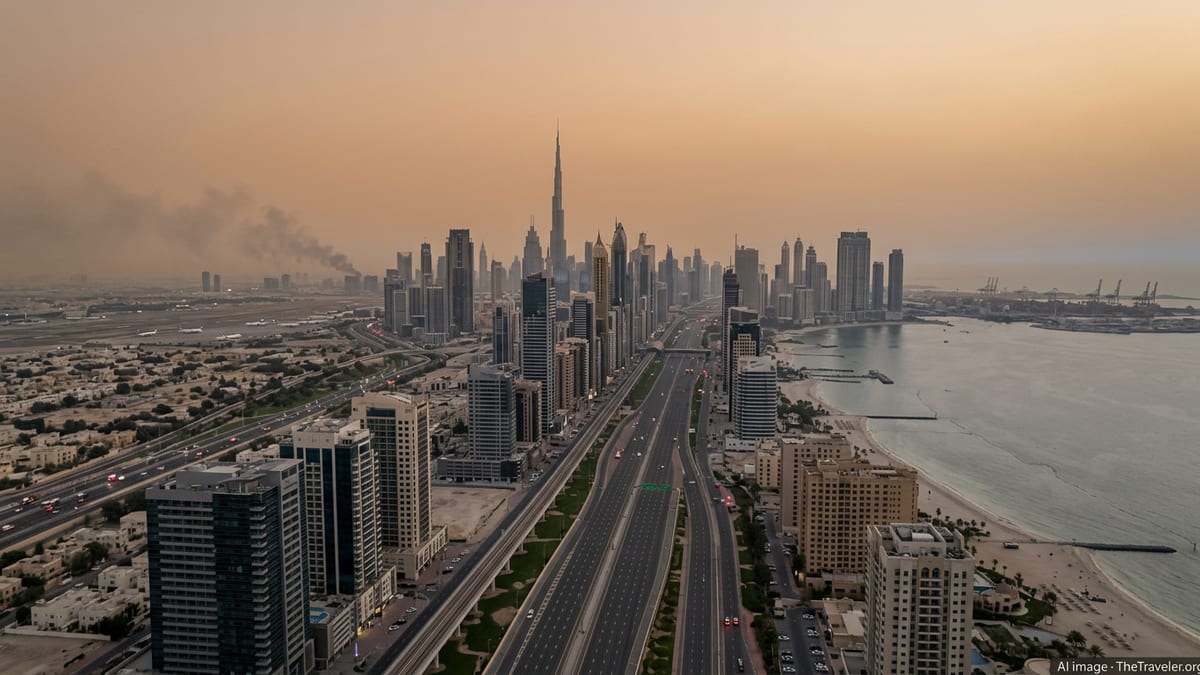
Dubai, long marketed as an island of calm within a turbulent neighborhood, has felt the new reality acutely. Satellite images and eyewitness accounts describe damage to hangars at Jebel Ali port, facades scarred by falling shrapnel in the Dubai Marina, and a drone crash at or near Dubai International Airport. The images contrast sharply with the city’s usual marketing visuals of pristine skylines and choreographed fireworks, reinforcing a message many residents once thought implausible: that the emirate is now within a very real theatre of war.
The strikes have not approached the scale of destruction seen in conflicts elsewhere in the region, but their symbolic impact is profound. For years, Dubai parlayed a reputation for technocratic efficiency and tight security into a role as the Middle East’s de facto neutral ground, a place where rivals could quietly transact even as tensions flared around them. With Iranian drones now crossing its skies, that carefully cultivated neutrality looks more fragile than ever.
Officials in Abu Dhabi and Dubai insist that the country remains committed to de-escalation and regional dialogue, but the message from Tehran has been unambiguous: the UAE is no longer off limits. Analysts warn that even if the current cycle of strikes is contained, the psychological line has been crossed, with implications that will reverberate through tourism, aviation and investment flows for years.
Airports Under Fire and the Shock to Global Travel
The most jarring blow to Dubai’s image as a safe, frictionless transit hub came on March 7, when Dubai International Airport suspended operations after air defenses intercepted missiles and drones in the vicinity of the terminals. Plumes of smoke rising near runways, bewildered passengers sheltering in concourses and viral clips of sirens echoing through departure halls shredded the notion that this was a conflict that travelers could watch from a comfortable distance.
In the days that followed, further incidents compounded the anxiety. Drone debris reportedly damaged parts of the airport and nearby buildings, while a separate incident saw falling shrapnel crack glass on a Dubai Marina tower. Although the overwhelming majority of threats were intercepted before impact, international carriers briefly halted or cut back services, and some foreign governments advised citizens to reconsider non-essential travel to the UAE. For a city that handled more than 90 million passengers last year and has built its entire economic model around seamless global connectivity, the optics were devastating.
Local airlines have since worked aggressively to restore schedules, with Emirates and flydubai resuming a reduced but steadily growing roster of flights. Travel agents in Europe and Asia report that Dubai holidays are still selling, albeit with more last-minute bookings and pointed questions about missile defenses and shelter protocols. Industry analysts say that while the physical damage to airport infrastructure appears contained and operations are normalizing, it will take much longer to repair the psychological damage to Dubai’s brand as the region’s most reliable transfer point.
For now, the city is leaning on its formidable crisis-management machine. Hotels have rolled out flexible cancellation policies, malls and attractions have increased visible security, and official social media accounts emphasize images of crowded beaches and busy terminals. Yet every new interception near the airport, every fresh plume of smoke visible from the Burj Khalifa’s observation deck, risks undoing that messaging in real time.
Tourism Wonderland Meets Wartime Reality
Tourism, which generates roughly 30 billion dollars annually for Dubai, is at the heart of the current shock. In recent years the emirate has positioned itself as a year-round leisure and events powerhouse, mixing mega-malls and beach clubs with global expos, football tournaments and luxury cruise terminals. That strategy rested on one critical assumption: that Dubai would remain insulated from the chaos that periodically engulfs parts of the Middle East.
The Iranian strikes have pierced that assumption. Tourists have described nights punctuated by distant booms and social media alerts, mornings spent refreshing airline apps or embassy advisories. Some have cut trips short, joining repatriation flights organized by European and Asian governments. Others have chosen to ride out the tension in resort enclaves, noting that daily life in many neighborhoods continues with remarkable normalcy. The contrast is stark: beach loungers and brunch buffets on one side of town, emergency crews responding to fires at industrial sites on the other.
Travel advisories now paint a far more complex picture of Dubai than the one featured in glossy campaigns. While most Western governments stop short of labeling the city an active war zone, they warn of a heightened risk of drone and missile strikes, particularly near airports, ports and foreign military facilities. Insurers are recalibrating coverage, and some corporate travel managers have temporarily frozen non-essential trips, redirecting conferences and meetings to alternative hubs such as Doha and Istanbul.
Yet Dubai’s tourism machine has not ground to a halt. Industry data and on-the-ground reporting suggest that while occupancy has dipped, hotels remain far from empty. Visitors from countries more accustomed to regional volatility are continuing to arrive, and some long-term residents say they are determined not to abandon the city they now call home. In the short term, however, the “Dubai dream” looks less like an escape from the region’s politics and more like a test of how much risk travelers are willing to tolerate for sunshine, shopping and spectacle.
Investors Weigh Resilience Against New Risk
For investors, the strikes have raised a harder-edged question: is Dubai still the safest place in the Middle East to park capital, or has the risk premium permanently shifted? In 2025 the emirate notched record real estate transactions, cementing its status as a magnet for global wealth seeking both returns and refuge. Even as war clouds gathered over the region in early 2026, property brokers spoke of surging interest from Russians, Europeans and high-net-worth individuals from the wider Middle East.
Those flows are now being re-evaluated against a different backdrop. Commercial landlords have quietly begun asking about hardened data centers, sheltered parking and business-continuity plans in the event of prolonged airspace disruption. Family offices and asset managers are factoring in the possibility that critical infrastructure, from ports to cloud facilities, could be targeted again, following reported Iranian strikes on data centers in the UAE and Bahrain. Some regional investors, however, argue that every major Gulf city now faces similar exposure, making Dubai’s relative advantages in governance and services more important than ever.
Market signals so far suggest caution rather than panic. There has been volatility in local equities tied to aviation, hospitality and logistics, but no systemic run for the exits. Developers continue to market off-plan projects, and government officials have highlighted the country’s high global rankings on safety indices, pointing to the effectiveness of air defenses that intercepted the vast majority of incoming threats. The question is less whether Dubai survives this crisis than how much additional risk premium investors will demand to keep betting on its story.
In private, some financiers concede that the aura of invulnerability around Dubai has been punctured. The city may remain, in relative terms, one of the safest environments in a dangerous neighborhood, but the notion that it could float indefinitely above the politics of the Gulf has been decisively challenged. For a place that has built its fortune on mastering perception as much as reality, that shift could prove just as consequential as any physical damage from the drones themselves.
Can Dubai Rebuild Its Security Brand?
As the immediate barrage of attacks appears to slow and diplomatic efforts intensify, the UAE is already moving to reframe the narrative. Senior officials have briefed international media on the country’s multi-layered missile defense systems, close coordination with Western allies and rapid-repair capabilities. State-linked outlets showcase images of reopened terminals, cleared highways and families strolling through waterfront districts, positioning the strikes as a harsh but manageable stress test of a robust security architecture.
Rebuilding Dubai’s brand as the Middle East’s most secure destination will, however, require more than slick messaging. Tourism and aviation executives say they are preparing for a world in which travelers scrutinize air-defense coverage maps alongside hotel pools and restaurant guides. Airlines may need to invest further in hardened infrastructure and crisis communication, while hotels could find that proximity to military or diplomatic sites is no longer a selling point but a concern.
Ultimately, the city’s biggest asset may be the same one that powered its rise: an ability to adapt at speed. If Dubai can demonstrate that airports and ports can resume operations quickly after strikes, that insurance and evacuation frameworks work, and that life in the city retains its day-to-day normalcy despite elevated geopolitical risk, it may persuade visitors and investors that stability here is relative but still superior to alternatives.
Yet a boundary has been crossed. Iran’s drones have not only tested air-defense systems; they have tested the belief that Dubai exists outside the conflicts that have long defined the region. Whether the emirate can turn this moment into a story of resilience instead of vulnerability will determine if it remains, in the eyes of the world, the Middle East’s safest bet or just another glittering city learning to live under siege.