

More news on this day
The expanding Iran war is rapidly reshaping global travel, as the United Arab Emirates joins Iraq, Qatar, Saudi Arabia, Kuwait and other Gulf states in restricting or closing airspace, sparking mass flight cancellations, soaring airfares and a cascade of disrupted holiday and business plans from Europe to Asia.
Get the latest news straight to your inbox!
Gulf Airspace Closures Ripple Across Global Flight Networks
Since the Iran war escalated at the end of February 2026, large swathes of Middle East airspace have either closed or become heavily restricted, forcing airlines to tear up schedules and improvise new routings. Publicly available flight-tracking data and aviation notices indicate that Iran’s skies are largely empty of civilian traffic, while Bahrain, Iraq, Kuwait, Qatar, Syria, Israel and the United Arab Emirates have all imposed sweeping bans or severe limits on overflights and commercial operations.
In the Gulf, the shift by the UAE from acting as a key diversion hub to implementing its own tight controls has marked a turning point. Earlier in the crisis, some regional airlines attempted to maintain truncated networks by skirting Iranian and Iraqi airspace. As the conflict broadened and missile and drone strikes hit near critical hubs, however, safety-driven restrictions spread quickly, removing multiple corridors that connect Europe and Asia.
The result is a cascading disruption that goes well beyond the Middle East. Long-haul services linking North America and Europe to South and Southeast Asia are being rerouted thousands of kilometers south or north, significantly lengthening flight times. Carriers that once relied on routine overflights of Iran, Iraq and the wider Gulf now face a shrinking map of viable routes, creating bottlenecks in already congested alternative airspace over Turkey, Egypt and parts of Central Asia.
UAE Hubs Hit as Dubai and Abu Dhabi Scale Back Operations
The UAE, long marketed as one of the world’s most reliable aviation crossroads, is now experiencing some of the deepest operational shocks in its history. Published coverage on the regional economic fallout describes Dubai International Airport and Abu Dhabi facing intermittent shutdowns and damage to supporting infrastructure after missile and drone incidents, forcing operators to suspend or drastically cut passenger services for safety and repair works.
Emirates and Etihad, the country’s flagship carriers, have responded by grounding large portions of their fleets, cancelling or consolidating flights and, in some cases, shifting limited operations to secondary airports. Industry analyses suggest that airlines based in the UAE are currently running at less than half of their pre-war capacity, a drop that has erased much of the post-pandemic tourism and transit rebound.
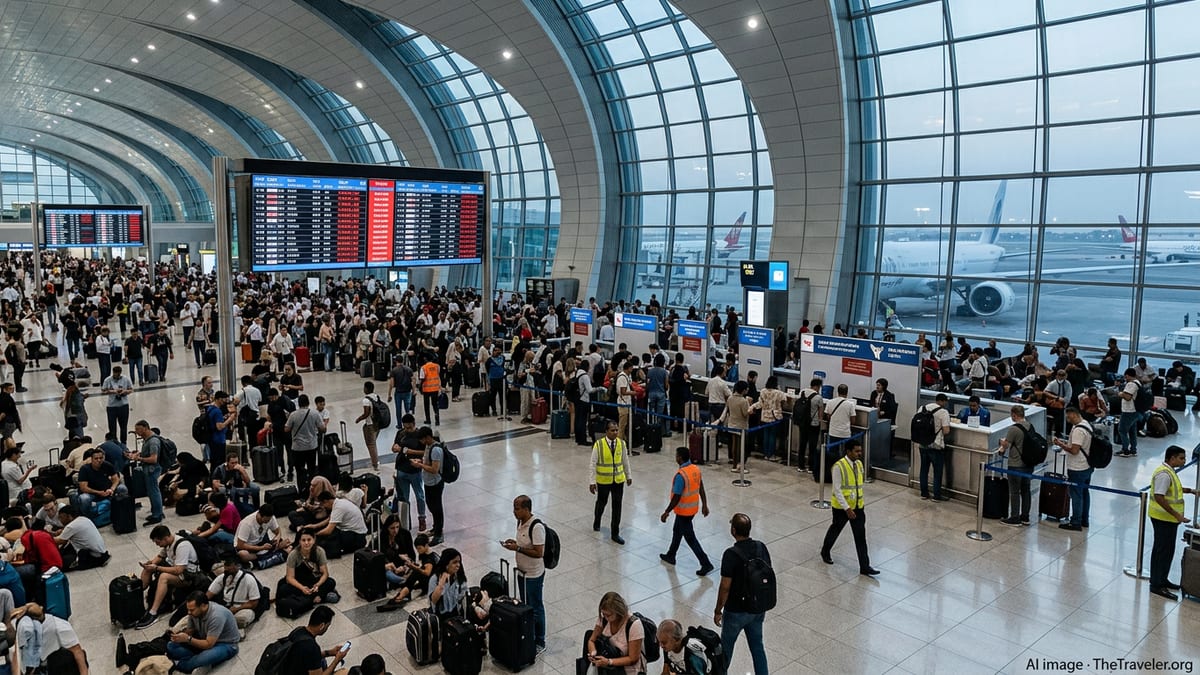
For travelers transiting the UAE, the disruption is immediate and highly visible. Terminals that normally process hundreds of departures a day are filled instead with stranded passengers, rolling delay announcements and improvised rebooking desks. Reports from travel management firms indicate that corporate clients with critical travel needs are increasingly diverting itineraries away from Gulf hubs altogether, even when alternative routings are longer and more expensive.
The image of the UAE as a secure and predictable stopover has been shaken, at least in the short term. While aviation authorities emphasize that restrictions are framed around safety and technical assessments, the cumulative effect is that Dubai and Abu Dhabi are no longer functioning as the seamless bridges between continents that many leisure and business travelers took for granted.
Skyrocketing Airfares and a Shrinking Supply of Seats
As capacity has collapsed across the Gulf, the basic economics of supply and demand have pushed airfares sharply higher on many routes. With airspace closures cutting off direct corridors and forcing detours, airlines are burning more fuel, deploying additional crew and tying up aircraft for longer rotations. Analysts tracking booking data and fare trends report steep price jumps on flights between Europe and South Asia, as well as between Asia and North America, where travelers are competing for a reduced pool of seats that avoid the conflict zone.
Published economic assessments of the war’s impact suggest that aviation and tourism are among the sectors suffering the most immediate financial pain. Billions of dollars in revenue are at risk as airlines in Qatar, the UAE, Kuwait and Saudi Arabia slash schedules, while foreign carriers from Europe, Asia and North America trim or suspend services to Gulf destinations due to operational and insurance constraints.
Travel agents and online booking platforms are seeing pronounced volatility. Fares that appear affordable one day can spike the next as carriers revise schedules or pull inventory altogether. Some passengers are reporting that rerouted journeys now involve two or three connections instead of one, often via secondary hubs in Southern Europe, North Africa or Central Asia, adding extra hotel nights and transit visas to already expensive trips.
For budget-conscious travelers and migrant workers who depend on competitively priced Gulf connections, the squeeze is particularly acute. Many are postponing trips, turning to bus and rail options where borders allow, or waiting in the hope that limited capacity will gradually return as risk assessments evolve.
Holiday Plans Upended from Europe to Asia
The timing of the Iran war and the subsequent airspace shutdowns has collided with peak booking windows for spring and early summer holidays, amplifying the human impact of the disruption. Tourists with long-planned itineraries to Dubai, Doha or Riyadh are finding their trips cancelled outright, while those using Gulf hubs merely as stopovers en route to destinations such as Thailand, the Maldives or Indonesia are being forced to rethink entire routes.
Travel advisories issued by multiple governments now caution against non-essential trips to parts of the Middle East and warn of significant delays for any journeys transiting the region. Tour operators that built packages around Gulf stopovers and multi-city itineraries are hurriedly reconfiguring products, in some cases dropping Middle East components entirely and shifting capacity to Mediterranean, Indian Ocean or East Asian destinations.
Families and independent travelers caught mid-journey are facing especially difficult choices. Publicly shared accounts describe passengers stranded in temporary accommodation near Gulf airports, juggling rapidly changing rebooking options while also navigating visa limits and insurance rules that may exclude war-related disruption. The uncertainty has led many would-be holidaymakers to delay firm travel commitments, skewing demand toward destinations perceived as more stable.
This shift is already visible in booking data cited by industry analysts, with increased interest in routes that connect via Istanbul, European hubs, or hubs in South and East Asia rather than the traditional Gulf gateways. The long-term implications for regional tourism strategies in the UAE, Qatar and Saudi Arabia remain unclear, but the short-term hit to visitor numbers is widely expected to be severe.
Advice for Travelers Navigating the Turbulence
For those who still need to travel through or near the affected region, publicly available guidance from airlines, airports and travel risk consultancies converges on a few practical steps. Passengers are urged to monitor their booking status closely, use airline apps and official communication channels rather than relying solely on third-party platforms, and avoid heading to airports without confirmed departure times, as terminals in key hubs remain congested.
Many carriers are offering flexible rebooking, travel credits or, in some cases, refunds when flights are cancelled due to airspace closures or security assessments. However, policies can differ widely between airlines and ticket types, so travelers are being advised to check fare rules carefully and to document all communications. Travel insurance providers are also updating policy language, and some products exclude disruptions linked to declared wars or known conflicts.
Experts in corporate travel management note that companies with staff in or near the Gulf are increasingly turning to specialized tracking and assistance services, rerouting employees via alternative hubs and reviewing contingency plans. Individual travelers are encouraged to register with their national consular services where available, keep copies of key documents offline and maintain flexibility around dates and routing.
With no clear timeline for a comprehensive reopening of Gulf airspace, the expectation across the industry is that elevated fares, longer journeys and periodic waves of cancellations will remain part of the travel landscape for the foreseeable future. For now, the once-routine act of connecting through the UAE, Qatar, Saudi Arabia or Kuwait has become a high-stakes calculation shaped by shifting frontlines and rapidly changing aviation risk assessments.