

More news on this day
Passengers across multiple continents are facing cascading cancellations, diversions and marathon journeys as the Iran war forces airlines to abandon key Middle East corridors and improvise new paths between Europe, Asia and Africa.
Get the latest news straight to your inbox!
Airspace Closures Turn a Regional War into a Global Travel Crisis
What began as a regional security emergency has rapidly evolved into one of the most disruptive shocks to international aviation since the pandemic. Following joint strikes on Iran at the end of February 2026, publicly available flight data and advisories indicate that Iran, Iraq, Israel and several Gulf states sharply restricted or closed their airspace, cutting off some of the world’s busiest crossroad skies.
Coverage from international outlets and aviation trackers shows that Bahrain, Qatar, Kuwait and the United Arab Emirates all introduced varying degrees of restrictions or suspensions at different points in early March. In some cases, only emergency, evacuation or cargo flights have been permitted, while regular commercial operations remain largely frozen. These overlapping no-fly zones effectively slice through the main trunk routes that normally link Europe with South and Southeast Asia, Australia and East Africa.
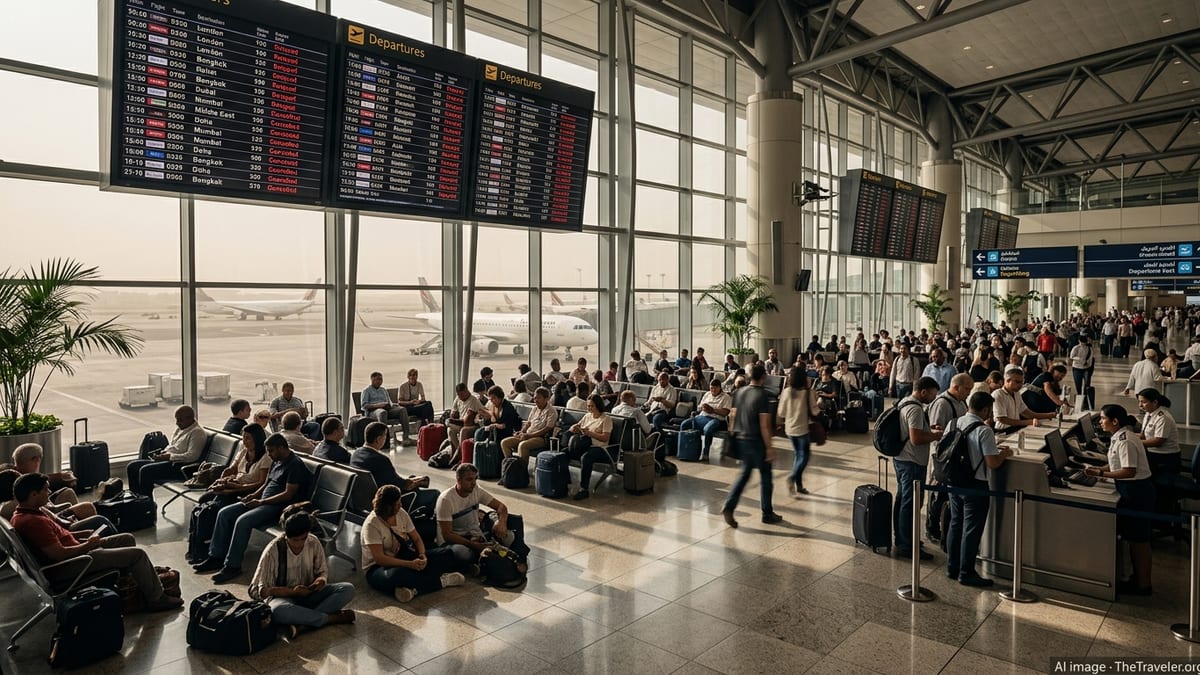
Analysts tracking the crisis report tens of thousands of flights cancelled or rerouted since the war began, with one widely cited market briefing estimating that cumulative cancellations have already surpassed the worst individual weeks of the post-pandemic recovery. For travelers, the impact is immediate and highly visible: departures boards filled with red “cancelled” notices from Dubai to Doha, and multi-leg rebookings that now zigzag via secondary hubs in Europe, Africa or Central Asia.
Industry assessments suggest the disruption will not be fleeting. With missile and drone activity documented across several active fronts, many carriers are treating the entire central Middle East as a dynamic risk zone. Even if some airspace corridors reopen on paper, the combination of safety protocols and insurance constraints means mainstream passenger traffic may be slow to return.
Key Hubs in the Gulf and Levant Fall Silent
The Iran war has struck at the heart of the global hub-and-spoke system that has defined long-haul travel over the past two decades. Published situation reports and travel advisories describe Dubai International, Abu Dhabi, Doha and other regional airports operating at a fraction of their normal capacity, or temporarily suspending passenger movements altogether during peak alert periods.
Dubai International, which before the conflict ranked among the world’s top international hubs by passenger volume, has faced intermittent suspensions, terminal evacuations and a wave of onward cancellations after reported incidents linked to the wider conflict. Similar scenes have been reported in Abu Dhabi and Doha, where restrictions on air navigation and security measures have narrowed operations to essential or emergency services.
Elsewhere in the region, airports in Saudi Arabia, Iraq, Israel and Kuwait have also experienced rolling disruptions, ranging from sharply reduced schedules to full closures at short notice. Business travelers connecting through Riyadh or Jeddah, as well as religious pilgrims and migrant workers moving between South Asia and the Gulf, have seen their journeys upended with little warning.
These interruptions are particularly significant because Gulf and Levant hubs handled a substantial share of global connecting traffic even for passengers with no final destination in the Middle East. For many routes between Europe and India, Southeast Asia, or Australasia, itineraries that once involved a smooth two-hour connection in Dubai or Doha are currently unavailable, forcing airlines and travelers to rethink the very geometry of intercontinental travel.
Longer Routes, Higher Fares and a Fresh Fuel Shock
With much of the traditional east–west corridor effectively carved out of the map, carriers are turning to longer, less direct routings that skirt conflict zones via Central Asia, North Africa or more southerly Indian Ocean tracks. Flight-aware mapping and airline schedules show services between Europe and Asia arcing farther north over Turkey, the Caucasus and parts of Central Asia, or detouring south via the Red Sea and East Africa where viable.
These diversions add substantial time and cost. Aviation analysts note that some long-haul journeys now include an extra hour or more of flying, compounded by congestion at alternative hubs not designed to handle such volumes of transfer traffic. For passengers, that often means an additional refuelling stop, missed onward connections and arrival times slipping from morning into late night.
The timing of the crisis has magnified the financial strain. Economic coverage of the conflict highlights a sharp jump in global oil benchmarks since late February, with jet fuel prices climbing even faster as refiners and logistics chains struggle to adapt. Airlines already operating on thin margins now face a double hit: longer sectors that burn more fuel and higher per-barrel costs for every kilometer traveled.
Regional examples underscore the trend. Greek media recently reported that Aegean Airlines plans modest fare increases and extended suspensions on several Middle East routes, citing higher fuel costs and regional uncertainty. Other carriers across Europe, Asia and Africa are publicly flagging similar pressures, warning that fares on many long-haul routes are likely to rise and that capacity cuts to the wider Middle East could persist for months.
Stranded Passengers Confront Uncertainty and Patchwork Support
For travelers on the ground, the crisis is playing out in crowded terminals, long queues at service desks and hours spent refreshing airline apps. Online travel forums and social media feeds are filled with accounts of passengers stranded in Gulf hubs, often with little clarity on when flights might resume or rerouting options become available.
Reports from travel risk consultancies and corporate security briefings recommend that passengers check flight status directly with operating airlines, rather than relying on third-party booking platforms, and keep contact details up to date to receive last-minute schedule changes. Many carriers are allowing fee-free rebooking or refunds on itineraries touching affected countries, but the details vary widely by route and ticket type.
Travel insurers are also grappling with the scale of the disruption. Some policies explicitly exclude war-related events, while others provide limited cover for trip interruption or emergency accommodation when airspace closures make travel impossible. Consumer advocates urge travelers to read policy wording closely, document all expenses and, where practical, seek written confirmation from airlines regarding cancellations or involuntary rerouting.
In parallel, national foreign ministries in Europe, North America and Asia have updated advisories for the broader Middle East, often recommending against non-essential travel to a range of destinations. Publicly available guidance typically encourages citizens already in the region to maintain flexible plans, register with consular services where possible and build in extra time for any onward journey that may involve indirect routings.
How Airlines Are Rebuilding a Fragmented Route Map
Behind the scenes, network planners and operations teams are engaged in a complex exercise: rebuilding global schedules around a moving conflict zone. Aviation industry commentary points to a surge in requests for new or expanded use of alternative corridors through Turkish, Egyptian, Saudi and Central Asian airspace, where conditions currently allow for controlled overflight.
Some carriers are accelerating existing plans to develop secondary hubs away from the Gulf. European and Asian airlines are reportedly strengthening transfer banks at home bases or at partner airports in Southern Europe, North Africa and Central Asia, in an effort to capture passengers who once defaulted to a one-stop itinerary through Dubai, Doha or Abu Dhabi.
At the same time, the crisis is spotlighting advances in flight-planning technology. Recent academic work on airspace-aware contingency routing and industry tools used in operations centers are being tested in real-world conditions as airlines seek to minimize delays, avoid dynamic risk areas and manage scarce slots and crew resources. While these systems can optimize complex networks on a given day, they cannot fully offset the structural loss of a major air corridor.
For now, travelers booking intercontinental trips that once passed near Iran are being advised by travel management companies and airline notices to expect schedule volatility well into the northern summer season. The emerging consensus across publicly available analyses is clear: even if diplomacy eventually cools the front lines of the Iran war, the psychological and operational scars on global aviation networks will endure long after today’s passengers have finally reached their destinations.