

More news on this day
An Iranian missile and drone strike on Saudi Arabia’s Prince Sultan Air Base has destroyed a U.S. E-3 Sentry airborne warning and control system aircraft and damaged multiple U.S. Air Force refueling tankers, marking one of the most serious blows yet to American air operations in the ongoing Iran war.
Get the latest news straight to your inbox!
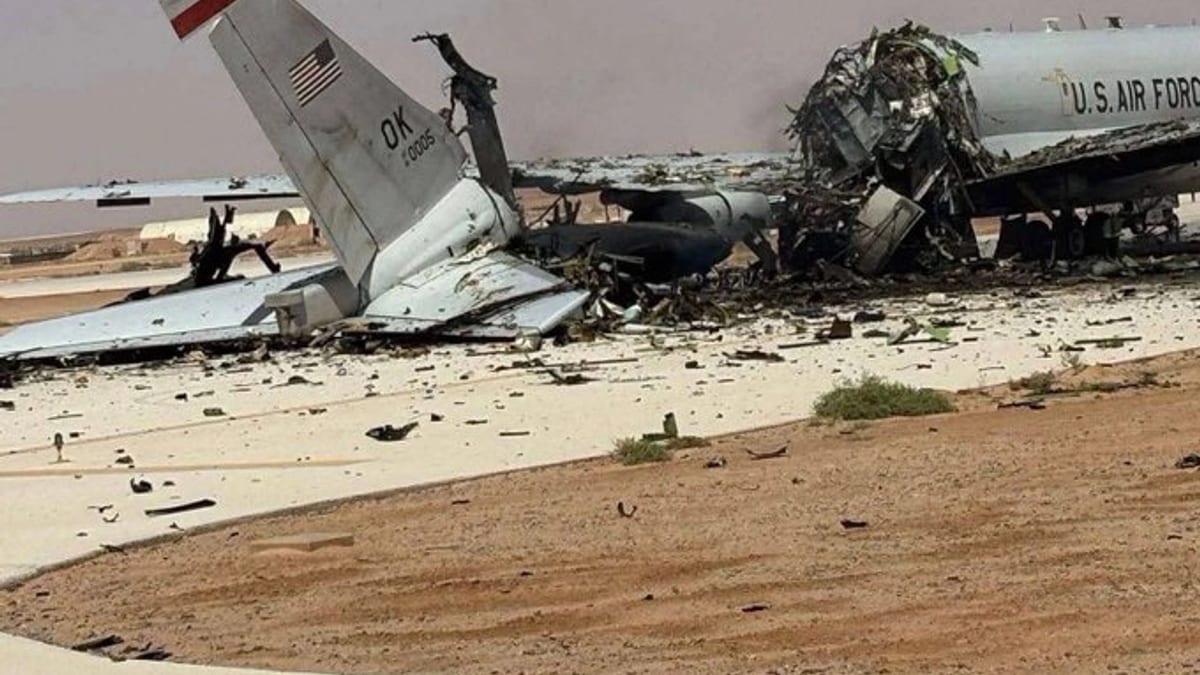
Image by Aviation News
Strike on Prince Sultan Air Base Targets High-Value Aircraft
Reports from regional and international media indicate that the latest Iranian attack on Prince Sultan Air Base, south of Riyadh, combined ballistic missiles with armed drones directed at preselected aircraft stands. Publicly available imagery and open-source defense analysis suggest that at least one E-3 Sentry AWACS, a critical command-and-control platform, suffered catastrophic damage on the ramp.
The same wave of strikes also hit a cluster of U.S. aerial refueling tankers. Earlier assessments had already pointed to serious damage to several KC-135 and related support aircraft at the base during previous strikes in March. Updated accounts now describe multiple tankers as destroyed or written off, with others undergoing repairs, significantly thinning the deployed tanker fleet in Saudi Arabia.
Prince Sultan Air Base has functioned as a major forward hub for U.S. air power in the region, supporting strike missions, surveillance flights, and airborne refueling for aircraft operating across the Gulf and into Iran. The concentration of high-value assets on exposed aprons, highlighted by satellite photographs shared in open sources, has drawn growing scrutiny from defense analysts who argue that hardened shelters and dispersal could have reduced the scale of the losses.
While casualty figures continue to evolve, recent published coverage notes that dozens of U.S. personnel have been injured at the base over successive attacks in late March, including several described as seriously wounded. Earlier in the month, at least one service member was reported to have died from injuries sustained in a separate Iranian strike on the same facility.
AWACS Loss Undermines Regional Surveillance Network
The destruction of a U.S. E-3 Sentry AWACS at Prince Sultan Air Base has strategic implications that extend beyond the immediate damage on the ground. The E-3 serves as an airborne command post, using a distinctive radar dome to track aircraft and missiles over vast distances and coordinate the movements of allied fighters, bombers, and defensive batteries. Losing even a single airframe reduces the flexibility and coverage of the U.S.-led air surveillance network that spans the Gulf region.
Defense commentators note that the U.S. and several partner nations have been operating limited numbers of AWACS and similar platforms to manage a high operational tempo since the conflict with Iran escalated in late February. With Iranian forces continuing to launch missiles and drones against targets in Saudi Arabia, Bahrain, and elsewhere, the ability to maintain near-continuous airborne radar coverage is considered central to protecting both military installations and critical energy infrastructure.
Publicly available information shows that the E-3 fleet as a whole is aging, with airframes often several decades old and requiring extensive maintenance. The loss of a fully equipped aircraft, along with its specialized onboard systems, cannot be easily or quickly offset. Analysts suggest that remaining AWACS assets may need to fly longer, more frequent missions from bases further afield, putting additional strain on crews and maintenance teams.
The strike has also prompted renewed discussion in defense circles about the vulnerability of large, slow, high-signature aircraft operating within reach of modern ballistic and cruise missiles. The Prince Sultan attack is now cited as a case study in how an adversary can use precise targeting data and salvo tactics to threaten key enablers of Western air power, rather than focusing solely on fighters or individual runways.
Tanker Damage Cuts Into U.S. Long-Range Reach
The reported destruction and damage of multiple U.S. refueling tankers at Prince Sultan Air Base is particularly significant for ongoing operations over Iran and the wider Middle East. Tanker aircraft extend the range and loiter time of fighters, bombers, and reconnaissance platforms, effectively multiplying the reach of each sortie. Without sufficient tanker support, aircraft may have to shorten missions, carry fewer weapons, or launch from closer but more politically sensitive locations.
According to published coverage in financial and defense outlets, an earlier Iranian strike had already damaged five U.S. Air Force refueling planes at the same base. The latest reports that some tankers have now been fully destroyed or rendered beyond economical repair deepen concerns about the resilience of the aerial refueling backbone in the theater. Even partial damage can sideline these aircraft for extended periods, given the complexity of their fuel systems and airframes.
Operationally, the cumulative impact of losing both tankers and an AWACS at the same location may force U.S. planners to rethink basing and sortie patterns. Aircraft may need to rely more heavily on bases in Europe, the eastern Mediterranean, or the Indian Ocean, increasing transit times to targets and patrol areas. In practical terms, this could reduce the number of daily missions that can be sustained over Iran, the Gulf, and critical shipping lanes.
Some defense analysts argue that the strikes highlight a long-discussed imbalance between investment in front-line combat aircraft and the protection of the enabling fleets that keep them flying. Hardened shelters, greater dispersal across multiple airfields, and more robust point-defense systems for high-value aircraft parking areas are being cited in open commentary as potential mitigation measures that were either insufficient or not fully implemented at Prince Sultan.
Regional Security and Energy Routes Under New Strain
The attack on Prince Sultan Air Base is part of a broader pattern of Iranian missile and drone strikes on military and energy targets across Saudi Arabia and the wider Gulf since late February. Other documented incidents during the conflict include hits on oil refineries on the Gulf coast and in the Red Sea region, as well as strikes on facilities in Bahrain and near key shipping chokepoints.
Publicly available information shows that Iran has framed its actions as retaliation for earlier U.S. and Israeli strikes on Iranian military and nuclear-related sites. In turn, U.S. forces have continued to target Iranian missile infrastructure, naval assets, and command nodes. The destruction of a major surveillance aircraft and multiple tankers on Saudi soil adds a new layer of risk to a conflict that already threatens global energy supplies and trade flows.
Energy analysts have warned that sustained attacks on Saudi bases and refineries could disrupt the kingdom’s exports at a time when alternative routes are constrained. While Saudi Arabia has sought to route more shipments via the Red Sea, the spread of strikes toward that area and toward ports in neighboring states suggests that no corridor can be considered entirely insulated from the fighting.
For travelers and the broader tourism and aviation sectors, the escalation at Prince Sultan underlines the fragility of airspace arrangements and overflight routes across the Middle East. Airlines have already adjusted flight paths to avoid high-risk areas, lengthening some routes between Europe, Asia, and Africa. The prospect of further strikes on high-profile military installations in Saudi Arabia may prompt additional rerouting, schedule changes, and insurance cost increases for carriers operating near the region.
Implications for U.S. Basing and Future Force Posture
The Iranian strike on Prince Sultan Air Base is likely to influence U.S. decisions about where and how to base forces in the Gulf in the months ahead. Publicly available commentary from former officials and independent experts suggests that the combination of concentrated high-value assets and evolving missile threats is becoming increasingly difficult to reconcile with existing base layouts.
Some analysts foresee a shift toward greater reliance on more distant but better protected hubs, complemented by rotational deployments and temporary forward operating locations instead of large, permanent concentrations of aircraft. Others point to the potential acceleration of investments in smaller, more survivable platforms, distributed sensing networks, and uncrewed surveillance aircraft that are harder to target than a handful of large AWACS.
The events at Prince Sultan also intersect with ongoing U.S. efforts to modernize its aerial refueling and airborne early-warning fleets. Plans to retire older tankers and E-3 airframes had already been in motion before the latest conflict. The confirmed loss of an AWACS and multiple tankers on the ground may sharpen debates in Washington over how quickly to field replacements, and whether those replacements should be based in exposed frontline locations or held further back.
For host nations such as Saudi Arabia, the strike reinforces the reality that partnering with external powers brings both security guarantees and heightened exposure. As the Iran war continues, regional governments are reassessing the balance between hosting foreign forces, investing in their own air and missile defenses, and pursuing diplomatic channels that might reduce the frequency and intensity of such high-profile attacks on their territory.