

Healthcare quality is a central consideration for any professional or retiree evaluating a move to Thailand. The country is known for having some of the strongest medical infrastructure in Southeast Asia, including internationally accredited private hospitals and a long-standing universal coverage policy for citizens. For foreign residents, however, access conditions, service standards, and financial exposure vary sharply between the public and private sectors. Understanding how each system works in practice is essential before relying on Thai healthcare for long-term living.
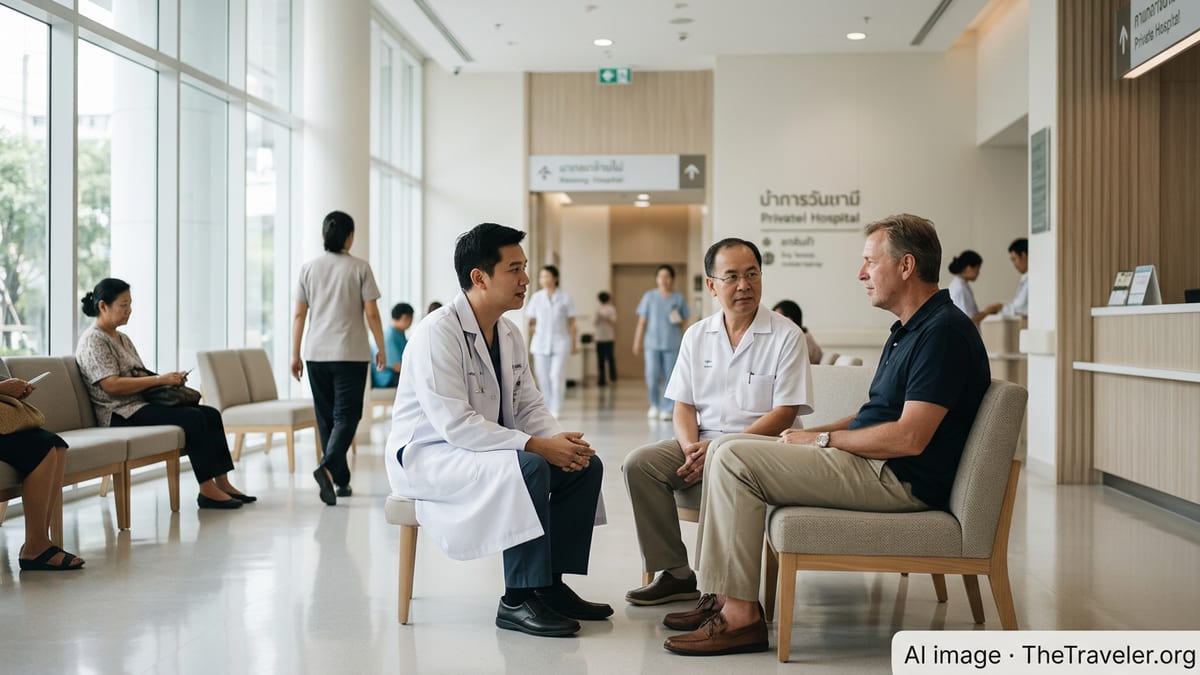
Structure of Thailand’s Healthcare System: Key Concepts for Expats
Thailand’s healthcare system is built on three main pillars: the Universal Coverage Scheme (UCS) for most Thai citizens, the Social Security Scheme (SSS) for formal-sector employees, and separate schemes for civil servants and the military. Together these policies underpin a universal health coverage model that has significantly expanded access to care over the past two decades.
The UCS, often referred to as the “30 baht scheme” or “gold card,” entitles registered Thai citizens to very low-cost or free treatment in designated public facilities. Co-payments have been reduced or abolished for many services, and recent reforms have focused on increasing flexibility so patients can more easily access care outside their originally assigned hospital network.([eng.nhso.go.th](https://eng.nhso.go.th/view/1/DescriptionNews/NHSO-to-expand-30-baht-get-treatment-anywhere-pilot-project-in-eight-provinces/601/EN-US?utm_source=openai))
For expats, the crucial point is that most of this universal cover is not automatically available. Foreign nationals generally only gain structured access to the public system when they work for a Thai employer and contribute to the Social Security Fund, which includes healthcare benefits. Self-employed expats, retirees, and dependants typically rely on the private sector, often backed by international health insurance.
In parallel, Thailand has a large and commercially significant private healthcare industry. Hundreds of private hospitals operate nationwide, with major corporate networks in Bangkok and key regional cities. The country hosts dozens of Joint Commission International (JCI) accredited hospitals and treats several million international patients per year, reflecting global recognition of its private medical standards.([dmcquote.com](https://dmcquote.com/guides/medical-tourism-thailand?utm_source=openai))
Public Healthcare in Thailand: Access, Quality, and Constraints
Thailand’s public healthcare network is extensive, including large tertiary hospitals in urban centers, provincial general hospitals, and smaller community facilities. Public hospitals handle the bulk of inpatient and emergency care nationally. Care is highly subsidized for citizens under the UCS and other schemes, which has driven major gains in health outcomes and financial protection.
Foreign residents can access public hospitals on a self-pay basis regardless of legal status, but foreigners without Thai social security contributions must typically pay full, though still relatively modest, state tariffs. When expats are formally employed and enrolled in the Social Security Scheme, they are assigned to a designated public or contracted private hospital for routine care, with coverage funded through mandatory payroll contributions.([oecd.org](https://www.oecd.org/en/publications/oecd-economic-surveys-thailand-2025_426b9bc0-en/full-report/tackling-informality_4d6a6d0f.html?utm_source=openai))
Service quality in public facilities is variable. Large teaching hospitals in Bangkok and provincial capitals often offer high technical standards, experienced clinicians, and access to specialist services. However, systemic constraints are significant: high patient volumes, staffing pressures, and limited consultation time. Non-urgent visits may involve waiting times of two to four hours or longer, especially in outpatient departments.([asialifestylemagazine.com](https://www.asialifestylemagazine.com/expat-health-insurance-asia-2026/?utm_source=openai))
For expats, the main drawbacks in the public system include crowding, more basic inpatient amenities, and limited English-language support outside major urban centers. Public hospitals prioritize cost-effective coverage for the population rather than personalized service. For long-term foreign residents comfortable with Thai language who prioritize low costs, the public system can be workable, particularly for chronic disease management. For most professionals and retirees seeking predictable comfort and short waits, it is better viewed as a backup for emergencies rather than a primary care route.
Private Healthcare: International Standards and Medical Tourism
Private healthcare is where Thailand’s global reputation is strongest. Flagship hospitals in Bangkok, Chiang Mai, Phuket, and other hubs position themselves explicitly for international and high-income local patients. Many offer concierge-style service, hotel-like rooms, short waiting times, and multi-lingual support desks. In Bangkok alone there are multiple large hospital groups operating dozens of facilities with advanced diagnostic and surgical capabilities.([moneyinternational.com](https://www.moneyinternational.com/healthcare-thailand/?utm_source=openai))
A key indicator for expats is the number of facilities meeting international accreditation benchmarks. Thailand has one of the highest concentrations of JCI-accredited hospitals in Asia, and leading private hospitals routinely rank in regional league tables for quality and patient experience. These institutions treat hundreds of thousands of foreign patients annually and have built specialized centers for cardiology, oncology, orthopedics, fertility, and cosmetic procedures.([dmcquote.com](https://dmcquote.com/guides/medical-tourism-thailand?utm_source=openai))
For foreign residents, the private sector typically offers the best balance of clinical quality, speed, and language accessibility. English is widely used among doctors trained overseas, and many hospitals have international departments handling admission, translation, insurance direct billing, and discharge planning. Facilities often resemble high-end hotels, with private or semi-private rooms standard.
The main limitation is cost exposure. While private treatment in Thailand is generally much cheaper than equivalent care in North America or Western Europe, complex inpatient episodes or repeated specialist care can still be financially significant relative to local incomes. Without robust health insurance, expats risk large out-of-pocket bills for surgery, intensive care, or long hospital stays.
Cost Profile: Typical Public and Private Healthcare Expenses
Cost comparisons between Thai public and private systems are stark. In public hospitals, consultation fees for self-paying foreigners are typically low by international standards. Basic outpatient visits often fall in the range of the equivalent of tens of US dollars, including physician fees and generic medications. Inpatient stays in standard wards remain relatively inexpensive, but the trade-off is limited privacy and simple facilities.
In private hospitals, routine outpatient consultations with an English-speaking specialist usually cost the equivalent of roughly 20 to 60 US dollars, depending on the hospital brand and specialty. Diagnostic imaging such as ultrasound, CT, or MRI scans is moderately priced relative to Western markets but can still represent a substantial cost for those on local or fixed retirement incomes. Complex surgical procedures may run into several thousand or tens of thousands of US dollars, though still often below prices in many developed countries.([dda-realestate.com](https://dda-realestate.com/posts/healthcare-system-in-thailand-2025-services-costs-and-benefits?utm_source=openai))
Thailand’s position as a medical tourism hub illustrates both the affordability and the risk. International patients are attracted by total packages that undercut Western prices, but those packages assume a one-off elective procedure. Expats, by contrast, must plan for repeated and sometimes unexpected use of the system over many years. This makes long-term financial protection through insurance more important than one-time price comparisons.
For expats enrolled in the Social Security Scheme through a Thai employer, most services at the assigned hospital are covered with minimal co-payments. However, coverage is tied to specific facilities and benefit rules, and it does not typically extend to premium private hospitals favored by many foreign residents. This can create a dual-track reality, where expats use social security hospitals for some care while paying privately for others.
Insurance, Eligibility Rules, and Practical Access Pathways
Eligibility for Thai public healthcare coverage is primarily determined by citizenship and contribution status. Thai nationals are covered by UCS or other schemes regardless of employment, while civil servants and military staff have dedicated arrangements. Employees in the formal private sector, including foreign workers with valid work permits, contribute to the Social Security Fund through payroll deductions and gain access to an assigned hospital network.([oecd.org](https://www.oecd.org/en/publications/oecd-economic-surveys-thailand-2025_426b9bc0-en/full-report/tackling-informality_4d6a6d0f.html?utm_source=openai))
Retirees, self-employed expats, dependants, and individuals on long-stay visas without employment generally do not qualify for subsidized schemes and must self-pay or rely on private insurance. Some long-stay visa categories already require proof of health insurance, reflecting government concerns about unpaid medical bills from older foreign residents.
Most middle- and higher-income expats therefore choose one of three strategies: local private health insurance that covers treatment in Thai private hospitals; regional or international expat policies that include cover for treatment in multiple countries; or a hybrid approach, using savings for minor costs and insurance for major events. Specialist brokers and banks increasingly market tailored policies for long-stay foreigners, often with age-related premiums and medical underwriting.
In practice, expats typically access care in three tiers. For minor issues, many prefer private clinics or mid-range hospitals in their local area. For more serious conditions or surgery, they may travel to top-tier private hospitals in Bangkok or major regional centers. Public hospitals mainly come into play for emergencies, for procedures not offered privately in some provinces, or when using social security benefits tied to employment.
Strengths and Weaknesses of Thai Healthcare from an Expat Perspective
From a relocation decision standpoint, Thailand’s healthcare environment presents a combination of strong advantages and specific structural risks. On the positive side, clinical quality in leading private hospitals is high, with modern facilities, internationally trained specialists, and accreditation that aligns with global safety standards. Waiting times for diagnostics and elective surgery are generally short, especially in comparison with many universal systems elsewhere.
Affordability is another key strength. Even at premium private hospitals, many procedures, tests, and consultations cost a fraction of equivalent services in North America. This cost advantage supports lifestyles where regular check-ups, dental care, and certain elective procedures are feasible without prohibitive expense, especially when complemented by insurance.
The system’s weaknesses for expats are more about access rules, capacity, and geographic variability than about headline quality indicators. Outside Bangkok and a few major centers, the range of private facilities narrows, English proficiency is less consistent, and reliance on the public sector increases. Public hospitals, while competent, often feel crowded and bureaucratic to foreign patients, with limited personalized communication.
There is also a gap between emergency and routine planning. Thailand can handle many medical emergencies well, but long-term management of complex chronic conditions may require careful choice of treating physicians, coordination between public and private providers, and ongoing insurance coverage that keeps pace with age and health status.
The Takeaway
For most expats, Thailand’s healthcare is not only “good enough” but a relative strength compared with many regional alternatives, provided it is approached with realistic expectations and adequate financial planning. The public system delivers broad-based coverage and solid clinical outcomes for Thai citizens, but its value for foreigners is limited mainly to those enrolled in social security or comfortable using crowded public facilities on a self-pay basis.
The real attraction for foreign residents lies in the private sector, where internationally accredited hospitals offer high standards, short waiting times, and extensive English-language support at prices usually much lower than in Western countries. This makes Thailand especially appealing for working professionals with employer-backed insurance and for retirees who can secure comprehensive private or international health coverage.
However, Thailand is not a low-cost substitute for comprehensive healthcare without planning. Out-of-pocket expenses for major procedures can still be significant, regional disparities in service quality are real, and public coverage is not automatic for foreign nationals. Prospective expats should evaluate their age, health profile, employment status, and insurance budget before relocation, and map out realistic access paths to both local clinics and higher-tier hospitals.
In summary, Thailand offers a strong healthcare proposition for expats who actively manage insurance and provider choice. Those who rely solely on low walk-in prices or assume they will be covered by the same schemes as Thai citizens face greater financial and service risks over the long term.
FAQ
Q1. Can foreign retirees use Thailand’s public healthcare system?
Foreign retirees are generally not eligible for subsidized public schemes and usually pay full public hospital rates or rely on private insurance and hospitals.
Q2. Is private healthcare in Thailand affordable without insurance?
Routine consultations and minor treatments are often affordable out of pocket, but major surgery or intensive care can be expensive, making insurance strongly advisable.
Q3. Do expats working for Thai companies get public health coverage?
Yes, expats formally employed in Thailand and contributing to the Social Security Fund normally receive healthcare benefits at an assigned hospital under that scheme.
Q4. Are Thai doctors in private hospitals internationally trained?
Many physicians in major private hospitals have trained or completed fellowships abroad, though training backgrounds vary by hospital and specialty.
Q5. How good is English communication in Thai hospitals?
English is widely spoken in leading private hospitals in major cities, but it can be limited in smaller provincial facilities, especially in the public sector.
Q6. Can expats access emergency care without insurance?
Yes, both public and private hospitals provide emergency care, but patients without insurance will be billed and may face significant costs for serious conditions.
Q7. Do Thai private hospitals accept international health insurance?
Many major private hospitals work with international insurers and can arrange direct billing, but expats should confirm network status before treatment.
Q8. Is long-term management of chronic diseases reliable in Thailand?
Chronic disease care is widely available, though expats often prefer to coordinate with specific specialists at reputable private hospitals for continuity.
Q9. Are prescription medicines easily available for expats?
Most common prescription medicines are widely available, though brand names and formulations may differ, and some imported drugs can be more expensive.
Q10. Is Thailand’s healthcare system a strong factor in relocation decisions?
Yes, for many expats the combination of quality private care and comparatively moderate costs is a positive factor, provided adequate insurance is in place.