

 Follow us on Google
I went to the Houston Zoo recently with a pretty simple question in mind: is this place actually worth a half or full day of my life in Houston, or has it become one of those pricey, overcrowded family attractions that you simply tolerate for the kids? I went in with moderate expectations, a flexible schedule, and a willingness to be surprised.
What I found was a mix of genuinely impressive modern habitats and thoughtful conservation work, wrapped in a sometimes frustrating, often crowded, occasionally underwhelming experience that depends heavily on when you go and what you are looking for.
Getting There, Tickets, and My First Frustration
I started my visit the way most people do: by navigating traffic around Hermann Park and dealing with parking. The zoo sits inside this dense cluster of museums, medical buildings, and green spaces, and the first thing I realized is that “free parking” in Hermann Park does not mean “easy parking.” The lots closest to the zoo entrance were already either full or clogged with cars circling for a spot. I arrived late morning on a pleasant weekday, not even a weekend, and it still felt like a small parking battleground.
To be fair, the zoo is honest about this. They make it clear that they do not own the lots and that parking can fill up fast, especially on nice days and holidays. That matched my reality. After ten to fifteen minutes of circling and a couple of near misses with other cars, I ended up settling for a spot a solid walk from the entrance. If you hate the stress of uncertain parking, you will not love this part of the experience. In hindsight I would have either come right when they opened at 9 a.m. or used light rail or a rideshare instead of driving right to the front.
Ticketing, however, was much smoother. The zoo now sells timed tickets online, and I had already reserved a slot. They do allow you to stay until closing once you are in, but the timed entry controls the flow at the gate. I liked that. When I walked up, there was a short, orderly line and I was inside in under five minutes. The walk through the new, redesigned main entrance and McGovern Plaza felt polished and contemporary, more like a modern cultural institution than an old city zoo. Prices are in line with other major U.S. zoos, not cheap but not shockingly high compared with similar attractions. Add-ons and food are what really push the day into “expensive,” and I felt that creeping up quickly.
First Impressions: Layout, Crowds, and Heat
Once inside, the first thing that struck me was how much the zoo has transformed in the last few years. Large sections feel new, thoughtfully landscaped, and immersive. The pathways are generally wide, lined with trees, and broken up with shaded seating and water refill stations. In theory, this should be a very pleasant stroll. In reality, how pleasant it feels mostly comes down to two factors: crowds and heat. I visited on a warm but not brutal day, and I still felt the humidity and sun building up by early afternoon. In summer, this could be oppressive.
It is also busy. Even on a weekday, school groups, strollers, and multi-generational families filled the central paths. It never felt unsafe or unmanageable, but it did feel like a place that spends most of its life at “moderately crowded” and goes to “packed” on weekends and holidays. That matters because some of the best exhibits are designed with immersive viewing windows and narrow-ish vantage points. Getting a clear view of a popular animal sometimes meant waiting behind several rows of people. If you are the kind of visitor who needs calm and space, or you dislike weaving through stroller traffic, this zoo may wear you down faster than you expect.
On the positive side, the signage and navigation are pretty good. I grabbed a map, but I did not need to stare at it constantly. Large, color-coded signs point you toward major zones like the Texas Wetlands, Galápagos Islands, and South America’s Pantanal. I rarely felt lost, and I appreciated that the layout encourages you to loop naturally rather than forcing lots of dead ends and backtracking. When I did encounter construction fences or temporary detours, the alternate routes were clearly marked, even if not always charming.
Highlight Habitats: Where the Zoo Really Shines
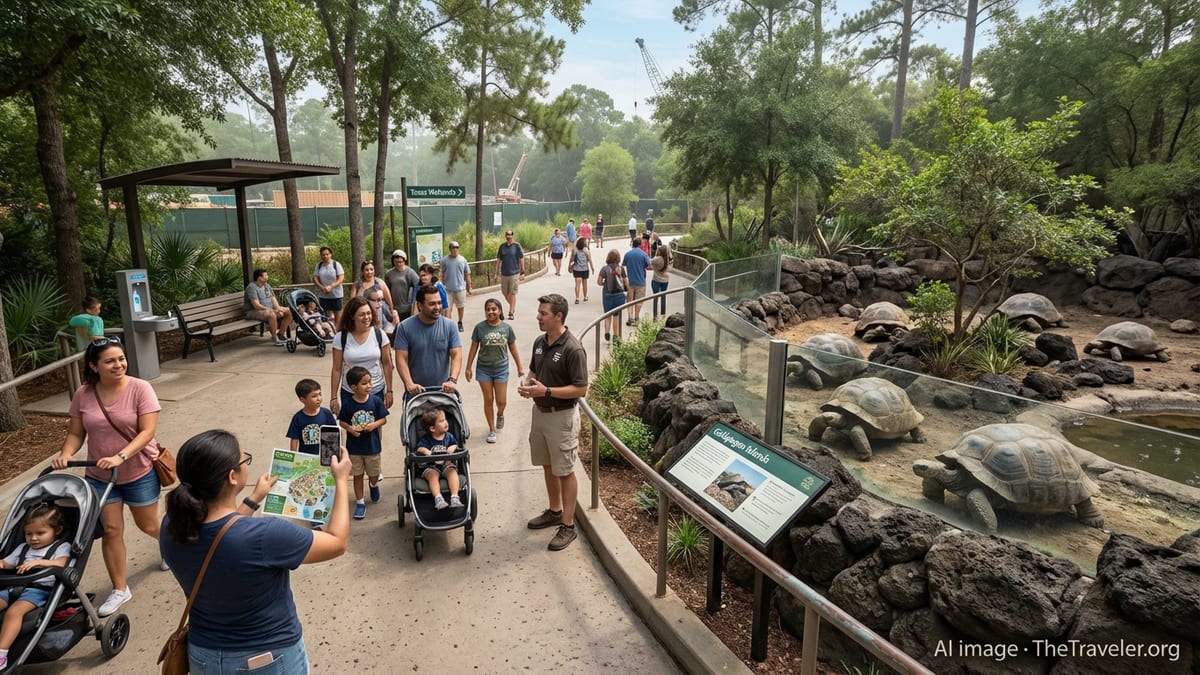
The Houston Zoo has poured a lot of money into modernizing its animal habitats, and in certain areas it absolutely shows. The standout for me was the Galápagos Islands section, a relatively new anchor exhibit. Walking into this area felt different. The space opens up into sweeping views of giant tortoises, seabird habitats, and carefully designed rockwork and water features that actually evoke the harsh, strange beauty of the real Galápagos. It is one of those rare zoo zones where you feel a bit transported, rather than just looking at animals behind glass.
The tortoises were active during my visit, slowly but steadily exploring their space, and the interpretive signage here is especially strong. Instead of generic “this species eats X and lives Y years,” I found well-presented information about how the zoo supports field research, how island ecosystems function, and why some of these animals are so vulnerable. It felt like the zoo was trying to connect my ticket purchase to something meaningful beyond a day’s entertainment, and that landed well with me.
South America’s Pantanal is another winner. Wide, water-rich enclosures with lush vegetation showcase tapirs, giant anteaters, and a variety of birds in a layout that feels both scenic and animal-centered. It is one of the more relaxing parts of the zoo, partially shaded and less congested than the main central pathways. The Texas Wetlands habitat, with its boardwalk views of native species like alligators and wading birds, also impressed me. It is not as dramatic as some of the international zones, but it quietly makes a point: local ecosystems can be just as fascinating as exotic ones.
I also appreciated the newer bird-focused areas, particularly Birds of the World. The aviaries are spacious and themed around different regions, and if you slow down and actually watch, these can be some of the most rewarding parts of the zoo. Parents tended to rush children past the birds in search of “more exciting” animals, which meant I often had more breathing room here. It is a good place to mentally reset when the crowds around the big mammals start to feel intense.
Letdowns, Closures, and the Penguins I Could Not See
For all the highlights, I did run into several disappointments that I think are important to know about before you go. The first is that some of the older or transitional areas simply do not match the standard of the flagship habitats. While the zoo has made major improvements, not every corner has caught up. In a few zones, enclosures felt smaller and more conventional, the kind of old-school “animal in a box with a sign” setup that modern zoos are gradually phasing out. They are not horrible, but they do feel dated compared to the marquee sections.
Then there are the closures and construction. The zoo is in the middle of ongoing renovations, including work on the white rhino and giraffe habitats and surrounding spaces. During my visit, that translated into construction fences, temporarily closed pathways, and some viewing areas partly obscured or rerouted. I understand that this is the price of progress, but if you are hoping for unobstructed views and a feeling of seamless immersion, the reality is more patchwork. I caught myself thinking, more than once, that I might have had a more complete experience if I had visited a couple of years later after the current wave of projects wraps up.
The most specific disappointment for me was the penguins. The Galápagos zone was heavily promoted, and I had read about the Humboldt penguins being a star attraction there. Unfortunately, due to habitat safety concerns, the penguins have been temporarily removed from their main public exhibit and moved behind the scenes. Instead of watching them glide through the water in a climate-controlled coastal environment, I was greeted by signage explaining that this area was temporarily affected. The zoo offers a separate paid “penguin encounter” experience that still lets some visitors see them up close, but that is a limited, extra-cost add-on rather than part of general admission.
I do respect that the zoo prioritized animal health over visitor expectations. That is absolutely the right call. Still, as a regular visitor who had been looking forward to that exhibit, it was disappointing. It also highlighted an ongoing tension at the Houston Zoo: they are pushing hard to present themselves as a world-class, conservation-forward institution, but the guest experience sometimes feels a step behind that ambition in how information and expectations are managed. I would have liked more prominent, up-front communication before I arrived so I could adjust my plan, rather than discovering it at the habitat itself.
Food, Shade, and All the Small Comforts
A full day at the Houston Zoo is not just about animals; it is also about how livable the place feels when you are on your feet for hours, often in serious heat. Here, the picture is mixed. On the positive side, the zoo has made real strides with its central dining and relaxation areas. The revamped Jack’s Café and surrounding plaza area are attractive, offering indoor, air-conditioned seating and a menu that goes beyond basic burgers and fries. I was pleasantly surprised by the range: there were local-style dishes, some lighter and healthier options, and kid-friendly standards. It still costs more than a casual off-site meal, but quality felt better than the old “concession stand” stereotype.
That said, lines at peak times can be long, and seating can be competitive. When lunchtime hit, the indoor dining areas quickly turned into a game of hovering and pouncing when a table opened up. I managed to find a spot, but it required patience. If I did this again, I would either eat early, well before noon, or aim for a late lunch after the rush.
Shade and rest areas are scattered throughout the zoo, but not always exactly where you want them. Some paths are nicely tree-lined and comfortable; others are surprisingly exposed, especially near newer concrete-heavy zones. I found myself hopping from shaded bench to shaded bench, planning my route around places where I could sit and cool down. Families with small kids in strollers, or anyone sensitive to heat, will feel this more acutely. The zoo does a lot of things right, but it still lives in Houston’s climate, and there is only so much they can do against that backdrop.
As for amenities, restrooms were reasonably clean and not too hard to find, and there were bottle-filling stations which I used multiple times. I was glad I brought my own water bottle; buying drinks repeatedly at concession prices would have added up quickly. Gift shops and kiosks are placed strategically enough that it is hard to exit without being tempted by plush animals or souvenirs, which I understand but still found a bit relentless by the time I reached the end of my visit.
Crowds, Kids, and the Overall Atmosphere
The Houston Zoo is, by design, a family magnet. That was obvious from the moment I stepped inside. Strollers, wagons, toddlers clutching animal-shaped snacks, school groups in matching shirts, grandparents trailing behind: this is the dominant vibe. If you are visiting with children, that can actually feel reassuring. You are in good company, and the place is set up to accommodate the chaos of family life. If you are visiting as an adult without kids and you crave tranquility, you need to be realistic about what the atmosphere will be like.
Noise is a constant. Excited children shouting, group leaders rallying kids, music from certain areas, chatter around food stands. It is not a peaceful botanical garden experience. I personally did not mind the energy most of the time, but there were a few moments, especially around the most iconic animals, when the crowd intensity made it harder to focus on the animals themselves. I had to intentionally seek out quieter corners like the aviaries and some of the less-hyped habitats to reset my patience.
On the plus side, staff and volunteers helped keep things organized. I saw several keepers and docents giving short talks or answering questions, and most of them came across as genuinely passionate about their animals. The scheduled keeper chats are worth seeking out if you are interested in conservation stories rather than just quick glimpses of animals. When one keeper talked about the behind-the-scenes medical care the zoo can now offer, including advanced imaging equipment, it reinforced my sense that this is not just a collection of exhibits but a serious animal-care operation behind the scenes.
Still, I left with the sense that the Houston Zoo knows exactly who its core audience is. It is unapologetically family-centered. Adult visitors looking for a quiet, contemplative wildlife experience might feel slightly out of step with the dominant mood unless they purposely visit at off-peak times and lean into the more low-key habitats.
Value for Money: Is It Worth the Price and Time?
By the time I left, I had been inside the zoo for roughly five hours. Between the timed admission ticket, a meal, a snack, and a drink or two, the cost of the day was not trivial. Factor in parking frustrations and the sheer energy expenditure of navigating crowds and heat, and it becomes a fair question: was it worth it?
In terms of pure animal-viewing value, I think the Houston Zoo delivers. The collection is strong, and the marquee habitats like Galápagos Islands, South America’s Pantanal, and Texas Wetlands are genuinely impressive. If you are interested in seeing well-cared-for animals in large, modern environments, you will not walk away feeling shortchanged on that front. The zoo has clearly spent serious money upgrading from older, cramped enclosures to multi-species landscapes that feel far closer to natural habitats.
Where the value calculation gets murkier is in the cumulative effect of smaller frustrations: difficult parking, construction detours, popular animals partially off-exhibit, long lines at peak lunch hours, and the ever-present heat. None of these on their own would have ruined my day, but together they made the experience feel slightly more draining than I expected. I enjoyed myself, but I was also ready to leave when I did.
If you measure value partly in terms of “how many things went smoothly,” the zoo lands somewhere in the middle. If you measure it in terms of “how memorable and immersive were the best parts,” it scores much higher. The answer to whether it is “worth it” depends heavily on what kind of visitor you are and how well you plan around the predictable pain points.
How I Would Do It Differently Next Time
Even though this was my first recent visit, I left with a clear list of things I would change if I went again, and I think those adjustments would significantly improve the experience. The biggest change would be timing. I would aim to arrive right when the zoo opens at 9 a.m., both to ease the parking struggle and to enjoy cooler temperatures and thinner crowds during the first couple of hours. Those early hours are prime time for both human comfort and animal activity.
I would also reconsider how I handle transportation. Instead of trying to compete for the closest Hermann Park lots, I would either park farther away and accept the walk, use a paid garage nearby, or take the METRORail or a rideshare. The ten to fifteen minutes I spent circling for a space at the beginning of my visit felt like wasted energy I would have rather spent inside the zoo.
Inside the zoo, I would prioritize the major new habitats early in the day, before crowds fully build up: Galápagos Islands, Pantanal, Texas Wetlands, and Birds of the World. I would save the smaller or more resiliently shaded sections for the hotter afternoon hours and avoid being in the most exposed areas at midday. For food, I would either eat a substantial breakfast beforehand and just grab light snacks in the zoo, or I would plan an early or late lunch to sidestep the worst lines.
Finally, I would set my expectations around ongoing construction and possible animal absences. Instead of assuming every promoted exhibit will be fully operational, I would treat the zoo’s current phase as transitional: already impressive in many ways, but with a few blank spots and detours while they push toward their next iteration. Framing it that way mentally reduces the frustration when you encounter closed sections or missing animals like the penguins.
The Takeaway
So, is the Houston Zoo worth visiting? For me, the answer is yes, but with caveats and conditions. It is a modern, ambitious zoo that has invested heavily in immersive, conservation-focused habitats. At its best, it offers some of the most thoughtfully designed animal environments I have seen in a city zoo, especially in the Galápagos Islands, South America’s Pantanal, and Texas Wetlands zones. If you care about seeing animals in spaces that resemble their natural homes and learning something genuine about wildlife conservation, the Houston Zoo delivers enough substance to justify the trip.
At the same time, it is not a flawless, serene experience. It is a busy, family-oriented attraction in a hot, often humid city, surrounded by limited parking and in the middle of ongoing construction and exhibit changes. You should expect crowds, some logistical headaches, and the possibility that a few marquee animals might be off public display for valid but still disappointing reasons.
If you are a family with kids, especially children who are excited about animals, the Houston Zoo is an easy recommendation. Plan to arrive at opening time, pack water, pace yourselves, and accept that you will not see everything perfectly. The highs outweigh the lows, and your kids are likely to remember the tortoises, giraffes, sea lions, and wetlands far more vividly than the line at the café.
If you are an adult visitor, a couple, or a solo traveler, it can still be very much worth it, especially if you are already spending time in the Museum District. Just be honest with yourself about your tolerance for crowds and heat. If you can visit on a weekday morning or during cooler seasons, you will see the zoo at something closer to its best. In that context, I would say yes: the Houston Zoo is worth visiting, not as a polished, perfect attraction, but as a strong and still-evolving urban zoo that rewards a bit of planning and realistic expectations.
FAQ
Q1. How much time do I realistically need at the Houston Zoo?
I spent about five hours and felt like I saw the major exhibits without rushing, but three to four hours is enough for a solid visit if you focus on highlights like Galápagos Islands, South America’s Pantanal, Texas Wetlands, and a few favorites in between. With young kids, you may move slower and take more breaks, so a half day can pass quickly.
Q2. Is parking really as bad as people say?
Parking is not impossible, but it is the most frustrating part of the experience. The free Hermann Park lots fill quickly on pleasant days, and I spent ten to fifteen minutes circling before finding a space. If you want to avoid that stress, consider arriving right at opening, using public transit, paying for a nearby garage, or taking a rideshare directly to the entrance.
Q3. What is the best time of day and year to visit?
The best time of day is right when the zoo opens at 9 a.m. The air is cooler, animals tend to be more active, and crowds are thinner. In terms of season, fall, winter, and early spring are more comfortable than peak summer, when heat and humidity can make long walks and outdoor viewing feel draining.
Q4. Are there any major exhibits currently affected by construction or changes?
Yes. The zoo is in an active improvement phase, with work on habitats like the white rhino and giraffe areas and surrounding spaces, which can mean detours and temporary closures. The Humboldt penguins are also currently off exhibit from their main habitat due to safety concerns, visible only through a separate paid encounter. Checking for recent updates before you go is wise.
Q5. Is the Houston Zoo a good choice for adults without kids?
It can be, but you need to be comfortable with a very family-heavy environment. I visited without children and still enjoyed the newer habitats and conservation stories, but I had to accept constant noise and stroller traffic as part of the deal. Going on a weekday morning or in cooler months makes it more enjoyable for adult visitors.
Q6. How expensive is a visit once you factor in food and extras?
General admission is comparable to other major U.S. zoos, but costs add up quickly when you include parking alternatives, meals, snacks, and optional experiences. A full day with food and drinks on site can easily feel pricey. Bringing a refillable water bottle and planning around one main meal inside the zoo helped me keep costs under better control.
Q7. What are the absolute must-see areas if I am short on time?
If you only have a few hours, I would prioritize Galápagos Islands for its immersive design, South America’s Pantanal for its lush, water-rich habitats, Texas Wetlands for a strong local conservation angle, and Birds of the World for surprisingly engaging aviaries. Those four areas gave me the strongest sense of how far the zoo has come in modernizing its approach.
Q8. How is the food inside the zoo?
The food is better than basic concession fare but still priced at typical attraction levels. The newer central café offers decent variety and some higher-quality options, including local flavors and kid-friendly standards. It is convenient and adequate, but lines can be long at peak lunch times, so planning to eat early or late can make the experience less stressful.
Q9. Is the zoo accessible and manageable for strollers or wheelchairs?
Overall, yes. The main paths are paved and mostly wide, and the zoo is designed with accessibility in mind. There are slopes in some areas, but I saw many strollers and mobility devices navigating without major issues. The challenge is less about terrain and more about crowd density in popular zones, which can make maneuvering slower and more tiring.
Q10. Would I go back, and what would I change next time?
I would go back, especially once some of the current construction wraps up and key exhibits like the penguin habitat return to full operation. Next time, I would arrive at opening, avoid circling for parking by choosing a clearer transport plan, focus on the major modern habitats early in the day, and time my meals to miss the busiest lunch rush. With those adjustments, I think the experience would feel more relaxed and even more clearly worth the time and money.