

Few countries are as closely associated with railways as the United Kingdom. From Victorian viaducts striding across valleys to sleek intercity services linking London with Scotland in a matter of hours, the network is both a national symbol and a daily necessity. Yet rising fares, periodic strikes and headlines about delays leave many visitors wondering whether taking the train in the UK is really worth it. The answer is nuanced, depending on where you are going, how flexible you can be and what you value most when you travel.
The State of UK Rail in 2026
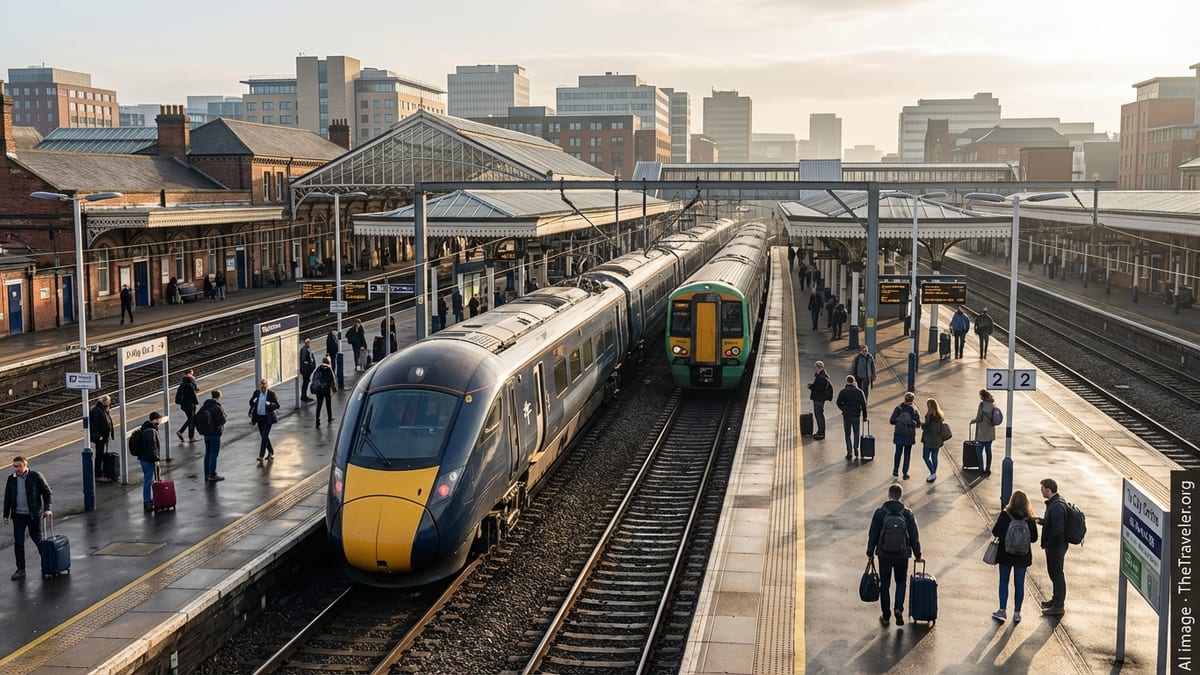
To decide whether train travel in the United Kingdom is worth it, you first need to understand the current state of the network. In the years since the pandemic, Britain’s railways have been through a turbulent period, with fluctuating passenger numbers, industrial disputes and a major political shift toward bringing services back into public ownership. Performance has gradually settled close to pre-pandemic levels, with official figures for the financial year ending 2025 indicating that roughly eight to nine trains out of ten arrive within a few minutes of their scheduled time. Cancellations remain a visible irritation for passengers, but they affect a minority of services rather than being the norm.
Passenger satisfaction, however, reflects a mixed picture. Independent surveys in 2024 and 2025 show overall satisfaction in the low 80 percent range, down from the high 80s in earlier years, with value for money, overcrowding and information during disruption emerging as consistent weak points. Travellers report large differences between operators and routes: some London commuter lines and busy intercity corridors score well for frequency and speed, while others in Wales or northern England struggle with older rolling stock, short trains and patchy punctuality. For a visitor, that means your impression of “UK rail” will depend heavily on the specific lines you use.
Overlaying this is a major structural reform. Since 2024 the government has been phasing out the old franchise system and renationalising passenger operators as their contracts expire, with a new public body called Great British Railways being built to take overall control of the network. The intention is to simplify ticketing, coordinate timetables and reinvest profits. In practice, the transition is gradual: as of early 2026 several large operators are already back in public hands, while others are scheduled to follow by 2027. For travellers today, the change is more about branding and back-office integration than day-to-day transformation, but it signals a long-term commitment to a more joined-up railway.
Where Trains Shine: Speed, Reach and Urban Convenience
For many itineraries, UK train travel remains the most efficient and enjoyable way to get around. Between major cities in England and Scotland, rail almost always beats driving on overall journey time and stress. The corridor from London to Edinburgh, for instance, is typically around four and a half to five hours by fast train from central London to the heart of the Scottish capital. Factoring in airport transfers and security, that compares favourably with flying, and you arrive within walking distance of historic districts rather than at an out-of-town terminal.
Similarly strong cases for rail exist on routes such as London to Manchester, Birmingham, Leeds, York, Bristol and Cardiff, where frequent departures and city-centre stations make trains compelling. On these lines, services can run as often as every 20 to 30 minutes at peak times, and advance fares bought early can be competitively priced. For visitors planning a classic circuit of London and a handful of major cities, rail offers a relatively low-hassle backbone for the trip, with no need to navigate unfamiliar motorways or city traffic.
Within cities, rail integrates into wider public transport systems. London’s extensive suburban rail mesh complements the Underground and buses, while cities such as Glasgow, Manchester and Liverpool have suburban or regional rail networks that work well for day trips to nearby towns and countryside. If you prefer not to drive on the left or wrestle with parking, rail plus local transit can give you seamless access to historic centres, waterfronts, university towns and cultural sites without the friction of car hire.
When the Numbers Add Up: Value, Passes and Booking Strategy
Whether UK train travel feels “worth it” often comes down to price. Britain’s walk-up fares are among the highest in Europe, and buying a flexible ticket at the last minute on a busy intercity route can be eye-wateringly expensive. The key is to understand the fare structure and book strategically. Advance tickets, released in limited numbers weeks or months ahead, can cut the cost dramatically on long-distance routes, especially outside peak commuting hours. These tickets usually tie you to a specific train, so they work best for travellers with fixed plans.
For visitors planning multiple journeys, rail passes can offer both savings and simplicity, though they are not automatically the best deal. BritRail passes, sold mainly to non-UK residents, allow unlimited travel across England, Scotland and Wales for a set number of days. As of 2025 and 2026, typical adult prices for multi-day passes run in the mid hundreds of US dollars, rising with the number of days and with first-class options. Whether that represents value depends on how intensely you use them: packing several long intercity trips into each pass day usually justifies the cost, while using pass days for short hops between neighbouring towns rarely does.
Regional passes, such as those limited to England or to specific areas, can be more economical if your itinerary is focused. In addition, the UK’s national railcard system is well worth investigating if you qualify. Various railcards offer around one-third off most fares for young people, older travellers, friends or couples travelling together, and families, in return for a modest fee. While some railcards are reserved for residents, others are available to international visitors. Combining a railcard discount with advance fares often brings UK rail prices back down to a reasonable, if not bargain-basement, level.
The bottom line is that UK trains are worth it financially when you either plan several substantial journeys that maximize a pass, or you are disciplined about booking in advance and travelling off-peak. If you rely on last-minute, fully flexible tickets on busy days, trains will still get you where you need to go quickly, but the cost may leave you questioning their value.
The Hidden Costs: Strikes, Disruption and Complexity
No honest assessment of UK train travel in recent years can neglect disruption. Industrial action by rail unions over pay and working conditions has been a recurring feature since 2022, with waves of strikes and overtime bans causing reduced timetables, early finishes and, on some days, near-total shutdowns on certain operators. By early 2026 the frequency of major strikes has reduced compared with the peak years, but sporadic action and tight staffing can still create headaches for travellers, particularly at weekends and around holidays.
Even on non-strike days, engineering works and infrastructure issues lead to delays and cancellations. The government’s own rail statistics for 2024 and 2025 show punctuality in the mid 80 percent range and a cancellation score of a few percent, which in practice means that while most trains operate close to schedule, it is wise to allow buffer time for connections, onward travel and flights. Travellers speak of patchy communication during disruption, with some operators proactive on station displays and announcements and others slower to provide clear alternatives.
Ticketing complexity is another soft cost. Historically, Britain’s fragmented system produced a confusing array of operators, tickets and routing rules. The ongoing shift to a more unified structure and the planned creation of a single national ticketing platform are meant to simplify this, but for the moment you still encounter a mix of operator-specific offers, regional smartcards and multiple online retailers. For a first-time visitor, figuring out whether to buy an advance, off-peak or anytime ticket, and from whom, can feel intimidating. This complexity does not always translate into higher prices, but it does demand more planning time and attention.
Put together, strikes, engineering works and ticketing quirks form the main reasons some travellers judge UK trains not to be worth the hassle. Whether you share that view depends on your tolerance for uncertainty and your ability to build flexibility into your itinerary. If you can shift plans by a few hours or a day and keep an eye on service updates, you can usually work around disruption. If you are on a rigid schedule with crucial same-day connections, the risk feels sharper.
Comfort, Scenery and the Experience Factor
Beyond cost and reliability, there is the experience of travelling by train across the United Kingdom, which remains a powerful reason many visitors choose rail. Even on ordinary routes, there is something engaging about watching the landscape evolve through the window: London’s dense suburbs giving way to hedgerows and fields, the rolling hills of the Cotswolds, the dramatic coastline of Devon and Cornwall, or the rugged moors and mountains of northern England and the Scottish Highlands. Certain stretches, such as the East Coast Main Line along the North Sea near Durham and Berwick-upon-Tweed, or the West Highland Line north of Glasgow, are journeys that many travellers remember as highlights in their own right.
On the comfort front, there is wider variation. Many intercity trains now offer modern interiors, at-seat power sockets, decent legroom, air conditioning and both quiet coaches and family areas. Free Wi-Fi is common, although signal quality can fluctuate, particularly in rural areas or through tunnels. First class on key routes often adds more spacious seating, complimentary refreshments and a calmer ambiance, which some long-haul travellers find worth the premium, especially if booked in advance at a discount.
On some regional and commuter lines, by contrast, you may encounter older rolling stock, basic seating and standing room only during busy peaks. Crowding has been a persistent complaint on certain corridors, especially into major cities on weekday mornings and late afternoons. For visitors who can travel outside these peaks, the experience improves markedly: mid-morning and mid-afternoon trains are typically quieter, and you are more likely to get a window seat to enjoy the scenery. For photographers and rail enthusiasts, these off-peak hours also offer better opportunities to move around trains and stations without getting in the way of hurried commuters.
Although UK trains are not usually luxurious in a classic sense, they do provide a kind of everyday comfort that driving cannot match: the ability to read, work, chat or simply gaze out the window without focusing on the road. For many travellers, that intangible experience value, combined with the visual pleasure of the landscape, is a decisive factor in favour of rail, even when costs and occasional delays are taken into account.
Trains vs Cars and Domestic Flights
When evaluating whether train travel in the UK is worth it, it helps to compare it directly with the main alternatives: driving and flying. Hiring a car gives maximum flexibility, particularly for rural areas, small villages and remote coasts not well served by public transport. In Scotland, Wales, the Lake District, Yorkshire Dales and parts of Cornwall, some of the most beautiful scenery lies away from railway lines, and local buses can be infrequent. A car lets you linger at viewpoints, detour to country pubs and stay in remote inns, which is difficult to replicate with trains alone.
However, driving in the UK has its own costs and stresses. Car rental rates, fuel, insurance and often expensive parking in cities add up quickly, especially if you are only using the car for occasional hops between urban centres already well connected by rail. Motorways can be congested around major cities, and city centres frequently have congestion charges, narrow streets and strict parking enforcement. For travellers unused to driving on the left, roundabouts and dense traffic can be tiring, making trains feel like a welcome relief rather than a sacrifice.
Domestic flights, meanwhile, retain a role on a few longer routes, such as between London and some Scottish cities, or from the mainland to Northern Ireland. Yet the trend over the past decade has been a gradual shift in public sentiment and policy toward encouraging rail, which typically has a lower per passenger carbon footprint on busy routes. When you include airport travel time, security checks and potential delays, a four to five hour intercity train journey within Great Britain often matches or even beats flying on door-to-door timing, while being more comfortable and less complicated.
For most classic visitor itineraries focused on England, Scotland and Wales, a hybrid approach works well. Use trains for the main intercity legs, relying on their speed, central stations and the chance to relax en route. Then, for more remote stretches or specific countryside regions, consider hiring a car for a shorter segment, or using local buses and occasional taxis out from a rail hub. From this perspective, the question becomes less “Are trains worth it?” and more “On which parts of my trip is rail the best tool?” In many cases, the answer is “for more than you might expect.”
Practical Tips to Make UK Rail Work for You
Assuming you decide that trains are worth incorporating into your UK trip, a few practical strategies can tilt the experience in your favour. The first is timing. Booking advance fares as early as your plans allow, especially on popular routes and Fridays or Sundays, will usually secure better prices and reserved seats. Travelling just outside the morning and evening peaks not only cuts costs on many routes but also reduces crowding and stress. If you are connecting to a flight, cruise or major event, plan to arrive in the city the night before rather than relying on a tight same-day rail connection.
Second, decide early whether a pass or point-to-point tickets are better for your style of travel. If your itinerary is flexible and you like to decide each day where to go, a pass can buy spontaneity and peace of mind even if it is only marginally cheaper than individual tickets. If your route is fixed, with a small number of long journeys, carefully chosen advance fares may be cheaper and equally straightforward. Remember that many passes still require you to reserve seats on certain trains, so factor in that extra step when assessing convenience.
Third, learn the basics of station life and on-board etiquette. In the UK, passengers generally queue on the platform near where doors are expected to stop, and most intercity trains have clear coach letters and seat numbers displayed outside and inside the carriage. Luggage space is often limited near seats, so larger bags are best stored on dedicated racks at carriage ends, keeping smaller items with you. Quiet coaches, if available, are designed for minimal phone use and conversation, which can be a haven on busy trains. Having a small daypack with essentials, snacks and a refillable water bottle helps you stay comfortable if there are delays or catering is limited.
Finally, keep an eye on service updates in the days before you travel. National and operator-specific sites and apps provide live departure boards and alerts about strikes and engineering work. Even if you prefer to handle bookings through a travel agent or overseas retailer, checking local information close to departure can help you spot potential issues early. Being forewarned lets you adjust timings, explore alternative routes or, in extreme cases, pivot to a coach or car hire for a particular leg.
The Takeaway
So, is train travel in the United Kingdom worth it? For many visitors and a great many journeys, the answer is yes, provided you understand the trade-offs. Trains remain one of the fastest, most convenient and, in environmental terms, more sustainable ways to move between Britain’s major cities. They offer central-to-central journeys, a chance to see the landscape unfold, and the comfort of not having to drive or negotiate airports. On the right routes, booked with a bit of foresight, they can represent good value relative to the time and hassle saved.
At the same time, UK rail is not a flawless system. Fares can be high if you buy late or insist on full flexibility, disruption from strikes and engineering work still occurs, and the quality of rolling stock and punctuality varies across the network. Political promises of a simpler, more integrated railway under public ownership are real but still in progress, meaning visitors in 2026 should expect incremental improvements rather than a fully transformed experience.
Ultimately, the worth of UK train travel comes down to your priorities. If you place a premium on speed between cities, low-stress travel and the pleasure of watching countryside glide by your window, trains are likely to be central to your trip. If you are budget-focused above all else, or your plans revolve around very rural areas, you may choose to combine rail with buses or car hire. The most rewarding itineraries often mix these modes thoughtfully, letting Britain’s storied railways do what they do best while other options fill in the gaps.
FAQ
Q1. Are UK trains reliable enough for tight connections or flights?
For very time-critical connections, it is safer to allow generous buffer time or travel the previous day, as delays and occasional cancellations do still occur.
Q2. Is a BritRail pass cheaper than buying individual tickets?
It can be, but only if you plan several medium or long journeys on pass days; for a few fixed trips, advance point-to-point tickets are often better value.
Q3. How far in advance should I book UK train tickets?
Booking several weeks ahead usually secures the best prices on long-distance routes, especially for Fridays, Sundays and peak holiday periods.
Q4. Are first-class tickets on UK trains worth the extra cost?
They can be worthwhile on busy intercity routes if you value more space, quieter coaches and refreshments, particularly when booked at discounted advance fares.
Q5. How badly do strikes affect train travel in the UK?
Strike days can see heavily reduced timetables or cancellations on some lines, so it is important to check for planned action and build flexibility into your plans.
Q6. Can I use trains to explore rural areas and small villages?
Trains work best for linking towns and cities; for remote countryside, you often need to combine rail with local buses, taxis or short-term car hire.
Q7. Do UK trains have good Wi-Fi and charging points?
Most modern intercity and many regional trains offer Wi-Fi and power sockets, though service quality can vary and may be patchy in rural areas.
Q8. Is it difficult to manage luggage on UK trains?
Managing luggage is usually straightforward if you can lift your bags; use luggage racks at carriage ends and try to avoid very crowded peak-time services.
Q9. Are there discounts for families or groups on UK trains?
Various railcards and some operator offers provide significant discounts for families and groups, so it is worth checking eligibility before you buy tickets.
Q10. Is train travel in the UK safe for solo travellers?
Yes, UK trains are generally safe for solo travellers, including at night, though normal common-sense precautions and awareness of your surroundings still apply.