

Winnipeg rarely tops the list of first-time Canada itineraries, yet travelers who do make the journey often speak of the city with a kind of conspiratorial affection. Set roughly halfway between Vancouver and Toronto, the Manitoba capital is a crossroads of rail lines, rivers, Indigenous cultures and immigrant communities.
For travelers exploring central Canada, the question is not simply whether Winnipeg is worth visiting, but how it can become the anchor that gives a Prairies trip its sense of place.
A Central Canadian Hub That Rewards the Detour
On a map, Winnipeg looks like a practical stop: a mid-continent hub with direct flights from major Canadian cities and several U.S. gateways, plus onward connections to northern Manitoba and the Arctic coast. Winnipeg James Armstrong Richardson International Airport is compact and easy to navigate, and Winnipeg Transit buses connect the terminal to downtown throughout the day, making arrival straightforward even for travelers without a car. Within about half an hour of landing, many visitors find themselves at their hotel near the riverfront or in the walkable Exchange District.
Beyond logistics, Winnipeg’s role as Manitoba’s main gateway shapes its character. Tourism officials report that the province welcomed more than 10 million visitors in 2023, with record spending that signals a strong rebound and growing interest in its experiences. Much of that traffic flows through Winnipeg, whether people are in town for a Jets game, a convention, or en route to polar bear watching in Churchill and fishing lodges farther north. For central Canada itineraries that string together cities and wilderness, the city has become a natural staging ground.
For road trippers coming from Ontario or Saskatchewan, Winnipeg is often the first sizable urban break after long hours of prairie or shield forest. The city’s compact core, with its concentration of major attractions, hotels and restaurants, means even a one or two night stay can be dense with experiences. Add in the relative affordability of accommodations and dining compared with larger Canadian cities, and Winnipeg makes economic as well as geographic sense as a base.
This practicality, however, only explains why travelers pass through. What determines whether Winnipeg is worth a dedicated visit is the combination of culture, history, riverfront green space and under-the-radar food that many guests find exceeds their expectations.
Signature Sights: From The Forks to the Canadian Museum for Human Rights
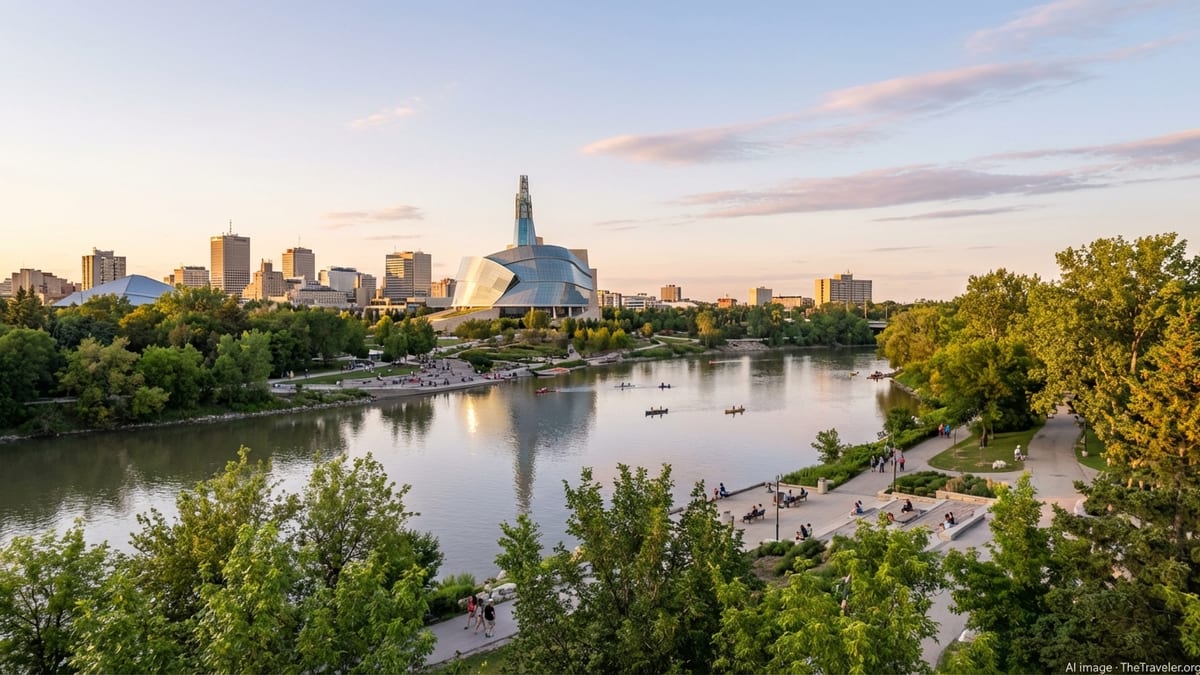
Almost every visit to Winnipeg eventually converges at The Forks, a 5.5-hectare historic meeting place at the confluence of the Red and Assiniboine Rivers. Archaeological evidence shows it has been a gathering site for more than 6,000 years, from Indigenous trading camps to fur brigades and rail yards. Today it is a lively public space that blends market halls, riverfront trails, public art and seasonal activities. Food stalls, local craft vendors and a six-storey viewing tower keep it busy in every season, while in winter, skating trails lace across the site.
Beside The Forks rises one of Canada’s most talked-about cultural institutions, the Canadian Museum for Human Rights. Its glass and limestone silhouette is striking, but the content inside is what lingers. Exhibits explore global and Canadian human rights stories, including Indigenous perspectives and contemporary issues. The experience is more contemplative than casual and can easily fill half a day, but for many visitors it becomes the emotional centerpiece of a Winnipeg stay and a strong reason to include the city in a cross-country route.
Within walking distance, the Manitoba Museum offers a different lens on the region, tracing the natural and human history of the Prairies, the North and the Red River settlement. Families in particular tend to value this stop, as the museum’s immersive galleries and ship replica bring the fur trade and early immigration era to life. Nearby, the Manitoba Legislative Building, with its Beaux-Arts architecture and manicured grounds, reflects the city’s early-20th-century ambition as a booming rail and grain hub.
Together, these core attractions anchor a compact area that is easy to explore over two or three days. For travelers weighing whether to dedicate precious time to Winnipeg on a central Canada circuit, the density and diversity of these experiences often tip the balance in the city’s favor.
The Exchange District: Architecture, Arts and Winter-Proof Walkability
North of downtown’s main thoroughfares, the Exchange District is where many visitors fall quietly in love with Winnipeg. This national historic site preserves one of North America’s best collections of early-1900s warehouse architecture, built during the city’s “Chicago of the North” era when grain and rail money poured in. Today those brick and stone façades house design studios, galleries, coffee shops, breweries and independent boutiques, giving the area a creative energy that contrasts with its industrial bones.
Strolling these streets, travelers can appreciate the district both as an open-air museum of turn-of-the-century commercial design and as a contemporary neighborhood. Seasonal walking tours, theater productions and outdoor events in Old Market Square add cultural texture, especially in summer. Photographers find the narrow lanes and faded painted signs particularly rewarding during golden hour, when the light warms the riveted steel and brick.
Winnipeg’s downtown is also known for the Winnipeg Walkway, an indoor network of skyways and tunnels that links office towers, hotels, the arena and key shopping streets. The system provides climate-controlled access to dozens of buildings over a distance of roughly two kilometers, which can be especially welcome in winter. For travelers, the Walkway offers the ability to move between accommodations, Canada Life Centre, the convention center and parts of the retail core while avoiding the harshest wind and cold.
Recent development around True North Square and the sports and entertainment district has further concentrated restaurants, patios and event spaces. For visitors, this yields a downtown that, while still evolving, is increasingly coherent and walkable, with clusters of activity that are easy to navigate on a short stay.
Four-Season City: Embracing Winter, Celebrating Summer
Winnipeg’s climate is famously continental: winters are long and can be bitterly cold, with temperatures often well below freezing, while summers are warm, sunny and surprisingly lush along the rivers. Whether the city is “worth it” depends in part on how comfortable you are with those extremes and what experiences you seek. Rather than attempting to hide from winter, the city leans into it with festivals, river trails and outdoor activities tailored to the season.
In colder months, the Red and Assiniboine Rivers typically freeze and become the site of one of the world’s longest natural skating trails when conditions permit. At The Forks, a network of groomed pathways, fire pits and warming huts designed by international architects turns the river surface into a seasonal promenade. Visitors can rent skates, sample hot chocolate from vendors and step into artful shelters that make braving the elements more inviting.
Winter festivals add another reason to visit in the off-season. Events such as Festival du Voyageur in the St. Boniface neighborhood celebrate the city’s francophone and fur trade heritage with snow sculptures, music and food. Throughout the colder months, Canada Life Centre hosts professional hockey, while theaters and concert halls maintain packed schedules. For travelers already touring central Canada in winter, Winnipeg offers an unusually vivid expression of how Prairie cities adapt to the climate.
Summer, by contrast, highlights Winnipeg’s park system, riverfront patios and open-air events. The long daylight hours and generally dry weather make it easy to explore neighborhoods by bike or on foot, and to day-trip to nearby beaches and lakes. For many visitors who prefer mild conditions, late spring through early fall is the most comfortable and versatile time to integrate Winnipeg into a broader Canadian journey.
Culture, Food and Neighborhood Character
Winnipeg’s cultural fabric is richer than its modest international profile might suggest. The city supports a symphony orchestra, opera company, major ballet company and numerous theater troupes, alongside contemporary music venues and festivals. For travelers who enjoy combining urban culture with outdoor exploration, the depth of the arts scene relative to the city’s size is often a pleasant surprise.
Food is another area where Winnipeg quietly excels. The city’s status as a regional center for Manitoba’s farms and lakes means seasonal ingredients travel a short distance from producer to plate. From casual diners sharing local pickerel and perogies to chef-driven restaurants exploring Prairie cuisine, there is a strong emphasis on hearty, accessible dishes. Multicultural neighborhoods further expand the options, with everything from Filipino bakeries and Ethiopian cafés to Ukrainian delis and South Asian eateries.
Neighborhoods like Osborne Village, Corydon and St. Boniface add dimension beyond the core. Osborne’s mix of boutiques, bars and older apartment buildings gives it a bohemian feel that appeals to younger travelers. Corydon’s sidewalk cafés and gelato stands come alive in summer. Across the river, St. Boniface centers French-language culture in Manitoba, reflected in its cathedral ruins, cafés and bilingual signage. Exploring these districts by transit or rideshare can turn even a brief visit into a broader survey of Winnipeg’s everyday life.
While Winnipeg does not have the density or polish of Canada’s largest cities, many visitors find that its scale works in their favor. It is relatively easy to secure reservations, tickets and accommodations even during busy periods, and the atmosphere tends to be relaxed rather than hurried. For travelers seeking authenticity and local character rather than postcard clichés, this unhurried quality is a genuine asset.
Practical Considerations: Safety, Mobility and Budget
Any honest assessment of whether Winnipeg is worth visiting must address practical realities. Like many mid-sized North American cities, Winnipeg has areas where visible poverty, housing insecurity and substance use are present, particularly around parts of the downtown fringe. Travelers who are accustomed to sticking to central, tourist-oriented districts in larger cities may notice these challenges more in Winnipeg, where transitions between revitalized blocks and struggling ones can be abrupt.
Most visitors who exercise routine urban awareness report feeling safe while exploring central neighborhoods and main attractions, especially during the day. At night, many choose taxis or rideshares over walking long distances through quiet areas, and stick to well-trafficked streets or organized events. Local tourism bodies and hotels can offer neighborhood-specific advice, which is worth heeding if you are unfamiliar with Prairie cities or arriving in winter when darkness falls early.
Getting around without a car is realistic for short stays focused on downtown, The Forks and nearby neighborhoods. Winnipeg Transit runs an extensive network of low-floor buses, including routes connecting the airport to the core throughout the day and into late evening. The city’s grid system and relatively light traffic compared with larger Canadian centers make rideshares and taxis efficient options. That said, if you plan to explore peripheral attractions, rural sites or lake country, renting a vehicle can provide useful flexibility.
From a budget standpoint, Winnipeg is generally more affordable than Vancouver, Toronto or many major U.S. cities. Hotel rates, restaurant prices and local transportation costs tend to be moderate, which makes longer stays or higher-quality accommodations accessible for more travelers. Combined with the city’s compact footprint and concentration of free or low-cost public spaces, this affordability makes Winnipeg a strong value proposition on a central Canada route.
Who Will Get the Most Out of a Winnipeg Stop?
Winnipeg’s appeal is not universal, and understanding who is likely to appreciate the city can help travelers decide whether to dedicate time here. Visitors interested primarily in dramatic mountain scenery or iconic skylines may find more of what they seek in other parts of Canada. Those who come expecting a polished, tourist-centric experience similar to larger urban centers might initially be puzzled by Winnipeg’s quieter, workaday feel.
Where the city shines is in rewarding curiosity. Travelers who enjoy urban history, architecture, human rights dialogue, and grassroots arts tend to find plenty to engage them. So do food-focused visitors who appreciate under-the-radar dining scenes and local ingredients. Families often value the mix of educational museums, open green space and relatively low congestion, which makes moving between attractions with children less stressful.
Winnipeg can also be an excellent hub for hybrid itineraries that combine city time with wilderness. From here, travelers can connect to rail or air services to northern Manitoba for wildlife watching, northern lights viewing and cultural experiences in remote communities. Closer to the city, day trips to prairie towns, Mennonite heritage sites or lakeside beaches provide a broader sense of central Canada’s landscapes and cultures.
Ultimately, Winnipeg tends to resonate most with travelers who are willing to look beyond marquee names and invest a little attention in the places they visit. For these guests, the city’s modest profile can feel less like a drawback and more like an invitation to discover a destination still largely absent from mass tourism circuits.
The Takeaway
So is Winnipeg worth visiting for travelers exploring central Canada? For many, the answer is a qualified yes. The city offers a meaningful combination of historic riverfront setting, nationally significant museums, a revitalized warehouse district, four-season festivals and a quietly ambitious food and arts scene. Its role as Manitoba’s transportation and cultural hub makes it a logical anchor point on routes that stretch from the Great Lakes to the Prairies and beyond.
Winnipeg is not without its complexities. The climate can be challenging, and social issues are visible in parts of the urban landscape. The city does not always reveal itself at a glance, nor does it provide the instant visual drama of coastal or mountain destinations. Yet for travelers prepared to engage with it on its own terms, those same factors can deepen the experience, highlighting resilience, creativity and community.
For a first-time central Canada trip, allocating two or three nights in Winnipeg is often enough to sample its core attractions while leaving room for further exploration elsewhere in the region. Repeat visitors may choose to stay longer, diving into neighborhood life, live music and day trips into rural Manitoba. Either way, Winnipeg rewards the traveler who treats it not as a quick refueling stop, but as a destination with stories, flavors and perspectives that enrich a broader understanding of Canada.
FAQ
Q1. How many days should I spend in Winnipeg on a central Canada trip?
Most travelers find that two to three full days provide enough time to explore The Forks, the Canadian Museum for Human Rights, the Exchange District and a few neighborhoods, while still allowing a relaxed pace.
Q2. Is Winnipeg safe for visitors?
Winnipeg is generally safe in the main visitor areas when normal city precautions are taken. Like many urban centers, it has pockets where social challenges are more visible, so staying aware of your surroundings and seeking local advice on where to walk at night is sensible.
Q3. What is the best time of year to visit Winnipeg?
Late spring through early fall offers the mildest weather and the widest range of outdoor events. Winter visits can be rewarding for those who enjoy cold-weather activities and festivals, but require proper clothing and comfort with low temperatures.
Q4. Do I need a car to get around Winnipeg?
For short stays focused on downtown, The Forks and nearby districts, you can rely on buses, taxis and rideshares. A rental car becomes more useful if you plan to explore rural Manitoba, lakeside areas or attractions on the city’s outskirts.
Q5. Is Winnipeg expensive compared with other Canadian cities?
Winnipeg is generally more affordable than Canada’s largest cities in terms of hotel rates, dining and local transportation. Travelers often find they can stay in central locations and enjoy quality meals without straining their budget.
Q6. What are the must-see attractions for first-time visitors?
Key highlights typically include The Forks, the Canadian Museum for Human Rights, the Exchange District, the Manitoba Museum and strolls along the riverfront, with time in neighborhoods such as Osborne Village or St. Boniface if your schedule allows.
Q7. How cold does Winnipeg get in winter, and can I still enjoy a visit?
Winter temperatures often fall well below freezing and can occasionally reach extreme lows. With proper layered clothing, insulated footwear and planned indoor breaks, many visitors still enjoy skating, festivals and cozy dining during the colder months.
Q8. Is Winnipeg a good base for exploring the rest of Manitoba?
Yes. Winnipeg serves as the province’s main transportation hub, making it a convenient starting point for trips to northern Manitoba, lake regions, small towns and cultural or wildlife experiences beyond the city.
Q9. What kind of food scene can I expect in Winnipeg?
Winnipeg’s dining scene blends Prairie classics like pickerel and perogies with diverse international cuisines. Travelers can choose from casual cafés and bakeries to inventive, chef-led restaurants that highlight local ingredients.
Q10. Is Winnipeg suitable for family travel?
Families often appreciate Winnipeg’s manageable size, educational museums, riverside parks and relatively light traffic. Many attractions are interactive and child-friendly, and the city’s pace tends to be less hectic than larger metropolitan centers.