

Building a 12‑month relocation budget for Italy requires a structured view of recurring and one‑off expenses, with realistic cost ranges anchored to current Italian price levels. This briefing outlines a practical framework and benchmark figures that expats can use to model annual spending and stress‑test affordability before relocating.
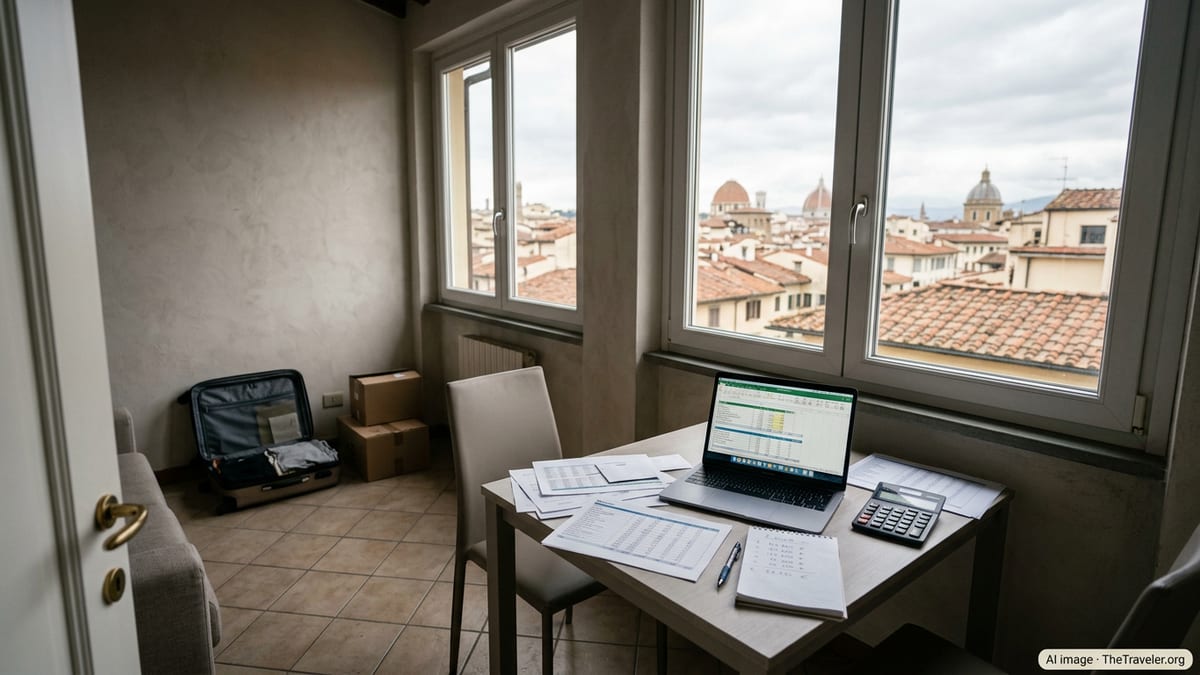
Framework for a 12‑Month Italy Relocation Budget
A 12‑month relocation budget for Italy should distinguish clearly between recurring monthly costs and one‑time or irregular expenses. Recurring costs include rent, utilities, groceries, local transport, communications, and basic personal spending. One‑time or irregular items include initial deposits, setup purchases, and annual insurance or transport costs. Treating these as separate layers improves comparability between cities and lifestyles.
Recent cost of living analyses indicate that housing and utilities absorb a significant share of typical monthly outlay in Italy, often around one third to one half of total spending for many households, with food and transport forming the next largest blocks.([expatica.com](https://www.expatica.com/it/moving/about/cost-of-living-in-italy-79342/?utm_source=openai)) As a result, any budget calculator that ignores local rent levels or building energy efficiency will misstate overall requirements.
For decision purposes, expats benefit from building at least two scenarios: a “lean” budget that assumes modest housing and spending patterns, and a “comfortable” budget that allows more space, central locations, and discretionary spending. The calculator structure below is designed to support both, while remaining adaptable to individual income and lifestyle preferences.
All figures below are indicative ranges in euros based on 2024–2026 data and should be treated as planning benchmarks rather than guarantees, with local quotes used to refine assumptions before committing to contracts.
Key Cost Drivers and City Tiers in Italy
To make a 12‑month calculator robust, it is useful to segment Italy into broad cost tiers rather than rely on a single national average. Rental market data and expat cost of living comparisons consistently show that Milan and central Rome sit at the top of the price spectrum, secondary cities such as Bologna, Turin, Florence, Verona, and Genoa occupy a middle band, and much of the South plus smaller towns form a lower‑cost tier.([escapeartist.com](https://www.escapeartist.com/blog/cost-of-living-in-italy-what-youll-spend-and-what-you-can-save/?utm_source=openai))
As of late 2025, average advertised rents for a one‑bedroom apartment in the city center cluster roughly in the following bands: around 1,500–1,900 euros per month in Milan and central Rome, 900–1,200 euros in mid‑sized cities such as Bologna or Turin, and 600–900 euros in many southern or smaller localities.([escapeartist.com](https://www.escapeartist.com/blog/cost-of-living-in-italy-what-youll-spend-and-what-you-can-save/?utm_source=openai)) Suburban or outer‑ring locations are typically 15–30 percent cheaper than central equivalents.
Italy’s national statistics and international comparisons also show that housing, utilities, and transport together account for a substantial share of household expenditure, while food and non‑alcoholic beverages represent roughly 17 percent of the consumer price index basket on average.([istat.it](https://www.istat.it/en/press-release/consumer-price-indices-year-2025/?utm_source=openai)) A budget calculator should therefore pay particular attention to these categories, using conservative upper‑range estimates when detailed local quotes are not yet available.
Expats designing an annual budget should decide early which tier they are modeling, as shifting from a smaller southern city to Milan can easily double rent and increase utilities due to larger or less efficient housing stock, materially altering the 12‑month cost picture.
Typical Monthly Expense Categories and Benchmarks
While individual spending varies widely, converging estimates from recent expat surveys and cost of living reports suggest workable monthly ranges for a single adult, excluding income taxes and discretionary luxury items.([escapeartist.com](https://www.escapeartist.com/blog/cost-of-living-in-italy-what-youll-spend-and-what-you-can-save/?utm_source=openai)) These can be scaled for couples or families, but should not simply be doubled, as housing and some utilities exhibit economies of scale.
The table below summarizes indicative monthly ranges for a single expat in 2025–2026, excluding rent, which is treated separately due to strong geographic variation:
| Category (monthly) | Lower‑cost areas | Mid‑range cities | High‑cost cities |
|---|---|---|---|
| Utilities (electricity, gas, water, waste) | 100–150 € | 130–200 € | 160–230 € |
| Groceries & basic household items | 200–300 € | 250–350 € | 300–400 € |
| Local transport (public) | 35–50 € | 40–60 € | 50–70 € |
| Mobile & home internet | 25–45 € | 30–50 € | 35–55 € |
| Basic personal & miscellaneous | 100–200 € | 150–250 € | 200–300 € |
These ranges are derived from utility price snapshots that place basic services for small apartments around 140–220 euros per month in 2026, consumer data that shows average food spending for residents above 500 euros per month at national level, plus multiple expat budget case studies that report 700–1,000 euros per month for non‑rent basics in many cities.([expatica.com](https://www.expatica.com/it/moving/about/cost-of-living-in-italy-79342/?utm_source=openai))
For couples, utilities and internet rarely double, while grocery and personal categories scale closer to 1.5–1.8 times a single‑person budget. This means a simple multiplier of 1.6 on the single‑person non‑rent totals often produces a reasonable starting point for a two‑person 12‑month budget scenario, subject to local adjustment.
Rent, Deposits, and Housing‑Related Upfront Costs
Rent is typically the largest single line in an Italy relocation calculator. A national survey in late 2024 reported average rents around 14 euros per square meter across Italy, with city centers and prime districts significantly above that level.([expatica.com](https://www.expatica.com/it/moving/about/cost-of-living-in-italy-79342/?utm_source=openai)) For a 50–60 square meter one‑bedroom apartment, this implies a broad average of roughly 700–900 euros per month at national level, though Milan, Rome, and Florence can be considerably higher and rural areas lower.
Beyond monthly rent, expats should include standard Italian upfront housing costs in their 12‑month planning. It is common for landlords or agents to require a security deposit of two to three months’ rent and, when an agency is involved, a fee equal to roughly one month’s rent.([immoabroad.com](https://www.immoabroad.com/italy/cost-of-living-in-italy-2025-guide-for-expats-retirees?utm_source=openai)) These amounts are mostly recoverable or one‑off, but they materially affect first‑year cash requirements.
A practical way to incorporate these into the 12‑month calculator is to annualize them. For example, a tenant paying 1,000 euros per month who faces a two‑month deposit and one‑month agency fee would need about 3,000 euros at move‑in. Spreading this over 12 months adds 250 euros per month to the effective first‑year housing cost, even though the ongoing rent remains 1,000 euros. For planning, many expats treat the first year as 12 times rent plus 3–4 months of rent equivalent in one‑off housing costs.
Housing‑related setup spending such as basic furniture, small appliances, and household goods can range from a modest 800–1,500 euros for a partially furnished apartment sourced from budget retailers to 3,000 euros or more for higher‑quality or fully unfurnished homes. Including a conservative furniture and setup allowance in the 12‑month budget avoids underestimating early‑stage cash needs.
Utilities, Food, Transport, and Communications in the Calculator
Utility spending in Italy has been among the higher brackets in the European Union, reflecting both energy prices and the age of some building stock. Recent guides aimed at expats indicate monthly utility bills around 140–220 euros for a small apartment, with higher figures in colder northern cities, older buildings, or larger homes.([expatica.com](https://www.expatica.com/it/moving/about/cost-of-living-in-italy-79342/?utm_source=openai)) A cautious 12‑month calculator might therefore assume 180–200 euros per month for a one‑bedroom in a mid‑sized city and 200–230 euros in Milan or central Rome unless more precise estimates from landlords are available.
Food costs vary by region and shopping habits, but Italian and international data place average monthly household expenditure on food and non‑alcoholic drinks at around 500 euros for residents, while expat budgets for a single adult often fall in the 250–400 euro range for groceries when meals out are limited.([expatica.com](https://www.expatica.com/it/moving/about/cost-of-living-in-italy-79342/?utm_source=openai)) A relocation calculator should separate home groceries from dining out so that discretionary restaurant spending can be adjusted independently if income or exchange rates shift.
Local public transport is comparatively affordable, with many city monthly passes in the 35–50 euro range for smaller cities and 50–70 euros in larger metros.([accessfinancial.com](https://accessfinancial.com/wp-content/uploads/2023/05/AF_Country-Guide_Italy-2023.pdf?utm_source=openai)) Car ownership, by contrast, significantly raises monthly costs through fuel, insurance, maintenance, and parking. Expat‑oriented cost breakdowns suggest that urban car owners can easily allocate 200–300 euros per month or more to transport, even when using a modest vehicle.([immoabroad.com](https://www.immoabroad.com/italy/cost-of-living-in-italy-2025-guide-for-expats-retirees?utm_source=openai))
Mobile phone and home internet packages are a smaller but predictable component. Typical combined spending for an unlimited mobile data plan and home broadband line tends to fall in the 30–55 euro range per month, with regional and provider variation.([wise.com](https://wise.com/gb/cost-of-living/italy?utm_source=openai)) Including these as fixed items in the calculator ensures that communications are not overlooked when modeling annual affordability.
Constructing Example 12‑Month Budget Scenarios
To make the Italy relocation calculator operational, expats can plug benchmark values into two contrasting scenarios: a lower‑cost provincial or southern city, and a mid‑sized or larger northern city. The figures below describe an indicative annual structure for a single adult, excluding income tax and long‑haul travel.
In a lower‑cost town or southern city, an illustrative “lean but sustainable” 12‑month budget might use: rent of 650 euros per month, utilities at 140 euros, groceries at 260 euros, local transport at 40 euros, communications at 35 euros, and personal or miscellaneous spending at 150 euros. This comes to approximately 1,275 euros per month in recurring expenses, or around 15,300 euros over 12 months. Adding the equivalent of three months’ rent for deposits and agency fees plus 1,200 euros for basic furniture and setup could lift first‑year cash needs to the 20,000 euro range.
For a mid‑sized northern city such as Bologna or Turin, a “comfortable” scenario for a central one‑bedroom might assume rent of 1,000 euros per month, utilities at 190 euros, groceries at 320 euros, transport at 50 euros, communications at 40 euros, and personal or miscellaneous costs at 220 euros. This totals about 1,820 euros per month, or 21,800–22,000 euros per year. Applying the same three‑month rent equivalent for deposit and agency fees plus 1,500 euros for setup pushes first‑year funding requirements closer to 27,000–28,000 euros.
In Milan or central Rome, where advertised one‑bedroom rents of 1,700–1,900 euros per month are common,([escapeartist.com](https://www.escapeartist.com/blog/cost-of-living-in-italy-what-youll-spend-and-what-you-can-save/?utm_source=openai)) the same structure yields substantially higher totals. A recurring monthly budget with 1,800 euros rent, 220 euros utilities, 350 euros groceries, 60 euros transport, 50 euros communications, and 260 euros personal spending would reach about 2,740 euros per month or roughly 33,000 euros per year. Allowing for deposits, agency fees, and setup can increase first‑year cash needs into the 40,000 euro range.
Making the Calculator Dynamic and Risk‑Aware
An effective 12‑month Italy relocation calculator should be dynamic rather than static, allowing expats to stress‑test key variables and consider risk factors such as inflation, exchange rate movements, and unexpected expenses. Italy’s inflation rates have moderated from the peaks seen earlier in the decade, but cost indices for housing and utilities still move and can vary by region.([istat.it](https://www.istat.it/en/press-release/consumer-price-indices-year-2025/?utm_source=openai)) Applying a 5–10 percent contingency margin on total annual spending is a prudent way to accommodate normal volatility.
Another design choice is whether to model in euros only or incorporate the home‑country currency. For expats paid in a non‑euro currency, fluctuations against the euro can have a material impact on affordability. A practical approach is to build the budget in euros and then convert using both a current and a conservative exchange rate, so that the calculator yields a range of potential home‑currency outcomes over the 12‑month window.
The calculator should also differentiate between committed and adjustable spending. Rent, utilities, and essential transport are largely fixed once contracts are signed, whereas discretionary dining, entertainment, and some personal purchases can be trimmed if needed. Marking these categories separately helps expats assess how much flexibility exists in their planned budget if living costs rise faster than expected.
Finally, advanced versions of the calculator can incorporate life‑cycle costs such as annual insurance premiums, occasional intercity travel within Italy, and replacement of durable goods. While these may not be large in any single month, annualizing them avoids systematically understating the real cost of a 12‑month stay.
The Takeaway
A 12‑month relocation budget for Italy is a decision tool rather than a prediction. Its value lies in highlighting the main cost drivers, quantifying realistic ranges, and revealing how location and lifestyle choices interact with income. Current evidence from Italian and expat sources indicates that a single person can often manage core annual expenses in smaller or southern cities on a budget in the high‑teens to low‑twenties thousands of euros, while mid‑sized northern cities and major metros require progressively higher figures, primarily due to rent and utilities.
Expats who allocate time to building a structured calculator, anchored in up‑to‑date rent data and conservative assumptions for utilities and food, are better placed to determine whether Italy is financially viable for their specific situation. Stress‑testing best‑case and worst‑case scenarios, and including all upfront and hidden costs in the first‑year total, transforms broad aspirations into decision‑grade financial planning.
FAQ
Q1. How much should a single expat budget for 12 months in a smaller Italian city?
For a modest lifestyle in a lower‑cost town or southern city, many expats can plan on roughly 18,000–22,000 euros for 12 months, including rent, utilities, groceries, local transport, communications, and basic personal spending, plus a margin for deposits and setup costs.
Q2. What is a realistic 12‑month budget for living in Milan or central Rome?
In high‑cost areas such as Milan or central Rome, a single expat renting a one‑bedroom apartment in the center may need 33,000–40,000 euros for the first year, depending on exact rent, utilities, and discretionary spending, with rent accounting for the largest share.
Q3. How should housing deposits and agency fees be treated in a 12‑month budget?
Deposits and agency fees are usually paid upfront but can be annualized for planning. A common approach is to add the equivalent of three to four months of rent to the 12‑month housing cost, which spreads those one‑time charges across the first year.
Q4. Do utility costs vary significantly across Italy?
Yes. Utility bills for similar‑sized apartments are typically lower in milder southern regions and newer buildings, and higher in colder northern cities or older, less efficient properties. Across most urban areas, monthly utilities for a small apartment often fall between 140 and 220 euros.
Q5. How can expats account for inflation and price changes in their budget?
Expats can apply a contingency margin of around 5–10 percent on total annual spending to accommodate inflation, seasonal utility spikes, and unexpected price changes, updating key assumptions if they plan to sign long leases or remain beyond one year.
Q6. Is it better to model the budget in euros or in my home currency?
It is generally better to build the calculator in euros, because most expenses in Italy are priced in euros, and then convert to the home currency using current and conservative exchange rates to understand exposure to currency movements.
Q7. How should car ownership be reflected in a 12‑month relocation calculator?
If a car is essential, the budget should include monthly fuel, insurance, parking, and maintenance, which can easily add 200–300 euros per month or more in cities, as well as any annual taxes or occasional large repairs.
Q8. How do budgets differ between singles, couples, and families?
Singles face higher per‑person housing costs, while couples and families benefit from sharing rent and utilities. Non‑housing expenses such as food, transport, and personal items generally scale by 1.5–2 times when moving from a single to a couple, with further increases for children.
Q9. How detailed should categories be in an effective Italy budget calculator?
At minimum, the calculator should separate rent, utilities, groceries, local transport, communications, personal or miscellaneous spending, and one‑off setup and deposit costs. More granular categories can be added if specific spending patterns, such as frequent travel, are expected.
Q10. How often should an Italy 12‑month budget be reviewed once relocated?
Reviewing the budget every three to six months is advisable, adjusting for actual rent and utility bills, observed grocery and transport costs, and any lifestyle changes, so that the 12‑month forecast remains aligned with real spending and income conditions.