

Italy’s airports are the entry point to some of Europe’s most visited cities, yet many travelers underestimate how much time and planning airport transfers can require. With multiple terminals, evolving rail links, shuttle buses, and occasional strikes, getting from the runway to your hotel can be either seamless or stressful. This guide brings together current practical information and on-the-ground tips to help you navigate Italy’s main airports, choose the best transfer for your trip, and make smooth connections across the country.
Understanding Italy’s Airport Network
Italy’s air gateway is spread across a network of international hubs and busy regional airports that serve both business and leisure travelers. Rome and Milan handle the highest volumes and act as primary long-haul entry points, while cities such as Venice, Florence, Naples, Bologna, and Catania connect more directly to regional destinations and popular tourist areas. Knowing which airport you are flying into and how it links to national rail and road networks is the first step to planning efficient transfers.
Rome Fiumicino, officially Leonardo da Vinci International Airport, is the country’s largest hub and the main base for many intercontinental services. It offers a dedicated non-stop train to the city center and frequent regional rail connections, which makes it one of the better-connected airports in Europe for public transport. Rome Ciampino, by contrast, is a smaller, low-cost carrier base with bus-focused links into the city. In Milan, Malpensa serves most long-haul routes, Linate caters to domestic and short European flights close to the center, and Bergamo Orio al Serio functions as a major low-cost hub.
Further north, Venice Marco Polo and nearby Treviso support traffic for the Veneto region, including visitors heading for Venice, Padua, and the Dolomites. Bologna, Pisa, Florence, Naples, Bari, Palermo, and Catania airports form an important secondary network along the peninsula and islands, often with quick bus or light rail links into their respective city centers. Since many Italian holidays involve combining multiple regions in a single trip, understanding how these airports connect to high-speed rail corridors can save significant travel time and help you avoid unnecessary domestic flights.
Italy’s airport infrastructure has been expanding and adjusting in recent years, with timetable tweaks, new shuttle services, and occasional construction work. Schedules, especially for buses and regional trains, are subject to seasonal changes. For that reason, travelers should treat any printed times as a guideline rather than a guarantee and always build a buffer for connections, particularly if they are traveling in peak summer months or around major holidays.
Rome Fiumicino and Ciampino: Getting Into the City
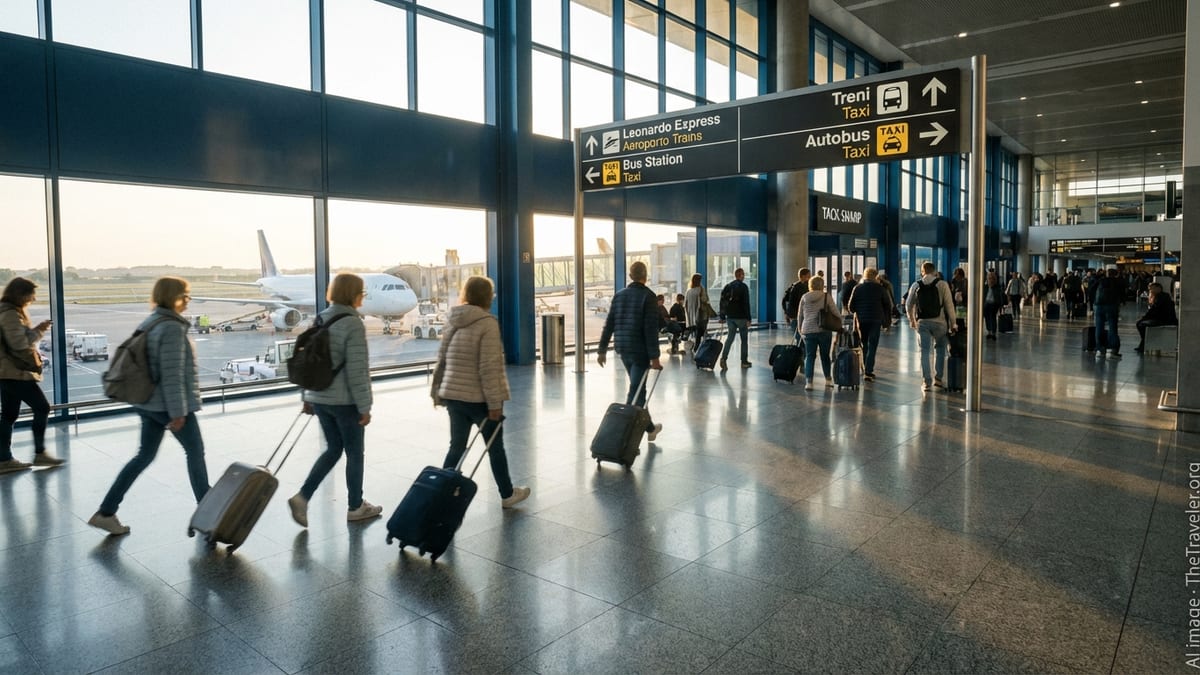
For most overseas visitors, Rome Fiumicino is the first point of contact with Italy. The airport has its own railway station integrated into the terminal complex, offering the Leonardo Express non-stop service direct to Roma Termini, the city’s central railway hub. The journey takes around half an hour and trains typically depart several times per hour throughout the day, making it a fast and predictable option. Tickets are sold through machines and staffed counters in the station area and can also be purchased digitally in advance; validation rules depend on the type of ticket, so check instructions carefully before boarding.
In addition to the Leonardo Express, regional FL1 trains link Fiumicino with several key stations in Rome, such as Trastevere, Ostiense, and Tiburtina. These trains are slower and usually involve a change if you are heading to Termini, but they are generally cheaper and can be more convenient if your accommodation is closer to their intermediate stops. During busy commuter periods they can be crowded, and luggage space is more limited compared with the dedicated airport service, so this option suits independent travelers who are comfortable navigating local rail networks.
Buses and licensed taxis round out the transfer options at Fiumicino. Fixed-fare taxis to central Rome operate from official ranks outside the terminals; using only marked white city taxis with a clearly visible license number on the side and roof is important, as unofficial drivers still occasionally approach arriving passengers. Several shuttle bus companies also run to Termini and other central locations, typically taking longer than the train but often at a lower cost. Journey times for road transfers vary significantly with traffic, especially during peak commuting hours or in the height of the tourist season.
Rome Ciampino, used heavily by low-cost carriers, has no rail station inside the airport. Instead, travelers connect via dedicated shuttle buses to nearby rail or metro stations or take direct coach services into central Rome. The airport is closer to the city than Fiumicino, so road journeys can be relatively quick in light traffic, but congestion on the approach roads is common during peak times. Since services at Ciampino are more limited in number and frequency, checking last departure times in advance is particularly important for late-evening arrivals.
Milan’s Airports: Malpensa, Linate, and Bergamo
Milan is served by three main airports, each with distinct transfer patterns. Malpensa, to the northwest of the city, is the principal long-haul gateway and can feel deceptively remote to first-time visitors. The most efficient way into central Milan for many travelers is the dedicated Malpensa Express train, which links both airport terminals with key stations including Milano Centrale and Cadorna. Journey times are typically around 50 minutes to Centrale, and trains normally run multiple times per hour. Services are designed with airport passengers in mind, with luggage space and clear departure screens, making them straightforward even for those unfamiliar with Italian rail.
Coach services from Malpensa to Milano Centrale and other stops offer a lower-cost alternative. Several companies operate on this corridor, with advertised journey times usually in the range of one to one and a half hours depending on traffic. Buses load directly outside the terminals and can be a good option for budget-conscious travelers or those arriving late at night when train frequencies taper. A free internal shuttle bus connects Malpensa’s terminals, allowing travelers to transfer between them around the clock, which is helpful if you are connecting between airlines that use different terminal buildings.
Linate Airport is significantly closer to Milan’s historic center, located to the east of the city. Recent improvements have strengthened its public transport links, with city buses and newer rail or metro connections providing relatively quick access to downtown areas and to Milano Centrale station. Taxis from Linate are generally faster than from Malpensa due to the shorter distance, though traffic conditions around the eastern ring roads can still cause delays at peak times. For business travelers or those on short city breaks, choosing flights into or out of Linate can noticeably reduce transfer times.
Bergamo Orio al Serio, widely marketed by low-cost carriers as an alternative Milan airport, is in fact closer to Bergamo than to Milan. Direct buses connect the airport with Milano Centrale, typically taking about an hour, while local buses and taxis provide quick access to Bergamo’s rail station. This airport can work well for travelers planning to visit the lakes or the Alpine foothills, but those with tight connections in Milan or onward high-speed trains should factor in the extra transfer time and the potential for motorway congestion, particularly on weekends and holidays.
Venice, Florence, Naples and Other Key City Airports
Airports serving Italy’s historic cities have their own transfer quirks, often shaped by geography. Venice Marco Polo Airport is a prime example. Located on the mainland opposite the Venetian lagoon, it offers a choice between standard land transfers and scenic water routes. Buses and taxis connect the airport with Piazzale Roma, the main road access point to Venice, in around 20 to 30 minutes in normal traffic. From there, visitors continue on foot or by waterbus into the car-free historic center. For a more direct but often pricier option, licensed water taxis and waterbus lines depart from docks a short walk from the terminal, reaching popular districts such as San Marco or Rialto.
Florence Peretola Airport is compact and relatively close to the city center. A dedicated tram line connects the terminal with the main railway station, Firenze Santa Maria Novella, usually in under half an hour. The tram runs at regular intervals and is often the fastest and most predictable route, avoiding the congestion that can build up on Florence’s narrow roads. Taxis and private transfers remain available and can be worth considering if you are traveling in a group, carrying heavy luggage, or staying in accommodation that is not easily reached on foot from the tram stops.
Naples International Airport, serving the wider Campania region and gateways to the Amalfi Coast and Capri, sits just outside the city. Shuttle buses link the terminal with central areas and the main station, Napoli Centrale, in roughly half an hour, though journey times can lengthen significantly with traffic. Taxis operate on a fixed-fare basis for certain city zones, which is useful for avoiding surprises at the end of the ride. As in other Italian cities, sticking to official taxi ranks and ignoring unsolicited offers helps ensure you are dealing with licensed drivers.
Elsewhere in Italy, airports such as Bologna, Pisa, Bari, Palermo, and Catania feature short light rail or shuttle bus connections into their respective centers and onward rail networks. Many of these routes have seen gradual improvements over the past several years, but they still operate with relatively limited late-night and early-morning schedules. Travelers catching early trains or flights should confirm first and last departure times the day before travel and allow for the possibility of delays or service changes, especially during adverse weather or transport strikes.
Choosing Between Train, Bus, Taxi and Rideshare
Deciding on the best transfer mode from an Italian airport depends on several factors: your arrival time, budget, luggage, group size, and familiarity with public transport. Dedicated airport trains, such as the Leonardo Express in Rome or the Malpensa Express in Milan, tend to be the quickest and most predictable options into city centers. They are especially attractive for solo travelers or couples with manageable luggage who want to avoid traffic and get directly to a major hub station, where they can connect to local trains, metro lines, or taxis.
Buses and coaches are generally the most economical choice and often provide direct connections to key downtown stops or central rail stations. They can, however, be vulnerable to congestion on arterial roads and ring roads, particularly at rush hour or during holiday travel peaks. For travelers arriving with significant jet lag or after long-haul flights, the prospect of navigating busy bus bays and variable timetables may be less appealing. In those cases, paying a little more for a train or taxi can be worthwhile simply for the reduced stress.
Taxis and prebooked private transfers offer door-to-door convenience and are ideal for families, small groups, or travelers with heavy baggage. Official taxi fares from major airports to central city zones are usually regulated, with fixed tariffs or metered rates published in the arrivals area. Prearranged transfers booked through reputable operators can sometimes be cost-competitive when costs are split among several passengers. Rideshare services operate in some Italian cities with varying rules, often focusing on prebooked journeys rather than spontaneous curbside pick-ups, so checking local regulations before relying on an app-based service is sensible.
When weighing all these options, think in terms of total journey time rather than distance alone. A train that appears slightly slower on paper might save time compared with a road-based transfer stuck in traffic. Similarly, a bus that drops you within walking distance of your accommodation could be more efficient than a train that requires additional metro or taxi connections. Flexibility is important: experienced travelers often have a primary plan and a backup in mind in case of delays, strikes, or last-minute schedule changes.
Inter-Airport and City-to-Airport Transfers for Connections
Italy’s airports are closely tied to the national rail grid, which means that many so-called air connections can be more efficiently handled as rail journeys. For example, travelers landing in Rome and continuing to Florence, Bologna, or Milan often find it faster to take a high-speed train from Roma Termini or Tiburtina rather than booking a separate domestic flight. Similarly, passengers arriving in Milan and heading for Venice, Verona, or Turin can often transfer by Malpensa Express to Milano Centrale and continue by high-speed rail, bypassing secondary airport connections altogether.
When actual inter-airport transfers are necessary, such as between Milan’s Malpensa and Linate airports or from Fiumicino to Ciampino in Rome, planning is essential. These routes typically rely on a combination of trains and buses or on dedicated shuttle coaches that operate on fixed schedules. Travel times can be substantial relative to the geographic distance due to traffic and the need to cross dense urban areas. Anyone attempting same-day flight connections that involve switching airports should allow a generous buffer of several hours and avoid tight layovers, especially in winter or during major trade fairs and events when traffic around Milan and Rome is particularly heavy.
For cruise passengers and those joining organized tours, specialized airport-to-port or airport-to-city transfers are common from hubs such as Rome, Venice, and Naples. These services, often bundled by cruise lines or tour operators, move groups between airports, rail stations, and cruise terminals on fixed timetables. While more expensive than independent arrangements, they reduce the stress of managing luggage and schedules alone, and operators typically adjust for moderate flight delays. Independent travelers replicating these routes should study port access options in advance, as some cruise terminals are located well away from city centers.
Travelers connecting between cities by air within Italy should also consider the impact of security screening and boarding procedures. For many domestic routes of a few hundred kilometers, the combined time of airport transfers, check-in, and security can rival or exceed the duration of an equivalent high-speed train journey. Rail stations, by contrast, are usually located in central districts and allow near-immediate boarding. Factoring in the cost and time of getting to and from airports often tilts the balance in favor of rail for medium-distance domestic legs.
Practical Timing, Ticketing and Luggage Tips
Successful airport transfers in Italy depend as much on small details as on big-picture planning. Timing is one of the most important considerations. Aim to be at the airport for outbound flights well in advance of check-in cut-offs, especially during the busy summer season and at major hubs like Rome Fiumicino and Milan Malpensa. When working backward from your flight time, allow not only for the published duration of your train or bus ride, but also for the time needed to buy tickets, walk between terminal areas, and clear security. Adding a safety margin of at least 30 to 60 minutes beyond the official transfer time can protect you from missed flights due to minor delays.
Ticketing practices vary between Italian transport providers. Some airport trains operate with tickets tied to specific departure windows, while others are more flexible within a given day. Paper tickets purchased from machines or kiosks often need to be validated in small stamping machines on the platform before boarding; inspectors regularly check for validation and can issue on-the-spot fines if it has been overlooked. Digital tickets purchased through official apps or operators’ websites typically do not require physical validation, but travelers should be ready to present the QR code or confirmation on request, even if offline.
Luggage handling is another important dimension. Dedicated airport trains and coaches usually provide reasonable space for suitcases near the doors or at the ends of carriages, but storage areas can fill up quickly at peak times. Keeping valuables and essentials in a small day bag that stays with you at your seat is prudent. On local buses, trams, and metro lines, luggage space is more limited, and large cases may be awkward during rush hour. In heavily touristed cities such as Venice and Florence, onward walking distances over cobblestones, bridges, or narrow streets can be significant, so packing light pays real dividends.
Finally, stay alert to service updates. Rail and bus operators in Italy sometimes adjust schedules at short notice due to maintenance, weather, or labor actions. Information screens and announcements at airports and stations will usually flag disruptions and suggest alternative routes. Keeping an eye on real-time information once you land and being prepared to switch from bus to train, or vice versa, if conditions change can transform an otherwise stressful experience into a manageable inconvenience.
The Takeaway
Italy’s airports are embedded in a dense web of rail and road connections that, with a little planning, can make transfers relatively smooth. Understanding the strengths of each major airport, from Rome Fiumicino’s dedicated Leonardo Express to Milan Malpensa’s express rail and Venice’s unique water transport, allows you to match your transfer strategy to your itinerary, budget, and comfort level. Thinking in terms of total journey time instead of just distance, and considering how airports connect to Italy’s high-speed rail network, can open up more efficient and often more enjoyable travel options.
The most important habits for stress-free transfers are simple: confirm the latest schedules before you travel, build generous time buffers into connections, use only official transport providers, and travel as lightly as practical. With these basics in place, moving between Italy’s airports, cities, and coastal resorts becomes less of a logistical hurdle and more of an integral part of the journey, giving you a first real taste of the country before you even reach your hotel.
FAQ
Q1. Which Italian airport is best to fly into for a first visit?
For a classic first-timer itinerary focused on Rome, Florence, and perhaps Naples, Rome Fiumicino is often the most convenient because of its long-haul connections and direct rail link to Roma Termini. For trips centered on northern Italy and the lakes, Milan Malpensa or Linate can be better gateways.
Q2. How much time should I allow to get from Rome Fiumicino Airport to central Rome?
The non-stop airport train typically takes a little over half an hour, but it is wise to allow at least 60 to 90 minutes from landing to reaching the city center, factoring in time for passport control, baggage claim, walking to the station, and buying tickets.
Q3. Is it worth prebooking airport transfer tickets in Italy?
Prebooking can be helpful for peace of mind in peak season or for late-night arrivals, especially for dedicated airport trains and some shuttle buses. However, tickets for many services can also be purchased easily on arrival, so prebooking is not strictly essential for most daytime arrivals.
Q4. Are taxis from Italian airports reliable?
Licensed taxis from official ranks at major airports are generally reliable and operate with regulated fares or published flat rates to key city zones. Problems arise mostly from unlicensed drivers who approach passengers inside terminals, so it is important to ignore unsolicited offers and use only marked taxi ranks.
Q5. What is the cheapest way to get from Italian airports into city centers?
In most cases, regular buses or regional trains are the least expensive options, though they may take longer and involve more walking or transfers. Dedicated airport coaches and some tram or metro lines also offer relatively low-cost links, especially compared with taxis or private transfers.
Q6. How do I handle luggage on Italian airport trains and buses?
Most airport trains and coaches have areas for suitcases near the doors or at carriage ends, but space can be limited during busy hours. Keeping important items in a small bag you can keep with you, and packing as lightly as possible, makes navigating platforms, steps, and crowded vehicles much easier.
Q7. What happens if there is a transport strike on the day I travel?
During official strike periods, some minimum services are usually guaranteed, particularly at peak times, but frequencies may be reduced and journeys extended. In such cases, it is important to monitor information screens, consider alternative modes such as taxis, and allow extra time for all transfers.
Q8. Is it better to connect between Italian cities by plane or by train?
For many domestic routes, high-speed trains are faster overall once you account for airport transfers, security, and boarding times. Trains also arrive in central locations, which can save money and time compared with secondary airports located far from city centers.
Q9. How far in advance should I arrive at Italian airports before departure?
For most short-haul European flights, arriving about two hours before departure is generally sufficient, while three hours is advisable for long-haul services. During peak summer or major holidays, adding another half hour can provide a useful buffer against queues at check-in and security.
Q10. Are rideshare apps widely available at Italian airports?
Rideshare availability varies by city and is often subject to local regulations, with some services focusing on prebooked trips rather than on-demand pickups. Travelers should check the current situation for their arrival airport in advance and always have a backup plan such as taxis, trains, or buses.