

Italy’s digital nomad visa, formally introduced in 2024, has quickly become a prominent option for non EU remote workers seeking a legal pathway to live in Italy while working for foreign employers or clients. However, the scheme is tightly regulated, aimed at highly skilled professionals, and implemented with notable variations between Italian consulates. This briefing analyzes the current requirements, income thresholds, and expected timelines to help prospective applicants assess whether the Italian digital nomad visa is a practical relocation route.
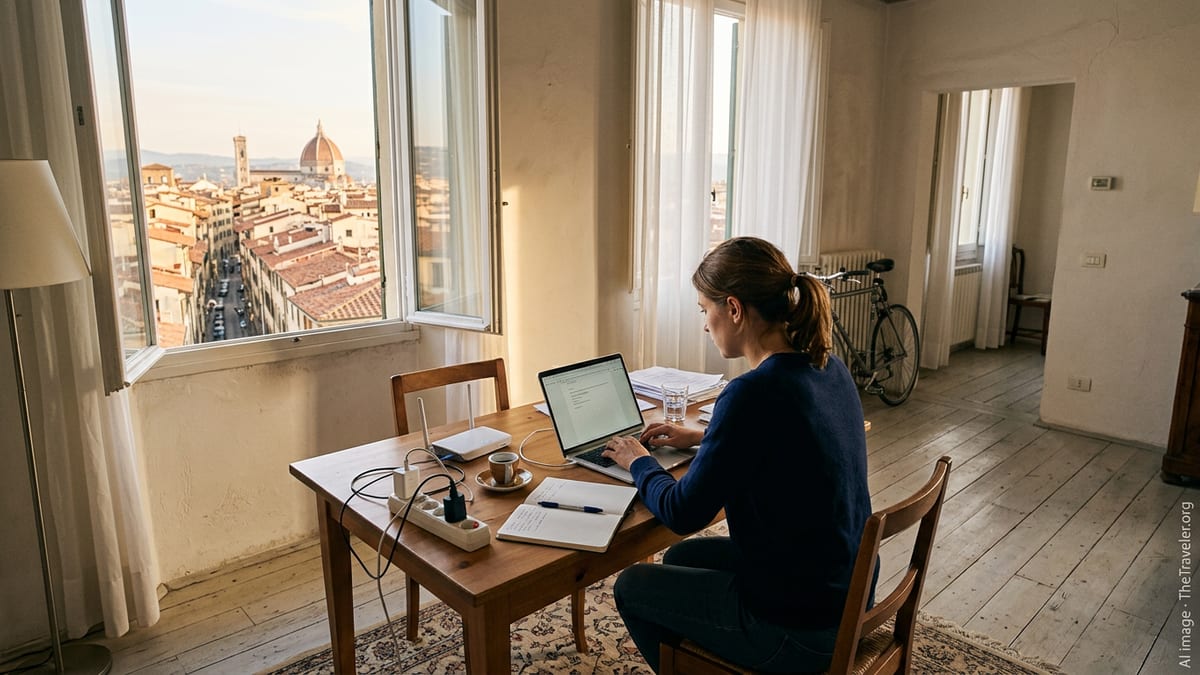
Overview of the Italy Digital Nomad Visa Framework
Italy’s digital nomad visa arises from a legislative provision adopted in 2022 and made operational by an implementing decree published in April 2024. The category typically appears on consular guidance as a “Digital Nomad / Remote Worker” visa and is intended for non EU nationals who perform location independent, highly skilled work for foreign employers or as freelancers with foreign sourced income. The status is distinct from tourist stays and traditional work permits and is designed to enable residence in Italy without accessing the domestic labor market.
The visa is generally issued as a national long stay visa with an initial validity of up to 12 months, renewable in country if the underlying conditions continue to be met. Specialist immigration sources indicate that the program sits outside Italy’s annual labor quota system, which removes one common bottleneck seen in other work based routes and makes availability more predictable year to year.
As of early 2026, Italian consulates in major jurisdictions such as the United States and the Gulf region actively process digital nomad applications, though documentation checklists and practical interpretation of rules can differ significantly from one mission to another. Applicants must therefore treat official guidance from their specific consulate of jurisdiction as the operational rule set, within the overall national legal framework.
The visa is aimed at “highly specialized” professionals rather than casual remote workers. This positioning has direct consequences for the eligibility criteria, income expectations, and evidentiary burden that applicants must satisfy.
Core Eligibility and Professional Requirements
To qualify for Italy’s digital nomad visa, applicants must demonstrate that they are highly skilled remote workers or freelancers conducting their activities primarily through digital means while physically based in Italy. The work itself must be for an employer established outside Italy or for foreign clients; the scheme is not designed for individuals seeking to work for Italian employers or to provide services principally to the Italian market.
Consular and ministerial guidance requires evidence of “highly qualified” status, often by cross reference to the categories listed in Italian immigration law for special skilled workers. In practice, applicants are normally expected to meet at least one of the following: a university level degree relevant to the current role; a post secondary professional qualification of at least three years; or several years of demonstrable professional experience in a field aligned with the proposed remote activity. Some consulates cite thresholds such as five years of sector specific professional experience, or three years for certain ICT or managerial profiles.
Another recurring operational criterion is proof of prior remote work practice. Implementing rules and commentary often refer to at least six months of experience as a digital nomad or remote worker before the application date. This can typically be evidenced through employment contracts that specify remote work, client service agreements, or documented history of freelance engagements conducted online, complemented by bank statements or invoices that corroborate sustained remote income.
Applicants must not have criminal records that would be considered a threat to public order or security, and consulates routinely require recent police clearance certificates from all countries of residence during a specified look back period. Additionally, the work arrangement must be technically compatible with remote performance; roles that inherently require in person presence in another jurisdiction may be scrutinized or deemed unsuitable.
Minimum Income Thresholds and Financial Evidence
Income requirements are a central feature of Italy’s digital nomad visa. The national decree stipulates that applicants must earn an annual income not less than three times the minimum amount set for exemption from healthcare cost participation in the Italian social system. In practice, this calculation currently aligns with a minimum annual income figure in the mid twenty thousands of euros. Several Italian consulates explicitly reference a minimum around 24,789 euros per year, while other advisory sources cite practical target ranges up to approximately 28,000 to 30,000 euros to create margin above the legal baseline.
Applicants should treat the legal minimum as a floor rather than a target. Because consular officials assess financial sufficiency and stability, profiles showing significantly higher income are more competitive, particularly for applicants supporting dependants. While there is no universally published family supplement table, many consulates informally expect proportionally higher income if spouses or children are included on the application or will later apply for family reunification.
Income must come from lawful, traceable sources and be compatible with remote work. For employees, consulates typically request an employment contract confirming ongoing engagement, job description, salary level, and explicit authorization to work remotely from Italy. Pay slips and recent bank statements demonstrating salary deposits over several months are standard supporting documents. For freelancers, evidence often includes client contracts, invoices, proof of business registration where applicable, and bank statements showing consistent revenue flows.
Because income thresholds are indexed and consular practice evolves, applicants should verify the currently applied minimum income at their specific consulate shortly before filing and plan for a conservative buffer above that figure. Under declaring or relying on borderline figures increases the risk of refusal, especially in posts that see high application volumes.
Supporting Documentation and Health Insurance Requirements
In addition to professional and financial criteria, Italy’s digital nomad visa requires a robust documentation package. While exact lists differ slightly among consulates, several elements are systematically requested. A valid passport with sufficient remaining validity, recent passport sized photographs, and a completed national visa application form create the core identity set. Applicants must also provide a detailed curriculum vitae, supporting the claim of highly skilled status and aligning with the evidence of qualifications and work experience.
Proof of accommodation is a recurrent condition and can be a practical challenge. Consulates often require either a registered lease agreement, property ownership evidence, or in some cases a hotel or temporary housing booking that covers at least the initial period after arrival. Some posts accept a formal hospitality declaration from an Italian resident. Where a lease is required, it may need to be registered with the Italian tax authorities, which can create sequencing issues for applicants who have not yet entered Italy. Local practice differs, so it is essential to follow consular instructions precisely.
Comprehensive health insurance covering the entire intended stay in Italy is mandatory at the visa stage. The policy must generally provide coverage for medical expenses and emergency hospitalization in Italy, with minimum coverage levels in line with Schengen long stay norms. Many consulates insist on private international health insurance valid throughout the Schengen area and specifically mentioning Italy, valid for at least the duration of the visa. Once resident, some digital nomads may later access local healthcare options, but this lies outside the visa issuance process and should not be assumed as a substitute for initial private coverage.
Additional documents frequently requested include: recent criminal background checks from countries of residence, marriage or birth certificates for accompanying family members, and, in some jurisdictions, letters of explanation or motivation describing the nature of remote work and reasons for choosing Italy. All foreign documents often must be legalized or apostilled and accompanied by certified translations into Italian according to consular specifications.
Application Procedure and Realistic Timelines
Applications for Italy’s digital nomad visa must be lodged at the Italian consulate or embassy with jurisdiction over the applicant’s place of legal residence. Many consulates use online appointment systems, and in popular jurisdictions it can take weeks or months to obtain a suitable timeslot. Given the relative novelty of the visa type and uneven publication of guidance, applicants should factor in lead time to clarify requirements and compile documents before the appointment date.
Consular submissions are generally made in person, although some posts allow or require postal submissions in limited cases. At the appointment, officials will verify documentation, collect biometric data if applicable, and receive the non refundable visa fee, which for long stay visas typically falls in the low one hundred euro range. Applicants may be asked targeted questions about their work, income sources, and plans in Italy. Incomplete documentation is a common reason for delays, so aligning precisely with the local checklist is critical.
Once the file is formally accepted, official sources and practitioner reports indicate that government processing times for the digital nomad visa are usually up to around 90 days, although decisions can be faster in straightforward cases or slower where additional verifications are needed. There is no premium processing option. Applicants should avoid committing to fixed move dates or non refundable housing arrangements in Italy until the visa is approved and stamped into the passport.
After arrival in Italy, digital nomad visa holders must complete in country formalities to obtain a residence permit (permesso di soggiorno). This typically includes filing an application within eight working days of entry, attending a biometrics appointment at the provincial police headquarters, and later collecting the residence card. These steps fall on a separate timeline from the initial visa and can add several weeks before full documentation is in hand.
Validity, Renewal, and Family Member Considerations
The Italian digital nomad visa is typically issued with an initial validity of up to one year. The corresponding residence permit, once issued in Italy, reflects this duration. Renewals are generally possible if the holder continues to meet the key criteria: ongoing highly skilled remote work for foreign entities, sufficient income at or above the indexed threshold, adequate accommodation, and valid health coverage. Renewal procedures are carried out in Italy directly with the immigration authorities and involve updated documentation similar to the initial application.
Several legal and advisory sources confirm that eligible family members, such as spouses and dependent children, can be included in the relocation plan. In some cases, they may be added to the original visa application; in others, they may apply later through family reunification channels linked to the principal digital nomad permit holder. Although public debate in late 2024 created uncertainty around potential waiting periods for family members of digital nomads, subsequent legal interpretation has reaffirmed the possibility of relatively prompt family reunification when statutory conditions are met.
Family members are not required to perform remote work themselves and typically receive residence permits tied to the primary holder’s status. They must, however, meet their own documentation requirements, including passports, civil status documents, and health insurance, and the principal applicant’s income must be sufficient to support them under Italian immigration standards. Because practice can diverge between local immigration offices, families should engage early with competent authorities or advisors in the intended province of residence to confirm expectations for renewal and family documentation.
It is important to note that the digital nomad visa is not inherently a direct pathway to permanent residence or citizenship, although time spent in Italy with legal residence can count toward long term residence eligibility if continuity, registration, and other conditions are observed. Individuals whose long term objective is settlement rather than a medium term remote work stay should take separate advice on Italy’s broader immigration and nationality rules.
Key Practical Risks, Constraints, and Planning Considerations
Although the Italian digital nomad visa appears attractive due to its relatively moderate income requirement compared with some competing European programs, it carries specific risks and constraints that applicants should factor into relocation planning. The most notable is the degree of discretion and variability in consular implementation. Different consulates may interpret “highly skilled” status, acceptable income evidence, and accommodation requirements differently, resulting in divergent experiences for applicants with similar profiles.
Processing times are another critical consideration. While the official guidance frequently refers to a maximum of around three months, actual timelines can fluctuate depending on consular workload, complexity of background checks, and coordination with Italian authorities. Applicants with fixed employment start dates, school enrollment schedules for children, or property transactions may need to build in generous buffers and avoid compressing their timelines.
Documentation intensity is also higher than some anticipate. Remote workers accustomed to informal arrangements may find that Italy’s digital nomad visa expects formalized, contract based work relationships, clear invoicing, and comprehensive financial records. This may require pre application restructuring of how work is documented and paid, particularly for freelancers using multiple platforms or clients. Aligning contracts to explicitly authorize remote work from Italy can materially strengthen an application.
Finally, applicants should be aware that the visa has an explicit focus on foreign sourced income and non participation in the Italian labor market. Those intending to build a client base in Italy or to be employed by Italian companies may not fit well within this visa category and might need to explore alternative routes. Attempting to use the digital nomad status for activities beyond its intended scope can create compliance risks at renewal or during in country checks.
FAQ
Q1. Who is the Italy digital nomad visa designed for?
The visa targets non EU nationals who are highly skilled professionals working remotely for foreign employers or clients, and who wish to reside in Italy while continuing that foreign based work.
Q2. What is the minimum income required to qualify?
The legal threshold is tied to three times a reference minimum income used in Italy’s social system, which currently translates into a required annual income in the mid twenty thousands of euros; applicants are advised to exceed this baseline for a stronger case.
Q3. Does freelance work qualify, or is it only for employees?
Both employees and freelancers can qualify if they can document stable foreign sourced income and a work setup that is fully compatible with remote execution from Italy.
Q4. How long is the digital nomad visa valid?
The visa is generally issued for up to one year initially, with an associated residence permit in Italy; renewals are possible if all eligibility conditions remain satisfied.
Q5. How long does the application process usually take?
From consular appointment to decision, applicants should plan for typical processing times of up to about 90 days, though some cases may be faster or slower depending on the consulate and file complexity.
Q6. Is health insurance mandatory for this visa?
Yes, applicants must present comprehensive health insurance covering medical treatment and emergencies in Italy for at least the entire intended stay at the time of the visa application.
Q7. Can family members accompany the principal applicant?
Eligible family members such as spouses and dependent children can generally relocate, either by being included in the initial application or through family reunification linked to the digital nomad residence permit.
Q8. Is this visa subject to Italy’s annual immigration quotas?
No, the digital nomad visa is structured outside the standard annual quota system, meaning availability is not capped in the same way as many traditional work permits.
Q9. Can digital nomad visa holders work for Italian companies?
The visa is intended for work carried out for employers or clients based outside Italy; using it to perform work for Italian entities may conflict with the scheme’s conditions and create compliance issues.
Q10. Does time spent on the digital nomad visa count toward long term residence?
Time spent in Italy with a valid residence permit under this scheme can, in principle, contribute toward long term residence eligibility, provided other legal conditions such as continuous residence and integration requirements are met.