

Italy offers an attractive long-term base for many international professionals, yet its administrative landscape is frequently perceived as intricate and slow-moving. A relocation complexity score for Italy seeks to quantify how difficult it is for an expat to navigate core public-facing processes after arrival, from registering residence to interacting with municipal and national systems. Understanding what drives this score helps organisations and individuals assess how much time, support, and risk-buffer they should plan for when considering a move to Italy.
Defining Italy’s Relocation Complexity Score
In relocation analytics, a relocation complexity score captures how challenging it is to complete key settlement procedures in a country. For Italy, this score is driven less by the legal rules themselves and more by how those rules are administered in practice across multiple layers of government. The score aggregates factors such as the number of offices involved, typical processing times, predictability of outcomes, and the degree of digitalisation versus in-person requirements.
From a comparative standpoint, Italy performs as a mid-range to moderately complex destination. World Bank regulatory efficiency data place Italy in the low- to mid-70s (out of 100) on ease of doing business style indicators, with room for improvement in dispute resolution and administrative efficiency. At the same time, World Governance Indicators on government effectiveness show Italy in the middle of the EU pack rather than among the top performers. These benchmarks align with expat feedback that procedures are usually possible to complete, but often require more follow-up and time than initially expected.
For an expat, Italy’s relocation complexity score therefore reflects a combination of systemic issues: fragmented responsibilities between municipal offices, police headquarters and consulates; limited standardisation across regions; and partial adoption of digital tools. The practical result is that the same statutory process can feel straightforward in one city and highly unpredictable in another, which is a defining feature of Italy’s relocation risk profile.
Relocation planners typically translate this complexity into operational assumptions. For example, they may recommend adding several weeks of buffer to expected timelines for residence registration and associated documentation. They may also budget for on-the-ground support to manage in-person visits to offices, local language interactions, and document follow-up. These adjustments are part of how the abstract complexity score becomes a practical planning tool.
Core Bureaucratic Drivers of Complexity
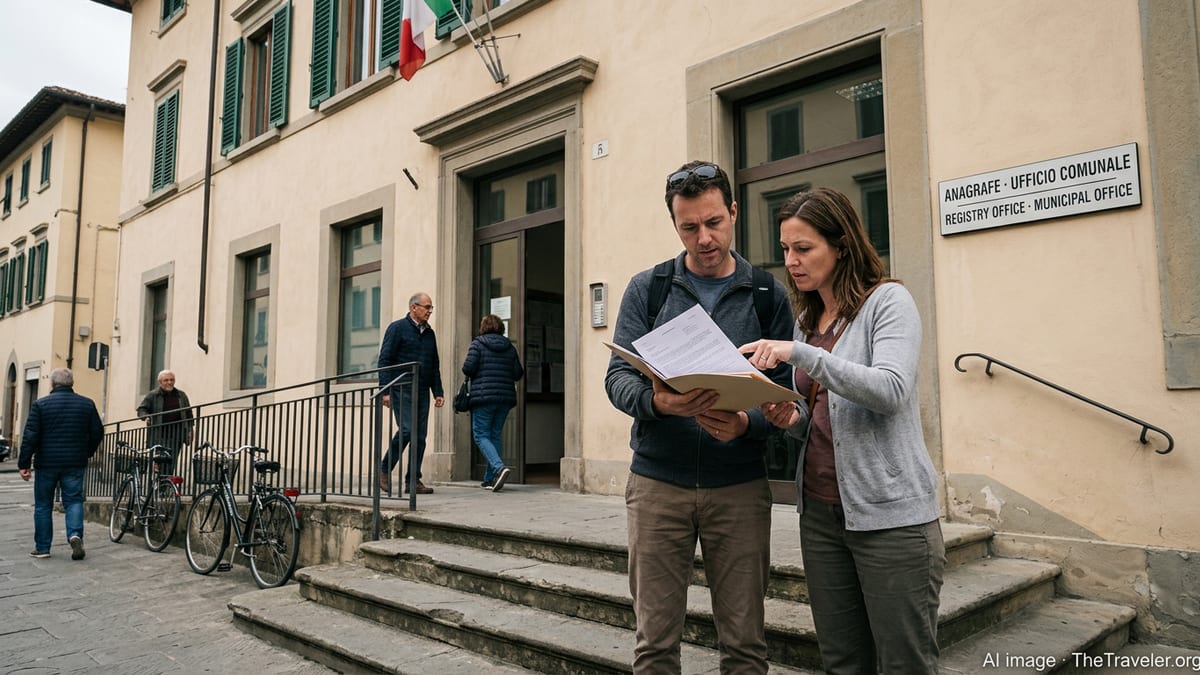
Italy’s relocation complexity is dominated by how basic population registration and related procedures are organised. The municipal registry office, the anagrafe, records residence changes, while immigration-related residence permits are usually handled at the provincial police headquarters, the questura. Each body operates under national law but with local practices and workloads that significantly influence the experience for new arrivals.
Registration with the municipal anagrafe is mandatory for residents, and external analyses describe it as a cornerstone of Italy’s administrative system. The anagrafe manages data that affect access to local services, municipal taxation and in some cases downstream rights such as naturalisation. However, processing times vary considerably. Specialist relocation sources note that smaller towns may process a residence registration in a day, while larger municipalities can take several weeks. Seasonal slowdowns, especially mid-summer and late December to early January, add further unpredictability.
In parallel, expats subject to immigration control must obtain or renew a residence permit. Legal practitioners report that, as of 2026, residence permit processing times are highly sensitive to local questura workloads, with delays described as “more unpredictable than ever” in some provinces. While national regulations foresee decisions in a matter of months, practical experiences range widely, and it is not uncommon for applicants to wait many months for final issuance when backlogs build.
Italy’s multi-layered governance structure amplifies these effects. OECD analyses emphasise that overlapping responsibilities and varied administrative capacity between levels of government continue to limit overall public sector effectiveness. For expats, this translates into the need to coordinate between offices that do not always share information seamlessly, requiring individuals or their advisors to actively manage each file rather than relying on automatic inter-agency communication.
Digitalisation and the Impact on Administrative Burden
Digitalisation is a major modifier of Italy’s relocation complexity score. Italy has made progress in centralising population data through the National Register of Resident Population (ANPR), which since 2022 has integrated thousands of municipal registries into a single national database. In theory, this consolidation reduces duplication and speeds up information exchange when residents move within Italy or register from abroad.
In practice, usage of digital public services in Italy remains relatively low compared with other EU states. Recent European analyses show that around half of Italian residents use e-government services, placing Italy among the lower-performing countries in the bloc. The key issue for expats is that many core procedures still require in-person appointments, original documents, and paper forms, even when online portals exist for initial filings or status checks.
For Italians living abroad, digital tools such as the FAST-IT portal and online consular booking systems have improved access to services related to the AIRE register of Italians resident overseas. However, multiple reports and official notices from consulates emphasise that backend processing still depends on coordination between consulates and the relevant comune in Italy. Where a municipal office is understaffed or slow to respond, digital front-ends cannot fully eliminate delays.
From a scoring perspective, this partial digitalisation moderates but does not resolve complexity. Italy benefits from having a national digital identity infrastructure and integrated registries, which reduces the risk of outright data loss. However, limited online completion of end-to-end processes, relatively low digital uptake in the population, and persistent reliance on physical appointments sustain a medium-to-high complexity profile for newly arriving expats who are unfamiliar with the system.
Residence Registration and Registry Interactions for Relocating Expats
While this article does not evaluate visa policy itself, residence registration after entry is a central input to Italy’s relocation complexity score. The anagrafe procedure typically requires proof of housing (such as a registered lease or ownership deed), identification documents, and in some cases evidence of lawful stay. Municipal staff may then request a home visit by local police to verify actual residence before finalising the record.
Italian guidance and practitioner commentary suggest that residence registration should be completed within about 45 days in normal circumstances. Nonetheless, larger cities and periods of high demand often stretch these timelines. Expats report that in some urban municipalities the period between application and final confirmation can extend beyond the standard, especially when documentation is incomplete or internal coordination is slow.
The registry also plays a critical role in downstream procedures that matter for long-term expats, such as naturalisation. A recent decision by a regional administrative court clarified that, for citizenship by residence, only formal registration in the municipal registry counts toward the required residence period, not alternative proofs such as work contracts or utility bills. This heightens the importance of timely and accurate registry entries and underscores how bureaucratic slippage can have multi-year consequences for status transitions.
For Italians abroad, the AIRE system adds another layer. Official communications from the Italian government stress that AIRE registration is a legal duty and a condition for access to many consular services. Legislative changes at the end of 2023 introduced stricter enforcement and potential sanctions for failure to register when relocating abroad. While these rules target Italian citizens rather than foreign expats, they illustrate the centrality of registries in Italy’s administrative model and the potential for penalties when registry obligations are not met.
Regional Disparities and Local Discretion
Italy’s relocation complexity score is strongly influenced by regional and municipal disparities. OECD and national assessments of public administration regularly highlight differing capacities across territories, with some regions operating more efficient and better-resourced offices than others. These disparities reflect variations in staffing, digital investments, management practices and local demand pressures.
For expats, this means that experiences differ markedly by destination. Smaller municipalities often deliver faster processing for anagrafe registrations and routine certificates thanks to lighter caseloads, while major metropolitan areas can experience pronounced delays. User accounts frequently describe short turnaround times in provincial towns contrasted with multi-week or even multi-month waits in large cities where backlogs accumulate.
Local discretion further shapes the complexity landscape. Municipal offices maintain some interpretative leeway on document formats, acceptable proofs of address and sequencing of steps. For example, certain comuni may accept a broader range of tenancy documentation or host declarations, whereas others insist on formally registered leases before initiating registry procedures. Immigration offices at the provincial level may likewise adopt stricter or more flexible practices in appointment scheduling and document scrutiny.
This heterogeneity increases planning risk for organisations relocating staff to Italy. A national-level view might suggest a medium level of complexity, but project managers must factor in the specific local environment. Relocation providers commonly adjust support levels based on destination city, with higher-touch case management recommended for high-volume urban centres where queuing systems, appointment scarcity and language barriers compound administrative complexity.
Governance Quality, Transparency and Predictability
Broader governance indicators help contextualise Italy’s relocation complexity score. World Bank government effectiveness measures place Italy around the global median among advanced economies, indicating moderate capacity to formulate and implement public policies. The OECD’s reviews of Italy’s public sector underscore ongoing challenges related to overlapping mandates, slow decision-making and limited performance management across administrative bodies.
Transparency mechanisms partially offset these weaknesses. Italy has progressively strengthened access to administrative documents and transparency requirements since the 1990s, culminating in a framework that formally allows individuals to request information and challenge administrative inaction. In the context of relocation, this creates channels for legal recourse when files remain unresolved for extended periods, although exercising these rights usually requires Italian-language legal support and time.
Perceptions of corruption and informality historically contributed to a sense of unpredictability in Italian bureaucracy. International surveys have documented concerns among business executives regarding bureaucratic inefficiency and burdensome regulations in Italy. However, more recent assessments show gradual improvement in corruption perception scores, suggesting a trend toward cleaner administration even if day-to-day inefficiencies remain.
For expats, governance quality translates less into outright denial of rights and more into waiting time, repeated document submission and the need for proactive follow-up. Italy is generally seen as a rule-bound system where outcomes are achievable but often delayed. As a result, the relocation complexity score reflects moderate institutional reliability combined with high procedural friction.
The Takeaway
Italy’s relocation complexity score can be summarised as medium to moderately high for expats, with the primary drivers located in administrative practice rather than in formal legal barriers. Core interactions with the municipal registry and immigration authorities are governed by clear rules but are subject to variable implementation across regions and over time.
Digital reforms such as the national population registry and consular portals have reduced some historical pain points, yet partial adoption and persistent reliance on in-person procedures mean that expats still face non-trivial administrative burdens. Residence registration timelines, registry-based eligibility for long-term statuses and local disparities in processing capacity all contribute to the overall score.
For organisations and individuals evaluating a move to Italy, the implication is not that relocation is impractical, but that it requires conservative planning. Allowing for extended timelines, anticipating multiple office visits, and securing experienced local assistance where possible can significantly reduce the operational impact of Italy’s administrative complexity. Used in this way, the relocation complexity score becomes a strategic tool for aligning expectations with on-the-ground realities.
FAQ
Q1. Why is Italy often considered administratively complex for expats?
Italy’s complexity stems from multiple offices involved in each process, variable local practices, and partial digitalisation, which together lead to longer and less predictable timelines.
Q2. Does Italy’s relocation complexity score mean relocation is not recommended?
No. The score indicates that more time and active management are required, not that relocation is unfeasible. With planning, most procedures can be completed successfully.
Q3. How much do regional differences affect Italy’s relocation complexity?
Regional and municipal differences are significant. Smaller towns can process registrations quickly, while major cities often experience delays due to higher caseloads and capacity constraints.
Q4. Has digitalisation reduced Italy’s relocation complexity for newcomers?
Digital tools and national registries have improved data sharing and some front-end processes, but many key steps still require in-person visits, limiting the overall reduction in complexity.
Q5. Which administrative touchpoints influence the complexity score the most?
Residence registration at the municipal registry, interactions with immigration offices for residence permits, and coordination between consulates and comuni are the main contributors.
Q6. How predictable are processing times for core relocation procedures in Italy?
Statutory frameworks exist, but practical processing times vary widely by location and season. Organisations usually build in generous time buffers to manage this uncertainty.
Q7. Does Italy’s government effectiveness rating correlate with expat experiences?
Italy’s mid-range government effectiveness aligns with expat reports that procedures are usually possible but often slow and administratively heavy.
Q8. Are there legal remedies if Italian offices take too long to process a case?
Yes. Transparency and administrative law frameworks allow formal complaints and, in some cases, legal appeals, though using these tools typically requires local legal support.
Q9. How does Italy compare with other EU countries on digital public services?
Italy performs below many EU peers in terms of regular use of digital public services, which contributes to ongoing reliance on paper-based and in-person procedures.
Q10. What practical steps reduce the impact of Italy’s relocation complexity?
Early document preparation, realistic timeline planning, use of digital portals where available, and professional local support can greatly mitigate the practical impact of complexity.