

More news on this day
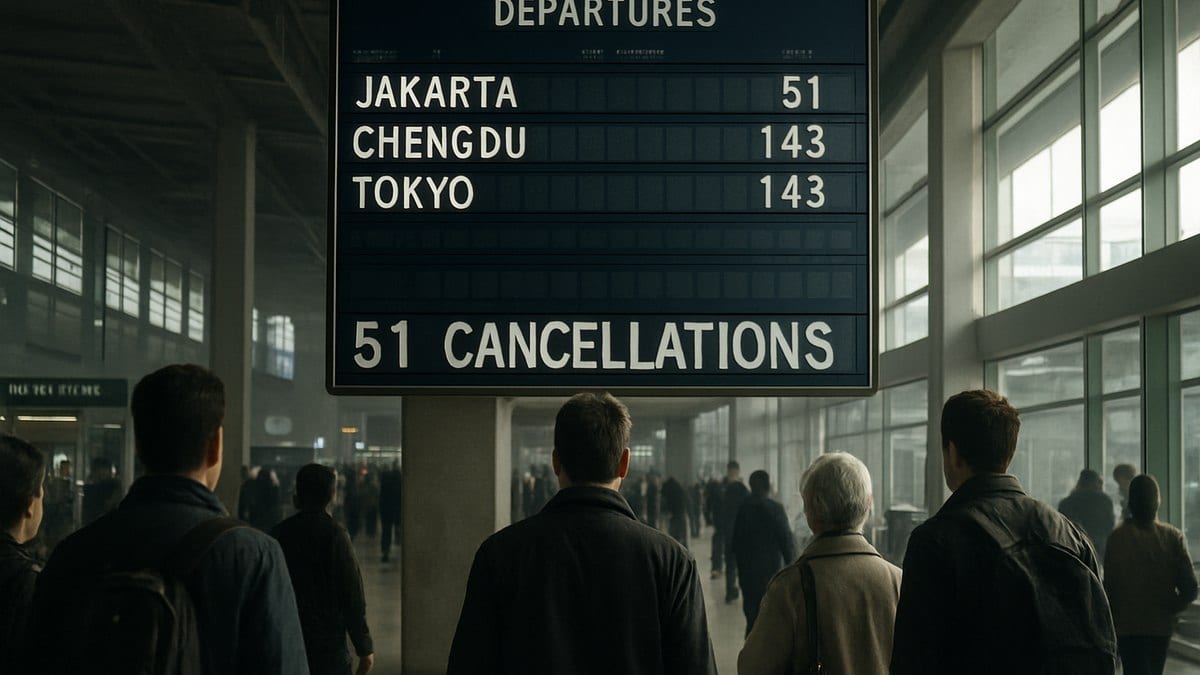
Fresh data on Asian air travel disruption indicates that flights passing through Jakarta, Chengdu and Tokyo have recorded 51 cancellations and 143 delays in a single operating cycle, underscoring continued pressure on some of the region’s busiest aviation hubs.
Get the latest news straight to your inbox!
Key Asian Hubs Grapple With Fresh Wave of Disruptions
The latest snapshot of flight operations across Jakarta, Chengdu and Tokyo points to a concentrated wave of cancellations and delays at three airports that collectively handle tens of millions of passengers each year. Publicly available tracking dashboards show that, within one recent peak travel window, 51 scheduled services were cancelled outright while a further 143 operated behind schedule.
The pattern reflects a broader uptick in operational strain across Asian hubs, where tight aircraft rotations and busy route networks leave limited room to absorb even short disruptions. Analysts note that when several busy hubs encounter issues at once, knock-on effects can spread rapidly along regional and long haul corridors, with late-arriving inbound aircraft triggering secondary delays on onward legs.
Although the volume of cancellations recorded at Jakarta, Chengdu and Tokyo is modest compared with major global disruption events, the imbalance between 51 cancellations and nearly three times as many delays underlines how airlines often attempt to preserve as much of the schedule as possible, even at the cost of longer ground times and revised departure slots.
Jakarta: Weather, Congestion and Tight Turnarounds
Jakarta’s main international gateway regularly ranks among the busiest airports in Southeast Asia, serving as a critical connector for domestic Indonesian traffic and international routes across the region. Recent operational data indicate that a share of the 51 cancellations and 143 delays can be traced to departures and arrivals involving the Indonesian capital, where adverse weather patterns and runway congestion periodically compress available operating capacity.
Indonesia’s tropical climate, with intense rain and low visibility during peak storm cells, can prompt temporary reductions in arrival and departure rates. When that happens during busy bank periods, flights are held on the ground or in holding patterns, pushing back departure times and cascading into delays for subsequent sectors that rely on the same aircraft and crew.
Industry assessments also point to the role of tight aircraft turnarounds at Jakarta, where busy domestic rotations link the capital to secondary cities. Any late inbound flight can make it difficult to dispatch the next leg on time, especially when additional checks are required or when ground handling teams are already stretched by peak-hour demand.
Chengdu: Rapid Growth Meets Operational Constraints
Chengdu has emerged over the past decade as a central hub for western China, with a fast-expanding network of domestic and international services. The city’s rise as an aviation center has coincided with strong passenger demand and dense scheduling, factors that can magnify the impact of even minor disruptions. Reports on recent operations show that a portion of the cancellations and delays tied to the wider region involved services routed through Chengdu.
Capacity at Chinese hubs has been under close scrutiny as airlines restore and in some cases expand route networks. At times of heavy demand, slot constraints, air traffic flow management measures and localized weather systems over interior China can slow departures and arrivals. When combined with long-haul connections and tight minimum connection times, such conditions can quickly translate into missed links and the need to rebook passengers on later services.
Published analyses of regional performance note that Chengdu’s role as both an origin and a connecting hub increases exposure to disruption. Late-running domestic flights feeding the airport can delay outbound departures, while any constraint on outbound traffic may leave arriving passengers facing extended waits for alternative options, especially on less-frequent international routes.
Tokyo: High-Density Operations Under Close Scrutiny
Tokyo’s airports, particularly Haneda and Narita, operate some of the densest schedules in the Asia Pacific region, combining high-frequency domestic services with a wide range of international flights. Operational reports suggest that Tokyo accounted for a share of the 51 cancellations and 143 delays affecting the three-city grouping, reflecting how small variations in capacity can ripple through a tightly choreographed schedule.
Seasonal factors, including periods of strong winds and low cloud over the Tokyo area, can require revised runway configurations and larger spacing between take offs and landings. Air traffic management initiatives aimed at maintaining safety margins occasionally reduce the maximum number of movements per hour, leaving airlines to adjust planned timings and, in some cases, to withdraw individual flights from the schedule.
Tokyo’s importance as a long haul gateway also means that delays at the city’s airports can have outsized consequences for passengers. A late departure on a transpacific or Europe bound service can disrupt onward connections for hours or even days, particularly when load factors are high and empty seats on alternative departures are limited.
What the Numbers Mean for Travelers
For passengers, the combination of 51 cancellations and 143 delays across Jakarta, Chengdu and Tokyo translates into missed meetings, disrupted holidays and unplanned overnight stays. Travel industry commentary highlights that, even when flights eventually operate, late departures can cause travelers to miss onward legs or arrive at their destinations well outside planned timeframes, adding costs for accommodation, meals and ground transport.
Recent guidance from travel advisers emphasizes practical steps to manage this environment, including building additional time into itineraries that use multiple Asian hubs, favoring slightly longer layovers to create a buffer, and monitoring flight status closely via airline apps and flight tracking services. Travelers are also encouraged to familiarize themselves with the conditions of carriage and any applicable passenger protection rules in the jurisdictions they are flying through.
While the figures from Jakarta, Chengdu and Tokyo represent a snapshot rather than a sustained shutdown, they highlight a pattern of intermittent but impactful disruption that has characterized parts of the global aviation recovery. With demand remaining strong and many airlines operating near capacity, similar waves of cancellations and delays are likely to recur, keeping pressure on both carriers and airports to refine schedules, invest in resilience and provide clearer information to those in transit.