

More news on this day
Japan is moving to ban the in-flight use of power banks across flights to, from and within the country from April 2026, as aviation regulators respond to a rising number of battery-related fire incidents and urge travelers to follow new safety guidelines in the cabin.
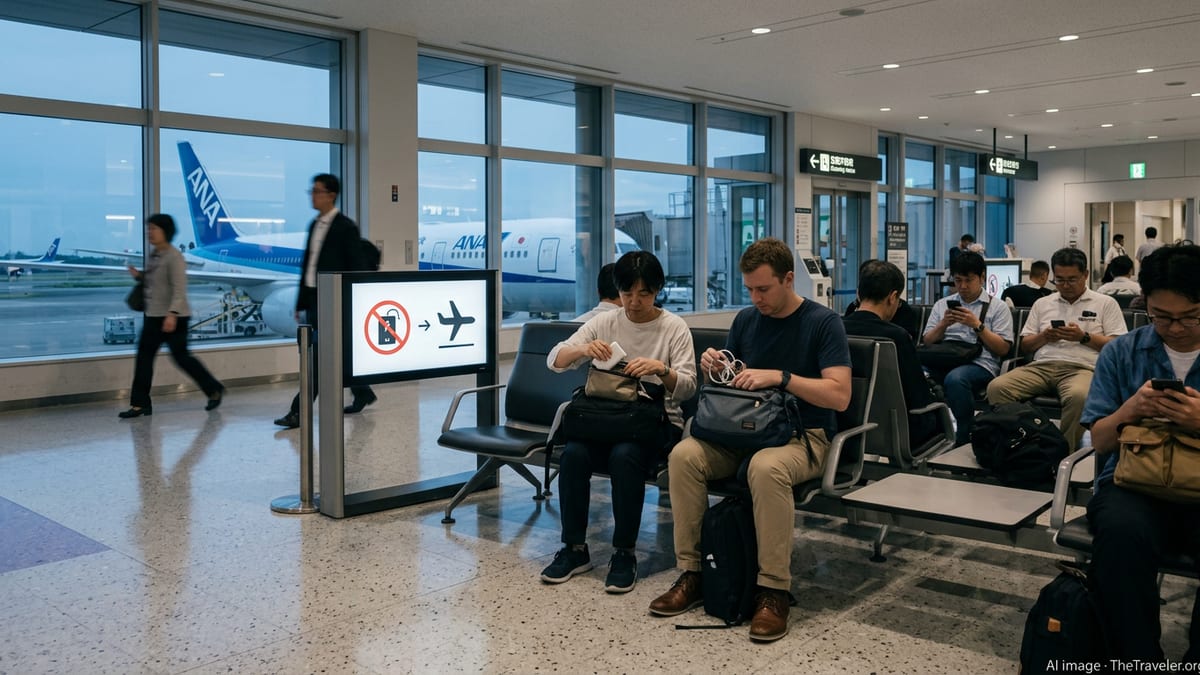
New Nationwide Rules Limit Power Banks in the Cabin
Japan’s Ministry of Land, Infrastructure, Transport and Tourism has formally notified airlines that power banks will soon face the strictest controls yet in domestic aviation. From mid-April 2026, passengers on Japanese carriers will no longer be allowed to use power banks in flight, whether to charge personal devices or to recharge the battery packs themselves. The devices must remain switched off and stowed safely throughout the journey.
The new regime also introduces a cap on how many mobile batteries travelers can bring into the cabin. Most passengers will be limited to two spare lithium batteries in total, including power banks and loose camera batteries, within existing international watt-hour limits. Until now, many Japanese airlines allowed multiple small power banks in hand luggage as long as they were under 100 watt-hours each.
While the detailed enforcement language is framed as a tightening of safety guidance, Japanese airlines have indicated they will treat the measures as mandatory operational rules. That effectively means that by the northern spring travel season next year, carrying more than two power banks or plugging one in during flight on a Japanese-operated service will no longer be an option.
Checked baggage rules will remain unchanged: power banks and other spare lithium-ion batteries are prohibited in checked luggage and must be carried in the cabin, where crew can respond quickly if there is smoke or overheating.
Fire Incidents Drive Concern Over Lithium-Ion Devices
The clampdown follows a string of high-profile incidents worldwide in which lithium batteries have been suspected or confirmed as the source of smoke or fire in aircraft cabins. Investigations into several recent events in Asia highlighted power banks stowed in overhead bins or seat pockets as possible ignition points, reinforcing regulators’ worries about how these devices are handled in crowded cabins.
Japanese officials have pointed in particular to cases where smoke filled the cabin after a power bank overheated in an overhead compartment, forcing emergency evacuations and causing injuries. Although no fatalities were reported, such events underline how even a small device can pose a disproportionate risk in a confined space at altitude.
Global aviation bodies have been tracking the trend for years, noting that lithium battery incidents on passenger aircraft have risen sharply in step with the explosive growth in personal electronics. Japan’s decision to move ahead with a comprehensive ban on in-flight power bank use positions it among the most conservative regulators on this issue, and aligns with emerging United Nations aviation guidance on managing battery fire risk.
For airlines, the new rules are also about clarity. Carriers say that drawing a bright line between permitted carriage and prohibited use makes it easier for crew to spot and stop unsafe behavior, rather than relying on more nuanced warnings that many travelers ignore once seated.
What Travelers Flying to and Within Japan Need to Know
For international visitors, the headline message is straightforward: power banks are still allowed in carry-on bags on Japanese-operated flights, but you will soon be unable to use them in the air. Travelers planning long-haul journeys to or from Japan in 2026 should factor in that their phones and tablets must rely on internal batteries or seat power, if available.
Passengers will also need to be more disciplined about how many spare batteries they pack. Bringing multiple compact power banks for different family members or devices may not be permitted once the two-unit limit comes into force, and security staff or gate agents will have authority to remove excess batteries before boarding.
Airports and airlines say they will step up communication ahead of the change. Expect more prominent warnings during online booking, check-in, and boarding, along with gate announcements reminding passengers not to plug in mobile batteries once on board. Cabin crew are being trained to intervene quickly if they see a power bank in use, treating it in much the same way as they would the use of an e-cigarette or other prohibited electronic device.
Travelers connecting onward on non-Japanese carriers should note that policies may differ. Some foreign airlines already restrict power bank use, while others still allow it under certain conditions. However, with Japan and several other countries now moving in the same direction, the global trend is clearly toward tighter controls.
Impact on Long-Haul Flyers and the Travel Experience
The upcoming ban will be most keenly felt by long-haul passengers who have come to rely on high-capacity power banks to keep phones, tablets and laptops running through multiple flights. Business travelers, digital nomads and photographers, in particular, often carry several battery packs and accessories as part of their standard kit.
Analysts in Japan have suggested that on some domestic routes, the stricter cabin rules could slightly shift demand toward high-speed rail, where there are no comparable limitations on personal batteries and ample access to power outlets. For many travelers, though, the change will simply require better planning: ensuring devices are fully charged before boarding and making greater use of airline seat power where it is available.
Airlines serving Japan are already promoting aircraft with individual USB-A, USB-C or AC outlets as more attractive options for tech-dependent passengers. Some carriers are also reviewing cabin safety briefings and in-flight entertainment guides to highlight where power is available and to discourage passengers from improvising with external batteries.
Airport infrastructure may quietly adapt as well. With more people needing to top up devices before boarding, terminals are expected to see higher demand for charging stations and power-equipped seating areas, particularly at busy international hubs in Tokyo, Osaka and Nagoya.
Part of a Wider Global Crackdown on Power Banks in Flight
Japan’s move does not occur in isolation. Over the past year, a growing number of major airlines in Asia, the Middle East and Europe have introduced their own bans on using or charging power banks in flight, even while still allowing passengers to carry at least one such device in the cabin. The Japanese policy, however, goes a step further by imposing a strict numerical limit and applying the rules nationwide across carriers based in the country.
Industry observers say the harmonization of rules across regions is likely to accelerate as international aviation bodies codify best practices on lithium batteries. For travelers, that could eventually translate into a single, predictable global standard on what is allowed and what is not, instead of a patchwork of airline-specific policies that change from route to route.
For now, anyone planning a trip involving Japan in 2026 should check their airline’s latest battery rules before departure, travel with only as many power banks as they absolutely need, and be prepared to keep those devices turned off once the cabin door closes. The era when travelers casually left a charging battery pack dangling from their seat pocket on a long flight is rapidly coming to an end.
As regulators balance passenger convenience against the potentially catastrophic consequences of an onboard fire, Japan’s strict new stance sends a clear message: portable power may be essential to modern travel, but in the air it will increasingly be treated as a risk to be tightly controlled.