

More news on this day
Travel to the Gulf is entering a new phase of uncertainty as Japan joins India, Germany, Brazil, Italy, Canada, the United Kingdom and other major markets in responding to sweeping airspace closures, visa slowdowns, and mass flight cancellations that are reshaping how passengers reach the United Arab Emirates, Qatar, Saudi Arabia, Iraq and neighboring states.
Get the latest news straight to your inbox!
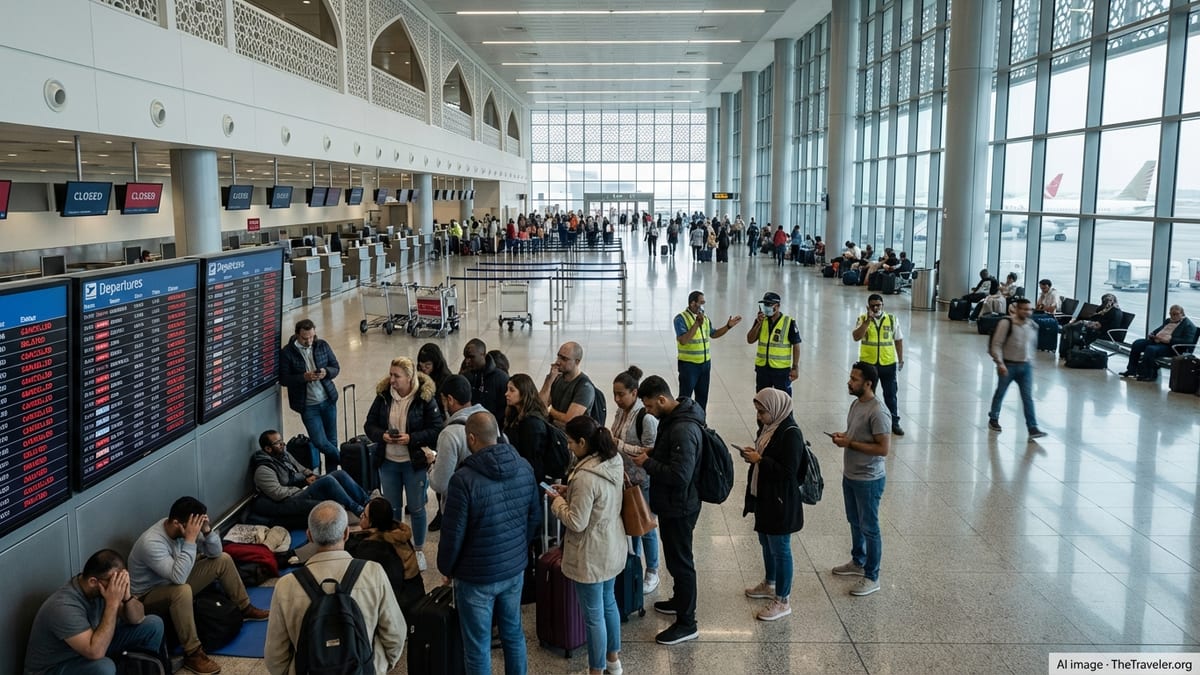
Airspace Closures Turn the Gulf Into a Global Bottleneck
Weeks of escalating tension centered on the Iran conflict and the Strait of Hormuz have pushed the Middle East’s skies into one of the most restricted zones in modern aviation. Industry advisories updated in late March describe full airspace closures for Iran and Iraq, along with Syria and segments of neighboring corridors, forcing long-haul carriers to reroute or suspend services altogether. Saudi Arabia’s airspace remains technically open but is now a crowded bypass for Europe–Asia and Africa–Asia flows, creating congestion and delays even on routes not directly touching the Gulf.
Operational bulletins circulated to airlines and freight forwarders note that Qatar’s airspace has seen intermittent closures since late February, with Doha’s Hamad International Airport operating a limited schedule under tight security conditions. Dubai and Abu Dhabi, traditionally among the most reliable global hubs, have faced rolling disruptions as carriers adjust to shifting threat assessments, air defense activity, and periodic restrictions over parts of the Gulf. The result is a patchwork of open, restricted, and closed zones that can change within hours.
Specialist risk databases tracking conflict-zone airspace now flag much of the central Middle East corridor as high risk for civil aviation. Routing that once passed routinely over Iran, Iraq, and Jordan is being redirected north over the Caucasus or south via the Arabian Sea and East Africa, adding several hours to many journeys. Travel planners describe this as an unprecedented level of structural disruption, comparable less to a temporary storm and more to a sustained redrawing of the aviation map.
For travelers headed to the United Arab Emirates, Qatar, Saudi Arabia, and Iraq, the practical effect is shrinking capacity and volatile timetables. Last-minute cancellations, diversions, and equipment changes are now a regular part of operations, with airlines publishing schedules that remain explicitly subject to rapid revision.
Japan Aligns With Other Major Markets on Caution and Rerouting
Japan has become the latest major outbound market to recalibrate its approach to the region. Publicly available airline notices show that Japanese carriers and codeshare partners have adjusted or suspended services that traverse the highest-risk segments of Gulf and Levant airspace. This follows earlier steps by India, Germany, the United Kingdom, Canada, Italy, and Brazil, whose regulators and airlines had already restricted routings over parts of Iran, Iraq, Israel, Jordan, and Lebanon, or imposed operational limitations on flights to certain airports.
Japan’s move reflects growing concern over the reliability of connections through Doha, Dubai, Abu Dhabi, and Riyadh, which have been important one-stop links between Japanese cities and destinations in Africa, South Asia, and Europe. Earlier disruptions had already led carriers in East Asia, including Japanese and Korean airlines, to favor more northerly paths across Central Asia or the Russian periphery when available, despite higher fuel burn and overflight fees. The current phase of closures and missile activity has made those alternative corridors even more critical.
Industry data and travel agency reports indicate that corporate travel managers in Japan and Europe are now formalizing these adjustments into policy. Many are temporarily blacklisting routings that rely on multiple Gulf transits or night-time connections in affected hubs. Travelers from India, Brazil, and Canada are seeing similar guidance, as multinational firms strive to keep staff within what they view as lower-risk airspace while still maintaining essential travel.
For leisure passengers, the shift may be less visible in policy documents but is increasingly apparent in booking engines. Routes via the Gulf that once undercut competitors on both time and price now often appear longer, more expensive, or unavailable altogether. Japanese tourists bound for popular winter destinations such as Dubai or coastal Saudi Arabia must contend with fewer direct options and tighter booking conditions, including revalidation rules that give airlines more leeway to adjust itineraries on short notice.
Visa Gridlocks Add a Second Layer of Friction
Even where flights are operating, travelers are running into a parallel obstacle: strained visa systems. Prior to the latest security crisis, demand for visas to the United Arab Emirates, Saudi Arabia, and Qatar had already surged, with global reports in 2024 and 2025 documenting significant jumps in applications and longer processing times for key destinations. The Gulf states’ own moves to tighten screening, reduce fraud, and link visas to verified hotel and itinerary data further lengthened the average approval window.
In the United Arab Emirates, updated rules for tourist visas have required more detailed documentation, including traceable hotel bookings and return flights. Travel industry coverage indicates that rejection rates, once minimal, rose as applications came under closer scrutiny. Consultants advising corporate travelers and high-net-worth clients describe a new normal in which lead times of several weeks are common, even for nationalities that previously enjoyed relatively swift processing.
Saudi Arabia and Qatar have pursued parallel reforms, rolling out new categories such as investor and long-stay visas while maintaining strict criteria for short-term visitors. Technical upgrades, including the planned Gulf-wide unified visa, were meant to ease movement across the six Gulf Cooperation Council states. However, according to regional policy trackers, implementation has slipped amid security and data-integration challenges, leaving travelers in an interim phase where systems are both changing and congested.
The current security environment is now compounding these backlogs. With some embassies reducing in-person appointments and overseas consular operations working under heightened alert, applicants from India, Germany, Brazil, Italy, Canada, the United Kingdom, Japan, and elsewhere report longer queues, additional document requests, and greater uncertainty about approval timelines. For group tours, trade delegations, and major events, these delays are forcing organizers to redraw calendars or shift locations entirely.
Mass Cancellations Reshape Global Flight Networks
The cumulative effect of these pressures is visible in global flight schedules. Cargo and logistics advisories released at the end of March point to sustained suspensions of passenger and freight services to multiple Gulf and Levant destinations, as well as sharply reduced operations by integrators that connect the Middle East with Europe, Asia, and North America. Some major carriers have temporarily halted flights to countries such as Iraq and Syria, while limiting their presence in Qatar and parts of the United Arab Emirates.
In addition to outright cancellations, airlines are trimming frequencies on longer-haul routes that have become more expensive to operate due to detours around closed airspace and elevated fuel prices linked to the Strait of Hormuz crisis. Network planners appear to be prioritizing routes with strong point-to-point demand or strategic importance, while deferring marginal services and seasonal flights that rely heavily on transit traffic through Gulf hubs.
Travel technology firms that aggregate global schedules report a measurable reduction in available seats connecting Asia with Europe and the Americas via the Middle East. This has knock-on effects well beyond the region itself, as passengers from India, Japan, and Southeast Asia compete for alternative connections through Istanbul, Central Europe, or secondary Asian hubs. The result is higher fares on some of these substitute routings, longer layovers, and reduced flexibility for last-minute travel.
For Gulf destinations, the disruptions threaten key tourism and business targets set for 2026. Dubai, Doha, Riyadh, and Abu Dhabi have invested heavily in becoming year-round global entry points. While domestic and regional travel remains more resilient, the loss of smooth long-haul connectivity undercuts one of their central competitive advantages, at least in the short term.
What Travelers Should Expect in the Coming Weeks
Publicly available risk assessments and airline advisories suggest that volatility is likely to persist into the coming weeks, even if the most intense phase of military activity moderates. Airspace closures are typically among the final restrictions to be lifted after a conflict, and aviation regulators often err on the side of caution when reviewing overflight permissions in regions that have recently seen missile or drone activity.
Passengers from Japan, India, Germany, Brazil, Italy, Canada, the United Kingdom, and other major outbound markets should anticipate that itineraries involving the United Arab Emirates, Qatar, Saudi Arabia, Iraq, and neighboring states will remain vulnerable to last-minute changes. Experts in corporate travel risk management recommend building longer connection buffers, avoiding tight self-transfers between separate tickets, and monitoring airline notifications closely in the 48 hours before departure.
On the visa side, travelers are being advised by consular information services and travel consultancies to apply as early as possible, supply complete documentation, and be prepared for processing pauses linked to local security conditions. For some, especially those on non-flexible work schedules or with fixed event dates, this may mean reconsidering the timing of trips to the Gulf or opting for alternative destinations until systems stabilize.
What unites these developments is the degree to which they involve not only regional states but also global powers. Japan’s entry into the group of countries actively revising travel and aviation posture toward the Gulf underscores that this is no longer a localized disruption. It is a global mobility shock that is testing the resilience of airline networks, visa systems, and passenger expectations all at once.