

More news on this day
Japan is preparing a major shift in how millions of tourists and business travelers enter the country, with a new Japan Electronic System for Travel Authorization, or JESTA, set to move border checks online and reshape the arrival experience by the late 2020s.
Get the latest news straight to your inbox!
From Paper Stamps to Predictive Screening
Publicly available policy documents and analysis indicate that JESTA will function as a pre-travel screening system for short-term, visa-exempt visitors, similar in concept to the United States’ ESTA, the European Union’s forthcoming ETIAS and New Zealand’s NZeTA. Travelers who currently board a flight to Japan with only a passport will, once the system is active, be expected to submit personal and travel details online in advance and receive an electronic authorization before departure.
Government strategy papers describe JESTA as part of a broader modernization of immigration controls aimed at reducing illegal overstays and easing congestion at arrival halls. The system is referenced in medium-term economic and migration plans as an electronic travel authorization to be developed by the end of Japan’s 2028 fiscal year, with full use built into targets that extend toward 2030. Timelines outlined in industry briefings suggest that enabling regulations are expected around the 2026 fiscal year end, with full operational rollout following testing and phased adoption.
Unlike traditional visas, which are processed through embassies and consulates and can involve in-person visits, JESTA is being designed as a fully digital gateway layered on top of existing visa-free rules. For eligible travelers, the shift is expected to move most security checks upstream, before they reach the airport check-in desk, and to give airlines a clear, machine-readable go or no-go signal before boarding.
While details are still emerging, comparisons with systems in the United States and Europe suggest that JESTA approvals will likely be valid for multiple trips over a set period, linked electronically to the traveler’s passport. Industry observers note that this model has become the global standard for managing large volumes of low-risk visitors while maintaining tighter data-driven oversight.
Security, Data and the Push to Cut Overstays
Policy materials connected to Japan’s immigration reform agenda tie JESTA directly to a long-term objective of sharply reducing, and eventually eliminating, illegal overstays. Briefing documents and legal commentaries point to plans for end-to-end tracking from entry to exit, supported by digital tools and analytics intended to identify higher-risk travel patterns before a passenger ever reaches the border.
Analysts following the reforms highlight references to the use of artificial intelligence in risk assessment, including AI-based profiling to flag inconsistent itineraries, incomplete histories or links to previously flagged applications. While specific technical standards have not yet been published, the direction aligns Japan with other destinations where electronic travel authorizations are used as both a facilitation and security instrument.
For travelers, the increased use of data raises questions about privacy, retention and redress if an application is refused. Civil society groups and legal specialists are already tracking how Japan will define the scope of information collected and how long it will be stored. Comparisons with the EU’s ETIAS framework, which embeds explicit data protection safeguards, are expected to influence both public debate and the eventual fine print of JESTA’s operating rules.
At the same time, border and aviation stakeholders stress that pre-arrival vetting can reduce last-minute denials at the airport, a scenario that is both stressful for passengers and costly for airlines. By shifting more scrutiny to the application phase, JESTA is being framed as a way to deliver a clearer, more predictable decision before a ticket is fully committed.
What Changes for Tourists and Business Travelers
For most short-stay visitors, the most visible change will be the need to apply online, pay a fee and receive an authorization before boarding a flight. Early commentary from immigration specialists suggests that the process is likely to mirror other electronic travel authorizations worldwide: travelers will enter biographical data, passport details, basic trip information and potentially respond to simple eligibility questions related to health, travel history or prior immigration issues.
If the system follows global patterns, many applications could be approved within minutes by automated checks against watchlists and immigration databases, while a small proportion may require manual review that could take longer. Travelers who are refused a JESTA authorization would then have to seek a traditional visa, just as visitors denied ESTA approval must pursue a full visa at a U.S. consulate.
Frequent visitors from visa-exempt markets in North America, Europe, Oceania and parts of Asia are expected to be among the first groups required to use JESTA once it goes live, reflecting the model used by other destinations. However, Japan has not yet finalized the list of nationalities, validity periods or fee levels, and observers note that these details will significantly influence traveler perception of the new system.
Travel industry groups are already preparing for a period of adjustment. Airlines, online travel platforms and tour operators will need to update their booking flows, reminders and documentation to highlight that JESTA approval is a separate step from buying a ticket. The experience of Europe’s ETIAS launch planning and the long-established U.S. ESTA program suggests that clear communication and early traveler education will be critical to avoiding last-minute refusals at the gate.
Digital Entry, Physical Queues and the Airport Experience
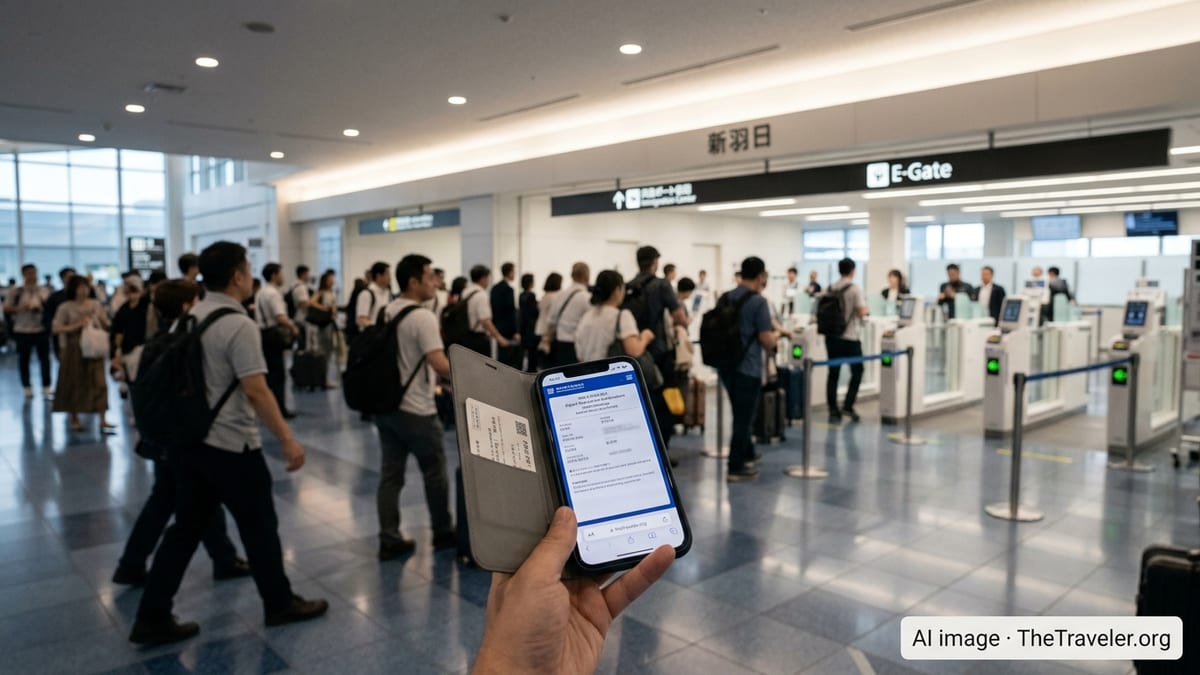
Japanese planning documents link JESTA to a vision of more automated, self-service border controls in the years ahead, with expanded use of e-gates, biometric verification and integrated digital queues at major airports such as Tokyo Haneda, Narita and Kansai. By vetting visitors in advance and tying approvals to passport data, JESTA is expected to support faster processing for low-risk travelers while allowing human officers to focus on more complex cases.
Travel technology analysts point out that Japan is effectively building the missing digital layer that many travelers already encounter in other parts of the world. In countries with mature electronic authorization regimes, approved visitors often move through dedicated lanes or automated gates, cutting wait times and smoothing peak arrival surges tied to long-haul flights.
However, the transition is unlikely to be instantaneous. Experience from other large travel markets shows that the first months of a new system can bring confusion over unofficial websites, conflicting information from intermediaries and uneven readiness among smaller carriers. Observers expect Japanese authorities and airport operators to roll out JESTA in phases, possibly starting with voluntary use or limited nationalities before making it mandatory for all eligible travelers.
Despite these challenges, aviation planners see JESTA as a cornerstone in Japan’s broader drive to remain competitive as a tourism destination while managing security and demographic pressures. With record numbers of foreign visitors in recent years and an aging domestic population, streamlining border formalities through digital tools is being framed as essential infrastructure for the country’s travel economy.
Japan Joins a Global Wave of Smart Border Systems
Japan’s move toward an electronic travel authorization places it firmly within a wider global trend. The United States has operated its ESTA system for travelers under the Visa Waiver Program for more than a decade, while New Zealand, Canada, South Korea and several Gulf states have introduced their own digital permissions as visitor numbers have grown.
In Europe, plans for ETIAS underline how central these tools have become to modern border management. ETIAS is scheduled to begin operations in the final quarter of 2026, after several postponements, and will require visitors from visa-exempt countries to complete an online authorization before arriving in the Schengen Area. Travel advisories and industry guidance increasingly treat such authorizations as a standard pre-departure task alongside passport checks and health documentation.
As JESTA moves from policy concept to operational reality over the next several years, Japan is expected to refine its approach in response to traveler feedback, industry needs and evolving technologies such as biometric identity management. The system’s impact will extend beyond security and convenience, touching how travel is marketed, booked and experienced at every stage of the journey.
For visitors, the message is clear: by the time the decade closes, entering Japan is likely to start not at the check-in counter, but on a screen, with an electronic authorization that quietly decides how seamless their arrival will be.