

More news on this day
Travel between Kuwait and Istanbul is being reshaped this month as Jazeera Airways begins routing passengers via Qaisumah Airport in Saudi Arabia, combining road transfers with new regional flights to keep journeys moving despite the ongoing closure of Kuwait’s airspace.
Get the latest news straight to your inbox!
A New Interim Gateway Between Kuwait and Istanbul
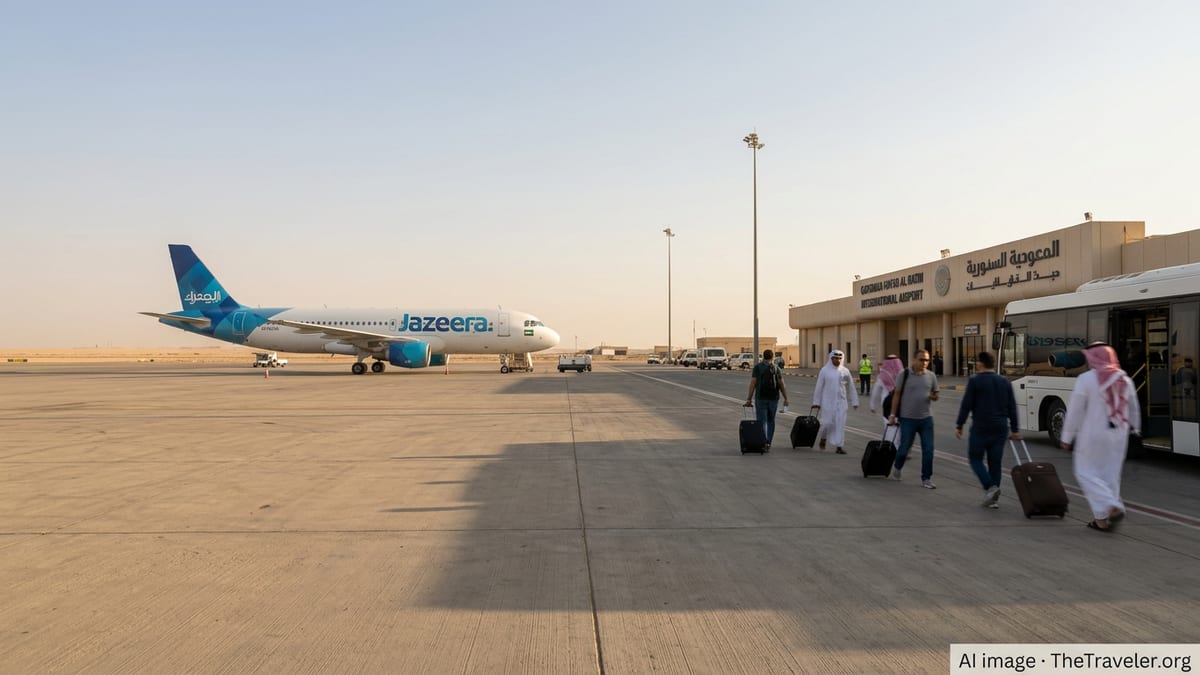
Publicly available information shows that Jazeera Airways has shifted a significant part of its operations from Kuwait International Airport to Qaisumah Airport in Saudi Arabia’s Eastern Province after flights in and out of Kuwait were halted in late February 2026. The move is designed to maintain connectivity for travelers, including those heading to and from Istanbul, one of the most in-demand routes from Kuwait.
Reports indicate that Qaisumah, roughly two and a half hours by road from Kuwait City, has effectively become a temporary hub for the carrier. Passengers depart Kuwait by road convoy or private vehicle, then continue their journeys by air to regional destinations, including major cities such as Cairo and Amman. Industry coverage notes that Turkey is among the markets earmarked for expansion from Qaisumah as the operation ramps up.
Before the disruption, Jazeera Airways already operated nonstop services linking Kuwait City and Istanbul, competing alongside other regional airlines on the busy corridor. With Kuwait International currently unavailable, the airline’s revised plan centers on preserving as much of that network as possible by inserting Qaisumah as an interim stop between Kuwait and Turkey.
While precise flight schedules are subject to rapid adjustment, published route data and airline announcements suggest that Istanbul services are expected to be incorporated into the expanding roster of departures from Qaisumah once initial charter and repatriation operations stabilize.
How the Kuwait–Qaisumah–Istanbul Journey Works
According to recent travel reports, passengers booked on Jazeera Airways from Kuwait now begin their trip on the ground. Travelers are instructed to reach designated meeting points near Kuwait International Airport, where organized buses and private transport options connect them to Qaisumah Airport across the Saudi border. The surface journey typically runs a few hours, depending on border procedures and traffic conditions.
From Qaisumah, passengers board Jazeera Airways flights to onward destinations. In the case of Istanbul, the routing is structured so that the overland segment effectively replaces what would normally be a short outbound phase from Kuwait International, with the long sector to Turkey still operated by air. The arrangement aims to keep total travel times within a manageable range compared with pre-disruption direct services.
Airline communications highlighted in regional media indicate that Jazeera Airways has been working to add bus capacity and refine the timing of transfers as passenger numbers grow. For travelers, that means itineraries should gradually become more streamlined, with shorter layovers at Qaisumah and better coordination between arrival of road convoys and flight departures.
Travelers are being advised through public channels to confirm the latest meeting locations, check-in times, and luggage rules before departure, as the hybrid road–air model introduces different operational steps compared with a conventional airport-to-airport journey.
What Travelers Can Expect on the New Route
For passengers used to flying nonstop between Kuwait and Istanbul, the most noticeable change is the addition of a cross-border road leg and an extra set of airport formalities. Rather than arriving at Kuwait International and proceeding directly to a check-in counter, travelers must factor in time to clear Kuwaiti exit procedures, travel by road to Saudi Arabia, and then complete check-in and security processes at Qaisumah Airport.
Travel industry reports suggest that Jazeera Airways is positioning the revised routing as a practical workaround that keeps fares relatively competitive while preserving access to popular destinations such as Istanbul, Cairo, and Amman. Budget-conscious travelers may view the extra ground segment as an acceptable trade-off for retaining low-cost options in a period of constrained capacity and widespread schedule changes across the region.
On board, the airline’s service remains in line with its established low-cost model, with buy-on-board refreshments and ancillary options such as extra baggage and seat selection. The main variables introduced by the temporary arrangement are on-the-ground logistics and timing rather than the in-flight experience itself.
Passengers are encouraged, through airline advisories and media guidance, to arrive well ahead of scheduled bus departure times, carry essential documents easily accessible for cross-border checks, and allow for potential delays in both directions due to evolving regional conditions.
Regional Aviation Under Pressure
The shift to Qaisumah highlights how quickly Gulf aviation networks can reconfigure in response to geopolitical tensions and airspace closures. In early March 2026, multiple carriers serving Kuwait were forced to suspend or reroute services as Kuwait’s airspace was temporarily shut, prompting airlines to seek alternative gateways in neighboring countries.
Analysts quoted in regional business coverage note that low-cost carriers such as Jazeera Airways face particular pressure in such scenarios, as their business models rely on high aircraft utilization and efficient turnarounds at home bases. Establishing a temporary hub at Qaisumah allows the airline to keep aircraft operating and maintain vital links for residents, expatriate workers, and connecting travelers while longer-term solutions are considered.
Qaisumah Airport itself, previously a relatively modest facility serving the Hafar Al Batin area, has seen a sudden increase in prominence. Publicly available information on the airport’s recent history indicates that it has hosted temporary operations from Kuwaiti carriers before, but never on the current scale, which includes charter-style rotations to multiple regional capitals and the planned integration of routes to Turkey and beyond.
Industry observers are watching to see how quickly infrastructure and services at Qaisumah, from ground handling to passenger amenities, adapt to the expanded role and whether any of the new connectivity patterns endure once normal operations in Kuwait resume.
Implications for Future Kuwait–Istanbul Connectivity
The introduction of a Kuwait–Qaisumah–Istanbul routing may prove to be a short-term measure, but it could leave a lasting mark on how airlines and travelers think about redundancy and flexibility in Gulf travel networks. If demand for Istanbul remains strong, carriers may look at retaining some level of service through alternative airports or mixed-mode travel even after Kuwait International fully reopens.
For Jazeera Airways, the current situation also serves as a live test of its ability to scale a distributed operational model that blends road transport, cross-border coordination, and hub-style flight schedules at a secondary airport. Performance on routes like Kuwait to Istanbul via Qaisumah will likely inform future decisions on seasonal bases, pop-up hubs, or contingency plans in other markets.
Travelers, meanwhile, gain a window into the complex logistics behind seemingly straightforward city-pair connections. The present workaround underscores that a “flight from Kuwait to Istanbul” can, under unusual circumstances, involve multiple jurisdictions, modes of transport, and operational partners, all working in sequence to deliver a single trip.
As conditions in the region evolve, published schedules and booking platforms will remain the primary reference for passengers planning journeys between Kuwait and Istanbul. For now, Qaisumah Airport has stepped unexpectedly into the spotlight as the crucial link keeping that corridor open.