

At the edge of Lisbon’s harbor, where the Tagus River widens toward the Atlantic, Jerónimos Monastery rises from the waterfront like a carved stone ship. Its lace-like arcades, maritime symbols and royal emblems were conceived as a monument to Portugal’s most daring era, the Age of Discovery.
Walk its cloisters today and you are not just visiting a beautiful religious complex; you are tracing the story of how a relatively small Atlantic kingdom projected its power across oceans and wrote itself into early modern history.
From Modest Riverside Chapel to Monument of Empire
Long before Jerónimos became a showpiece of imperial ambition, this stretch of Belém shoreline was home to a simple hermitage dedicated to Santa Maria de Belém. The Order of Christ maintained the chapel and welcomed sailors who stopped to pray before venturing into the open ocean. This modest starting point would prove decisive when Portugal’s sea routes transformed from coastal ventures into globe-spanning journeys.
The turning point came at the end of the 15th century, when King Manuel I inherited a kingdom suddenly enriched by maritime trade. Vasco da Gama’s successful voyage to India in 1497–1499 opened a direct route to Asian spices and luxury goods, redirecting wealth on a scale Europe had rarely seen. Manuel decided that the small riverside chapel at Belém, near the point of departure of many expeditions, should be replaced with a grand foundation that would both honor these achievements and secure spiritual intercession for the Crown.
On January 6, 1501, construction began on the new monastery for the Hieronymite (Jerónimos) order. The project was funded largely through a dedicated tax on overseas commerce, a five percent levy on profits from trade with Africa and the East. In architectural stone, Portugal was converting its maritime success into a physical symbol that could not be ignored: a sprawling monastery complex that would stand watch at the entrance to Lisbon’s harbor and greet every ship returning from distant seas.
Royal Patronage and the Politics of the Age of Discovery
Jerónimos Monastery was never just a religious house; from its inception it served as a calculated statement of royal power and ideology. King Manuel I chose the Hieronymite monks partly for their reputation for strict observance and contemplative life, but also for their role as spiritual guardians of sailors. Their daily prayers were to be offered for the king’s soul and for those at sea, tying the rhythms of monastic devotion directly to the fortunes of the Crown’s maritime ventures.
The timing of the monastery’s construction is crucial to understanding its meaning. By the early 1500s, Portugal’s maritime empire stretched from Brazil to India and beyond. Lisbon had become a central hub of global trade, and Manuel I styled himself not only as a Christian king, but as a monarch with a providential role in spreading the faith and ordering commerce across oceans. The monastery at Belém thus functioned as a gateway monument: any foreign envoy, merchant or sailor entering the Tagus would see this gilded affirmation of Portuguese power along the riverfront.
Inside the complex, dynastic politics were inscribed in stone. Jerónimos gradually became the pantheon of the Aviz-Beja dynasty, with Manuel I and his successors choosing it as their burial place. This transformed the monastery into a royal mausoleum as well as a spiritual engine of empire. The link between monarchy and exploration was explicit: kings and queens were laid to rest within the same walls that sheltered the tombs of explorers and the men who recorded their feats in epic verse.
Manueline Architecture: The Age of Discovery Carved in Stone
What sets Jerónimos apart from other European monasteries of the period is its distinctive architectural language, known today as the Manueline style. This late Gothic development flourished during the reign of Manuel I and is inseparable from the world opened by Portuguese voyages. The first master architect, Diogo de Boitaca, laid out a complex that was Gothic in its structural logic but revolutionary in its ornament, embedding maritime and global motifs in almost every surface.
Walk the cloisters or study the facades and you will see anchors, ropes, knots and twisted cables carved into creamy lioz limestone. Armillary spheres, an emblem associated with Manuel I and with celestial navigation, appear repeatedly, as do crosses of the Order of Christ, the military-religious successor to the Templars that financed many shipborne expeditions. Exotic foliage, shells, coral forms and fantastical creatures twist around columns and arches, suggesting the new worlds and natural wonders encountered overseas.
The monastery’s plan and elevations evolved over time as different architects added their interpretations. After Boitaca, the Spaniard Juan de Castilho continued the work, gradually moving the design toward a more refined Renaissance sensibility while preserving the exuberant Manueline vocabulary. Inside the church of Santa Maria de Belém, slender, tree-like columns rise to support a vast vaulted ceiling that appears to float with almost no visible support. The overall effect is both theatrical and ethereal, a stone translation of the optimism and daring of early sixteenth-century Portugal.
Key Spaces: Church, Cloister and Royal Pantheon
For visitors trying to read history in the building itself, three spaces are particularly revealing: the church, the cloister and the royal burial areas. The church, completed in large part by the mid-sixteenth century, was designed as a hall-style space with three naves of nearly equal height. This unifies the interior, drawing the eye toward the luminous crossing and high chancel, where members of the royal family are entombed in sculpted marble.
The high chancel, commissioned under Queen Catherine of Austria, wife of King João III, serves as the dynastic heart of the complex. Here rest Manuel I and his queen, Maria of Aragon, alongside João III and Catherine. Their tombs, designed in a more classical idiom than the rest of the church, sit on marble supports often described as elephant-like, surrounded by columns that blend Renaissance restraint with Iberian grandeur. This is where the royal narrative of Portugal’s expansion era is anchored in stone.
The cloister, laid out as a nearly square courtyard measuring roughly 55 by 55 meters, offers a different experience of the same historical story. On two levels, delicate traceries, intricate capitals and ribbon-like carvings compose one of the most celebrated cloisters in Europe. Here the maritime symbols multiply: crosses, ropes, spheres and botanical motifs form an almost encyclopedic catalogue of Manueline imagery. It was in such quiet spaces that monks once read, prayed and walked, while outside ships plied the route between Lisbon and Goa or Brazil.
Scattered through the church are other tombs that tie Jerónimos directly to the Age of Discovery. The most famous belong to Vasco da Gama and to the poet Luís de Camões, author of the national epic that celebrated Portuguese voyages and maritime heroism. Although their remains were moved here in the nineteenth century, their tombs anchor the narrative of exploration within the sacred geography of the monastery. To stand before them is to feel the intertwining of faith, literature and navigation that defined early modern Portugal.
Earthquakes, Secularization and the Road to UNESCO Recognition
The story of Jerónimos Monastery is not only one of triumphant construction. It is also a narrative of damage, neglect and reinvention. The great Lisbon earthquake of 1755, which devastated much of the city, inflicted serious harm on the monastery and its surrounding district. Although the main church and cloister survived structurally, many auxiliary spaces and decorative elements were damaged. In the years that followed, as political and economic winds shifted, Portugal’s relationship with its convents and monasteries changed dramatically.
In 1833, as part of a broader liberal reform that dissolved many religious orders in Portugal, the Hieronymite community at Belém was disbanded and the monastery secularized. Its properties were transferred to a charitable institution, and the building was used intermittently as a parish church, school and orphanage. Without the monastic community that had once animated its corridors, Jerónimos entered a long period of partial abandonment and physical decline.
It was only in the later nineteenth century that the monastery’s architectural and historical value was systematically reappraised. Restoration campaigns began around the 1860s, focusing first on stabilizing and cleaning the riverfront facades and then on restoring the cloister and interior spaces. These were followed by further works in the twentieth century, including conservation projects in the 1990s and early 2000s that aimed to remove accumulated grime and preserve fragile stone sculptural details.
Recognition of Jerónimos as a monument of global importance culminated in its inscription, together with the nearby Belém Tower, on the UNESCO World Heritage List in 1983. The listing highlighted both structures as outstanding examples of Portuguese art at the height of its power and as architectural avatars of the maritime discoveries that reshaped world geography. Today, the monastery is protected as a national monument and remains one of Lisbon’s most visited historic sites.
The Monastery’s Living Role in Modern Portugal
Although Jerónimos evokes a distant age of caravels and spice fleets, it continues to play a role in modern Portuguese identity. It has served as the setting for state ceremonies and international events, most famously the signing of the Treaty of Lisbon in 2007, which reformed the institutions of the European Union. On such occasions, its cloistered spaces and monumental church become a backdrop for contemporary diplomacy, linking today’s political projects with the country’s long history of outward engagement.
The monastery also functions as a cultural hub. Its wings house the National Archaeology Museum and the Maritime Museum, both of which deepen the narrative of Portugal’s past that begins in the stonework of Jerónimos itself. Exhibitions held here in recent decades have ranged from retrospectives of Portuguese painting to displays of scientific manuscripts, underscoring the building’s versatility as a setting for cultural dialogue.
At the same time, Jerónimos remains a site of religious significance. The church continues to host liturgical celebrations, including major ceremonies that draw national attention. For many Portuguese visitors, entering the nave is an act of both spiritual reflection and historical remembrance, a chance to acknowledge ancestors who sailed from these shores and those who later wrote, painted and prayed about their voyages.
For travelers, the monastery’s modern role is more immediate. It is a highlight of virtually every visit to Lisbon, a place where the country’s layered past is presented in a form that is both visually arresting and intellectually rich. The steady stream of visitors also poses challenges for conservation and crowd management, prompting ongoing discussion about how best to balance public access with preservation of delicate stone surfaces and centuries-old artworks.
Reading the Age of Discovery in Stone: What to Notice When You Visit
Part of what makes Jerónimos such a compelling destination is how clearly its architecture and decoration can be read as a narrative of the Age of Discovery. To appreciate this fully, it helps to slow down and treat the monastery not just as a picturesque backdrop but as a text. The riverside location, a short walk from the point where ships once departed for India and Brazil, is the first clue: the monastery literally faces the route of empire.
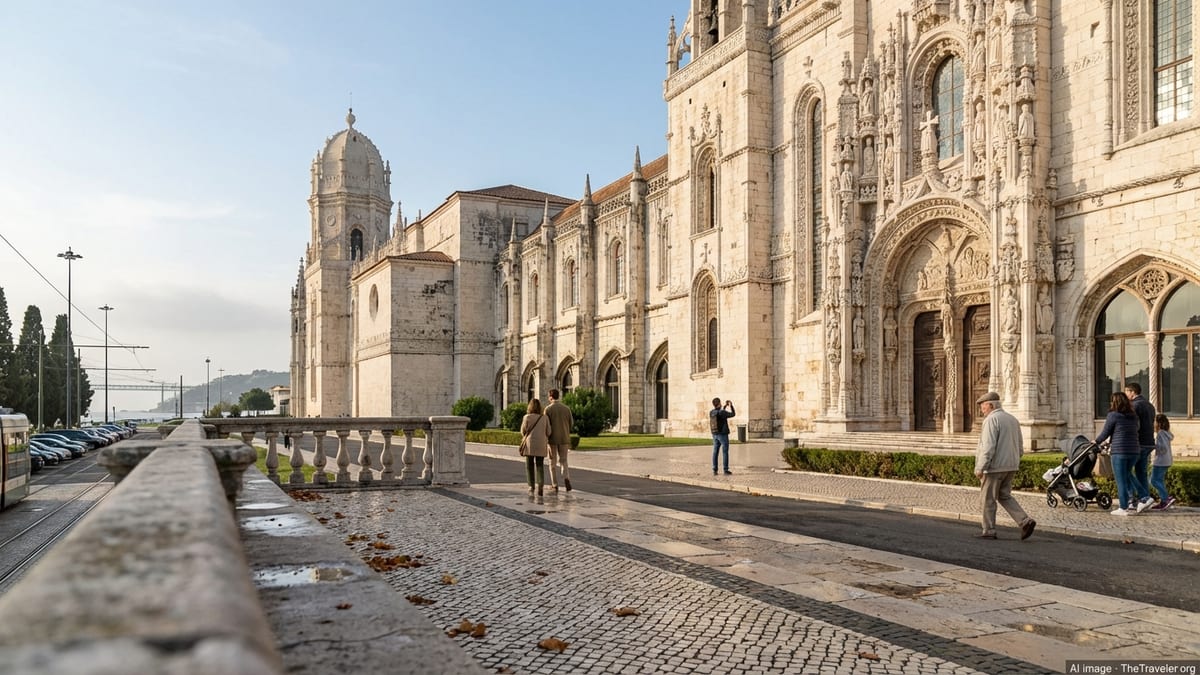
As you approach the southern facade, notice how the ornament clusters around doorways and windows. The great south portal, a kind of stone proscenium, is richly carved with statues of saints, prophets and royal figures, including a representation of Manuel I himself. Above and around them, vegetal motifs and maritime details intertwine, signaling that this is a Christianity engaged with the world beyond Europe, carried outward by ships and sailors.
Inside the cloister, the Age of Discovery is written in more intimate scale. Look for the armillary sphere carved into arches and friezes, symbolizing both the king’s personal emblem and the science of navigation. Seek out the cross of the Order of Christ, a reminder of how religious and military impulses fused in Portugal’s expansion. Even the sculpted gargoyles and fantastical animals can be read as echoes of the new species and imagined creatures that populated European accounts of distant lands.
The tombs of Vasco da Gama and Luís de Camões, placed near the entrance of the church, form a kind of threshold between the secular and the sacred. The explorer who opened the route to India and the poet who mythologized that journey lie opposite one another, their sarcophagi decorated with Manueline motifs. They personify two essential dimensions of the Age of Discovery: practical navigation and the stories that turn historical events into national legend.
The Takeaway
Jerónimos Monastery is far more than a picturesque stop on a tour of Lisbon. It is one of the clearest architectural expressions of a turning point in global history, when maritime technology, royal ambition and religious fervor combined to connect continents and redraw maps. Within its honey-colored stone, the aspirations and contradictions of Portugal’s Age of Discovery are preserved in remarkably tangible form.
To walk through its cloisters is to move through a gallery of maritime symbols and royal emblems; to stand in its church is to share space with the tombs of kings, explorers and poets who defined an era. The building’s subsequent history, marked by earthquakes, secularization, restoration and international recognition, adds another layer to its narrative, illustrating how societies reinterpret their monuments over time.
For travelers seeking to understand Portugal beyond postcard views, Jerónimos offers a deep and rewarding encounter. Here, history is not confined to museum labels. It is etched into every rope-like column, every armillary sphere, every shaft of Atlantic light falling across the stone. In Belém, the Age of Discovery is still written in stone, inviting you to read it with your own eyes.
FAQ
Q1. When was Jerónimos Monastery built, and why here in Belém?
The monastery was commissioned by King Manuel I at the very start of the 16th century, with major construction beginning in 1501. It was built in Belém because this riverside area near the mouth of the Tagus was the departure point for many voyages, including Vasco da Gama’s journey to India, making it the ideal symbolic gateway for a monument to Portugal’s maritime era.
Q2. What exactly is Manueline architecture that I see at Jerónimos?
Manueline is a Portuguese late Gothic style that flourished during Manuel I’s reign. At Jerónimos it appears in the lavish use of maritime and royal motifs, such as carved ropes, anchors, shells, armillary spheres and crosses of the Order of Christ, all woven into Gothic structural forms and Renaissance details to celebrate Portugal’s seafaring achievements.
Q3. How is Jerónimos Monastery connected to the Age of Discovery?
The monastery was funded by taxes on overseas trade and dedicated to Saint Jerome’s order to pray for the king and seafarers. Its construction celebrated the opening of ocean routes to Africa, Asia and Brazil, and its art and symbolism directly reference navigation, ships and global exploration. In many ways, it is the Age of Discovery translated into stone.
Q4. Who is buried inside Jerónimos Monastery?
Among the most notable burials are King Manuel I and Queen Maria of Aragon, King João III and Queen Catherine of Austria in the high chancel. The church also houses the tombs of explorer Vasco da Gama and poet Luís de Camões, along with other royal and noble figures linked to the period of Portuguese expansion.
Q5. Did the 1755 Lisbon earthquake damage Jerónimos?
Yes. The great earthquake and subsequent fires affected the monastery and its surroundings, although the main structure of the church and cloister survived. Some ancillary buildings and decorative elements were damaged, and the complex required later restoration campaigns to stabilize and repair affected areas.
Q6. What happened to the monks who once lived here?
The Hieronymite monks inhabited the monastery for more than three centuries, praying for the king and supporting sailors spiritually. In 1833, as part of liberal reforms, religious orders were dissolved in Portugal and the community was dispersed. The monastery was secularized and used for purposes such as a school and orphanage before becoming a protected monument.
Q7. Why is Jerónimos Monastery a UNESCO World Heritage Site?
Jerónimos, together with nearby Belém Tower, is recognized by UNESCO as an outstanding example of Portuguese art at the height of its power and as a symbol of maritime discoveries that reshaped world geography. Its Manueline architecture, historical role in the Age of Discovery and remarkably preserved cloisters and church all contribute to its universal value.
Q8. What should I pay special attention to during a visit?
Visitors should take time to examine the details of the cloister carvings, the slender tree-like columns of the church, and the south portal with its sculpted saints and royal figures. The tombs of Vasco da Gama and Luís de Camões near the entrance, as well as the royal tombs in the high chancel, are key to understanding the link between monarchy, exploration and cultural memory.
Q9. How has Jerónimos Monastery been used in modern times?
In addition to serving as a parish church and housing museums, Jerónimos has been the venue for significant national and international events, including the signing of the Treaty of Lisbon in 2007. It functions as both a heritage site and a living setting for state ceremonies, cultural exhibitions and religious celebrations.
Q10. Is Jerónimos Monastery still religious, or is it mainly a museum now?
The monastery no longer houses a resident monastic community, but the church remains an active place of worship, hosting services and special ceremonies. At the same time, much of the complex operates as a historic monument and museum space, welcoming visitors who come to appreciate its architecture and its central place in Portugal’s Age of Discovery.