

More news on this day
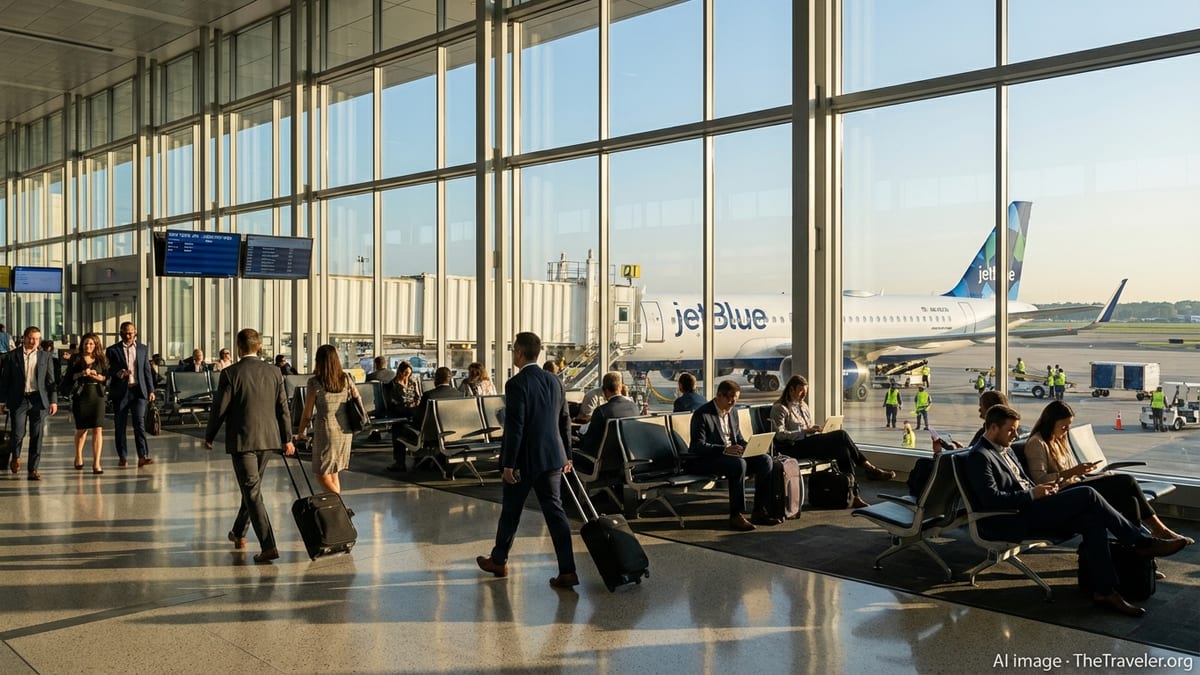
JetBlue is set to reopen a crucial air corridor for corporate America, announcing new twice-daily nonstop flights between New York’s John F. Kennedy International Airport and Houston’s George Bush Intercontinental Airport from May 21, 2026, in a move that underscores the rebound of US business travel and rising competition on one of the country’s most important energy and finance links.
A Strategic Return to a High-Value Corridor
The decision to relaunch nonstop service between New York and Houston places JetBlue squarely back in a corridor that connects two of the nation’s most influential economic hubs. The new route links New York’s global finance, media and corporate headquarters ecosystem with Houston’s dominant energy, engineering and healthcare sectors, offering a fresh option for time-sensitive travelers who shuttle between the two cities.
Beginning May 21, JetBlue will operate two daily round trips between JFK and George Bush Intercontinental Airport, using Airbus A320 aircraft. The schedule is tailored to capture both early-morning and late-afternoon demand, enabling same-day corporate trips in either direction. Morning departures from New York are timed to arrive in Houston before midday meetings, while afternoon departures support end-of-day returns for executives and project teams.
The new flights restore a link JetBlue once operated from New York to Houston in the mid-2000s, but this time with a sharper focus on business travel and network connectivity. The carrier is using the route to plug Houston directly into the heart of its JFK operation, which feeds dozens of domestic and international destinations across the East Coast, Latin America, the Caribbean and Europe.
Industry analysts say the move reflects airlines’ broader recalibration as business travel continues to rebuild. Rather than adding capacity across the board, carriers are doubling down on high-yield corridors where corporate demand, connecting traffic and schedule convenience combine to support sustainable fares.
Business-Friendly Schedule Targets Corporate Demand
JetBlue’s new Houston schedule has been built around the needs of business travelers, a segment that remains critical to airline profitability even as hybrid work reshapes corporate travel patterns. The first daily flight leaves JFK shortly before 8 a.m., arriving in Houston just before 11 a.m., giving travelers a usable workday on arrival. A mid-afternoon departure from New York forms the second daily option, touching down in Texas in the late afternoon.
In the opposite direction, late-morning and early-evening departures from Houston are designed to appeal to executives wrapping up meetings, site visits or conferences. The early return lands at JFK by late afternoon, allowing for evening events or onward connections, while the later flight arrives in New York close to midnight, maximising time on the ground in Houston for longer workdays.
This pattern responds to what travel managers describe as “compression” in corporate itineraries. Many firms have reduced the total number of trips their staff take, but when employees do travel, itineraries are often packed with back-to-back meetings, making same-day turns and productive timing more valuable than ever. A twice-daily schedule also adds resilience for travelers, providing back-up options when delays or last-minute schedule shifts occur.
By routing the flights through JFK rather than another New York airport, JetBlue is positioning the service as much more than a simple point-to-point link. Corporate travelers flying from Houston will be able to connect onwards to major business and tech hubs such as Boston, Washington, Detroit and Pittsburgh, along with long-haul destinations in Europe and Latin America that are increasingly important for global energy and finance.
JetBlue Bets on Premium Experience for Road Warriors
While JetBlue built its brand on low fares and a relaxed onboard atmosphere, the airline has spent recent years polishing its appeal to business travelers. The New York–Houston route will be operated with A320 aircraft configured with JetBlue’s signature extras such as fast, free Wi-Fi, seatback entertainment and complimentary snacks and drinks, features that the carrier believes set it apart in a crowded marketplace.
For road warriors who treat the aircraft as an extension of the office, high-speed connectivity and power access can be as important as seat pitch. JetBlue is wagering that its cabin product, long seen as consumer-friendly, now offers enough reliability and comfort to sway corporate travelers who might otherwise default to legacy carriers. The airline’s loyalty program, TrueBlue, and its partnerships are also being leveraged to entice frequent fliers who value points accrual and flexible redemption.
Although the Houston flights will not initially feature the fully lie-flat Mint cabin that JetBlue offers on select transcontinental and international routes, the airline is banking on a competitive economy experience and attractive pricing to win share. Corporate travel buyers often negotiate discounts and bundle routes when they see value across an airline’s wider network, and JetBlue has been quietly expanding its portfolio of business-relevant city pairs from New York.
That broader strategy is key as companies re-examine preferred airline agreements. With travel budgets under scrutiny, corporate clients are seeking a balance of cost, reliability and traveler satisfaction. JetBlue’s branding around customer service, cabin comfort and transparent pricing is being repackaged for a business audience that once viewed the airline primarily through a leisure-travel lens.
Strengthening New York’s Role as a National Hub
The new Houston flights land at a time when New York’s aviation infrastructure is going through a multi-year transformation. JetBlue has committed to keeping its headquarters in New York City and is investing heavily in the continued evolution of its JFK footprint, including enhancements to its flagship Terminal 5 and the integration of new terminal facilities that promise additional gates and upgraded passenger amenities.
Recent plans to refresh Terminal 5, with expanded concessions, redesigned communal spaces and a stronger “sense of place” reflecting New York’s neighborhoods, are intended to make connections and dwell time more productive and pleasant. For travelers connecting between Houston and other markets via JFK, these upgrades aim to smooth what has historically been one of the most congested and complex major airports in the United States.
New York officials have framed these investments as part of a broader effort to secure the city’s status as a premier global gateway despite growing competition from other hubs. JetBlue’s decision to allocate additional aircraft time and slots to a high-value business market such as Houston reinforces New York’s role as a nerve center for corporate travel, particularly for sectors like finance, law and consulting that operate across multiple time zones.
At the same time, New York’s broader airline landscape is shifting, with new alliances and terminal projects reshaping how carriers coordinate schedules and manage capacity. JetBlue’s moves at JFK, including the new Houston service, are being watched closely as indicators of how mid-sized carriers can carve out a distinct position alongside the largest network airlines.
Houston’s Airport Upgrades Meet Rising Demand
On the Texas end of the corridor, JetBlue’s return dovetails with major upgrades at George Bush Intercontinental Airport. Houston has been overhauling its international facilities and security infrastructure, expanding security lanes and reconfiguring terminal spaces to handle growing passenger volumes and streamline connections. These improvements are intended to ease bottlenecks for both domestic and international travelers.
Houston is a natural anchor for the energy industry, with many global oil, gas and renewables companies maintaining large presences there. The city is also an important center for healthcare, life sciences, space technology and advanced manufacturing. These sectors rely heavily on frequent, dependable air service to link headquarters, regional offices, laboratories and project sites across the country and abroad.
Local business groups have long argued that more competition on the New York–Houston corridor can support the region’s growth. Additional nonstop options can lower effective travel costs, reduce time lost in transit and allow companies to respond more quickly to market shifts and project demands. JetBlue’s entry is likely to be welcomed by corporate travel departments looking for alternatives that still meet internal standards on safety, reliability and traveler satisfaction.
For the Houston Airport System, attracting a prominent New York-based carrier back into the market also carries symbolic weight. It signals confidence in the city’s continued role in global commerce and offers another selling point for firms evaluating expansions or relocations that depend on strong national and international connectivity.
Competitive Pressure on Legacy Carriers
By stepping into the New York–Houston corridor with a twice-daily service, JetBlue is inserting itself into a competitive arena long dominated by the largest US network airlines. Those carriers have historically relied on business-heavy routes like this one to underpin their premium cabins and global connecting banks, particularly at their respective hubs.
Low-cost and hybrid carriers such as JetBlue typically compete on a blend of pricing, product differentiation and customer service rather than on sheer network size. On the Houston route, the airline is expected to emphasize its in-flight experience and digital tools, as well as flexible fare structures that appeal to both managed corporate programs and small and mid-sized businesses that book travel less formally.
Analysts say that even a modest capacity addition from a challenger brand can pressure incumbents to refine schedules, sharpen their value propositions or adjust fares, particularly in markets where corporate contracts are periodically up for renewal. Travel buyers often use the presence of an additional carrier as leverage in negotiations, and travelers themselves may push employers to allow bookings on airlines perceived as more comfortable or customer-friendly.
The airline industry is also contending with higher operating costs, including labor and fuel, while still rebuilding balance sheets after the pandemic years. That environment leaves little room for unprofitable flying, so JetBlue’s move into the New York–Houston corridor is seen as a targeted bet on a market where demand and yields are strong enough to support new competition.
Connectivity Beyond the Corridor
Although the New York–Houston flights will be marketed as a nonstop link between two powerhouse cities, much of their value lies in the onward connectivity they unlock. From JFK, JetBlue can funnel Houston-origin travelers into a growing web of domestic routes along the Eastern Seaboard and Midwest, as well as to sunshine destinations, island getaways and transatlantic gateways that appeal to both leisure and blended “bleisure” trips.
For example, executives based in Houston might use the route to connect through New York to European financial centers, Caribbean project sites or Latin American energy markets, using a single ticket and loyalty currency. Conversely, travelers originating in the Northeast can reach Houston for oil and gas meetings, medical conferences or space-related business while still benefiting from JetBlue’s familiar product throughout their journey.
This connectivity is particularly important at a time when many companies are encouraging employees to combine meetings, site visits and client engagements into fewer, more efficient trips. Being able to stitch together multi-stop itineraries via a strong hub like JFK adds value that goes beyond the headline city pair.
Additionally, the Houston link complements JetBlue’s broader push to reinforce its identity as New York’s hometown airline, with a network that not only serves local origin-and-destination traffic but also connects communities and industries across the country. The airline’s leadership has framed these incremental route additions as building blocks in a more resilient, diversified network that can weather economic swings and shifting travel preferences.
Signal of Confidence in US Business Travel
JetBlue’s expansion into the New York–Houston corridor is also a barometer of confidence in the long-term health of US business travel. While remote collaboration tools and hybrid work arrangements have permanently altered how companies operate, in-person meetings, site inspections, client negotiations and conferences remain essential in many sectors, particularly energy, heavy industry and high finance.
Travel data from corporate booking tools and industry groups has shown a gradual but steady recovery in domestic business trips, with certain city pairs outperforming pre-pandemic patterns. Routes that connect major corporate centers, large universities, medical complexes and specialized industrial regions have been among the first to see demand return.
In this context, committing aircraft, crew and slots to a new high-frequency business route represents more than a tactical network tweak. It signals that JetBlue sees durable, revenue-generating demand in the corridor and is prepared to compete for corporate travelers who drive a disproportionate share of airline profitability.
As carriers across the United States refine their networks for the next phase of growth, moves like JetBlue’s New York–Houston expansion provide a snapshot of where the industry believes the business of travel is headed: toward focused investment in corridors that link innovation, energy, capital and talent, with service and schedules designed to keep commerce moving at full speed.