

More news on this day
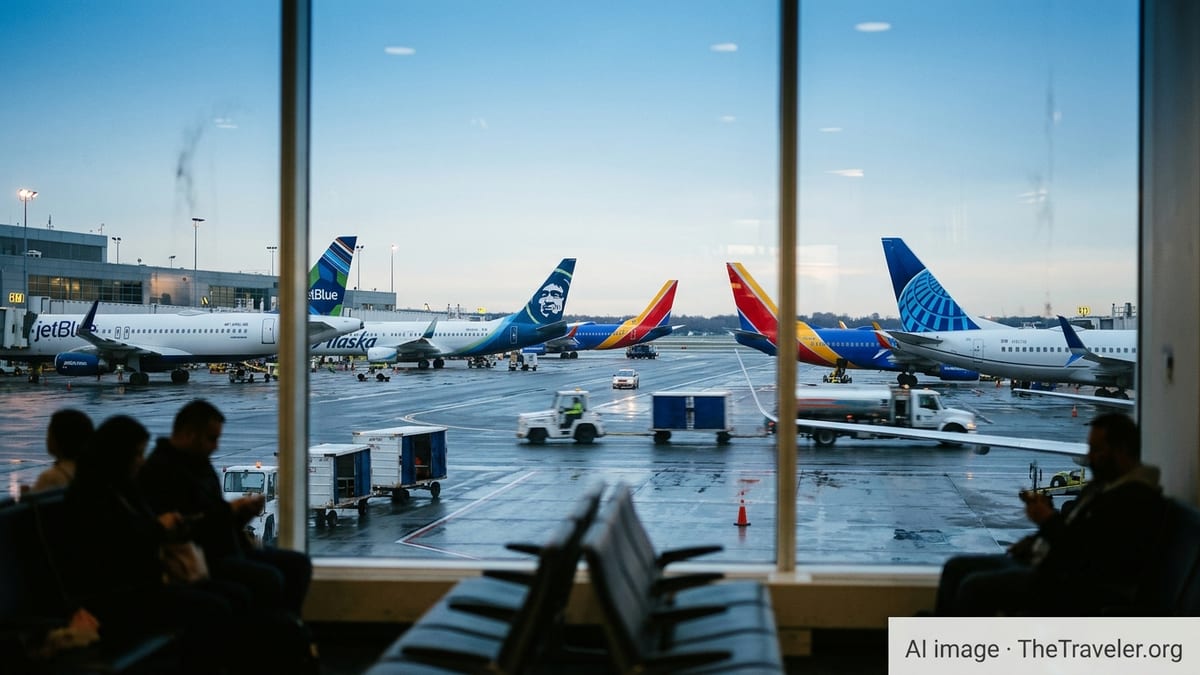
JetBlue Airways is actively running internal simulations on potential merger combinations with Alaska Airlines, Southwest Airlines, and United Airlines, according to industry analyses and financial commentary, highlighting how pressure from regulators, rising costs, and an uneven recovery have pushed the New York based carrier to reassess its long term future as a standalone airline.
Get the latest news straight to your inbox!
Strategic Reboot After Failed Spirit Deal
The renewed merger modeling comes in the wake of JetBlue’s terminated acquisition of Spirit Airlines and the collapse of its Northeast Alliance with American Airlines, two setbacks that removed key pillars of the carrier’s previous growth strategy. Publicly available filings and airport planning documents show JetBlue retrenching on certain marginal routes while concentrating flying at core hubs such as New York, Boston, Fort Lauderdale, and Orlando, a pattern that analysts interpret as preparation for either disciplined standalone operation or a future combination with a larger partner.
Industry research on recent airline consolidation notes that four large U.S. carriers already control the majority of domestic capacity, leaving smaller players like JetBlue in a structurally challenging middle ground. The carrier lacks the ultra low cost structure of discounters but also falls short of the global breadth offered by the largest network airlines. Running merger simulations with multiple counterparts allows JetBlue to test how different combinations could address that strategic gap, from boosting domestic scale to improving access to long haul international traffic flows.
Financial commentary following JetBlue’s recent earnings cycles has highlighted persistent margin pressure despite product upgrades and network adjustments. Modeling potential mergers with Alaska, Southwest, or United gives the company a framework to quantify possible unit cost reductions, revenue synergies, and capital spending efficiencies, even if no transaction is imminent. These exercises also help inform internal decisions on fleet renewal, airport investments, and loyalty program enhancements that would be critical in any future tie up.
Why Alaska, Southwest, And United Stand Out
Alaska Airlines, Southwest Airlines, and United Airlines appear repeatedly in analyst speculation because each offers a distinct strategic logic when paired with JetBlue. Alaska has already absorbed Virgin America and is in the process of integrating Hawaiian Airlines, creating a combined carrier with a strong West Coast and Pacific footprint. JetBlue, by contrast, is weighted toward the Northeast, Florida, and key Caribbean markets. Modeling a merger between the two suggests a more geographically balanced network with limited overlap in core hubs and complementary Airbus and Boeing fleets that could be rationalized over time.
Southwest presents a different scenario. It is one of the country’s largest domestic airlines with a single class product, a primarily Boeing 737 fleet, and a deep presence in secondary and mid sized markets. A hypothetical JetBlue Southwest combination would test whether JetBlue’s more premium product, including business focused transcontinental service and evolving premium cabins, could be layered onto Southwest’s broad domestic footprint. Simulation work in this case would need to address brand positioning, cabin standardization, and the financial impact of blending two very different customer propositions.
United Airlines enters the modeling discussions from the perspective of global reach. United operates large hubs at Newark, Chicago, Houston, Denver, San Francisco, Washington, and other cities, with extensive transatlantic and transpacific networks. JetBlue’s narrowbody fleet and established slot portfolio in New York and Boston could, in theory, feed United’s long haul operations and offer more options for premium travelers on key East Coast and Caribbean routes. Running internal scenarios with United allows JetBlue to explore how a merger might reshape alliance participation, corporate travel contracts, and joint scheduling across domestic and international markets.
Regulatory And Competitive Hurdles Remain Steep
Any real world move toward consolidation would face substantial antitrust scrutiny in Washington, particularly after federal regulators opposed both the Northeast Alliance and the JetBlue Spirit merger on competition grounds. Simulations with Alaska, Southwest, and United therefore devote significant attention to what a combined market share would look like at slot constrained airports such as New York’s John F. Kennedy, LaGuardia, and Newark, as well as in large leisure markets in Florida and the Caribbean where JetBlue is a major player.
Analyses circulating in the financial community emphasize that a JetBlue United transaction would likely trigger the toughest examination, given United’s status as one of the four largest U.S. network carriers. Modeling exercises need to layer in potential divestitures of takeoff and landing rights, gates, and routes that could be required to secure approval. Alaska and Southwest may appear somewhat less complex on an individual market basis, but a merger with either would still lift combined market share in several city pairs to levels that competition authorities have flagged in previous airline cases.
In assessing these scenarios, JetBlue’s internal teams and external advisers are also believed to consider the impact on labor, particularly in pilot and flight attendant groups that are in high demand across the industry. Combining seniority lists, harmonizing work rules, and aligning pay scales are central challenges in any airline merger. Simulation models can test the cost implications of different integration timelines and contract outcomes, as well as the operational resilience of the combined network during peak travel periods.
Network Maps And Fleet Plans Under The Microscope
Beyond regulatory questions, the core of JetBlue’s merger simulations lies in how route maps and fleets would be restructured. For an Alaska combination, the focus is on connecting the carrier’s strength in the Pacific Northwest, California, and Hawaii with JetBlue’s footprint in the Northeast and Florida. Scenario planning explores which overlapping transcontinental routes might be consolidated, how connecting banks at key hubs could be retimed to improve utilization, and where additional capacity could be deployed to challenge incumbents in high yield business markets.
With Southwest, network modeling looks at how JetBlue’s presence in major coastal cities could be woven into Southwest’s extensive operations at large domestic airports and secondary fields. Analysts expect that any combined network would likely preserve Southwest’s core point to point philosophy while integrating select JetBlue focus cities as de facto connection centers. Fleet planning in this case would need to evaluate whether to maintain parallel Airbus and Boeing subfleets or gradually converge toward a more uniform narrowbody lineup over the medium term.
In a United scenario, modeling likely gives special attention to hubs where both airlines already operate, including Newark and Boston, as well as to airports where United is relatively weaker but could benefit from JetBlue’s established customer base. Integrating loyalty programs, lounges, and premium services would be a complex undertaking, with models projecting how many high value passengers might shift from competitors once a unified schedule and frequent flyer offering are in place.
Uncertain Timeline But Intensifying Speculation
Despite the detailed simulations underway, public information does not indicate that JetBlue has committed to any particular partner or timeline. The carrier continues to fly under its own brand and has recently outlined product upgrades and schedule refinements that suggest it is still pursuing a viable independent strategy. However, industry observers note that the very act of rigorously modeling mergers with Alaska, Southwest, and United signals a recognition that scale and network breadth are increasingly decisive in the U.S. market.
Financial markets have responded to recurring merger speculation with bursts of volatility in airline share prices, particularly for carriers seen as likely participants in any consolidation wave. Investor commentary frequently frames JetBlue as a potential acquisition target rather than a buyer, given its relative size and recent regulatory experiences. Running simulations now allows JetBlue to better evaluate unsolicited approaches should they materialize, and to shape negotiations with a clear view of the value it brings to any combined entity.
For travelers, the outcome of these deliberations could reshape competition on some of the country’s most heavily traveled routes, particularly along the East Coast and across the continent. For now, the potential tie ups with Alaska, Southwest, or United remain theoretical, but the intensity of the modeling work underscores how fluid the next chapter of U.S. airline consolidation may be.