

More news on this day
Flight delays at New York’s John F. Kennedy International Airport are radiating across the U.S. domestic network, with 127 disrupted departures and arrivals helping to fuel another day of strained spring operations.
Get the latest news straight to your inbox!
A Fresh Flashpoint in an Already Fragile April
The latest operational snarl at JFK is unfolding against a turbulent April for U.S. air travel. Recent days have seen thousands of delayed flights nationwide as storms, congestion and staffing constraints collide with heavy leisure and business demand at major hubs from Atlanta and Chicago to Miami and Seattle, according to publicly available tracking data and aviation coverage.
Within that broader pattern, the 127 delayed services tied to JFK’s domestic schedule are emerging as a critical pressure point. New York’s largest international gateway plays an increasingly important role in U.S. point to point traffic, linking the Northeast with Florida, Texas, the Midwest and the West Coast. Even modest schedule disruptions at JFK can therefore trigger missed connections and rolling delays far beyond the New York region.
Data aggregated by flight status platforms on April 9 indicate that New York area airports once again feature prominently among the nation’s most disrupted facilities. Industry analysis shows that when delays at one New York hub intersect with congestion at others, it often produces a compounding effect that is difficult for airlines to unwind over the course of a single operating day.
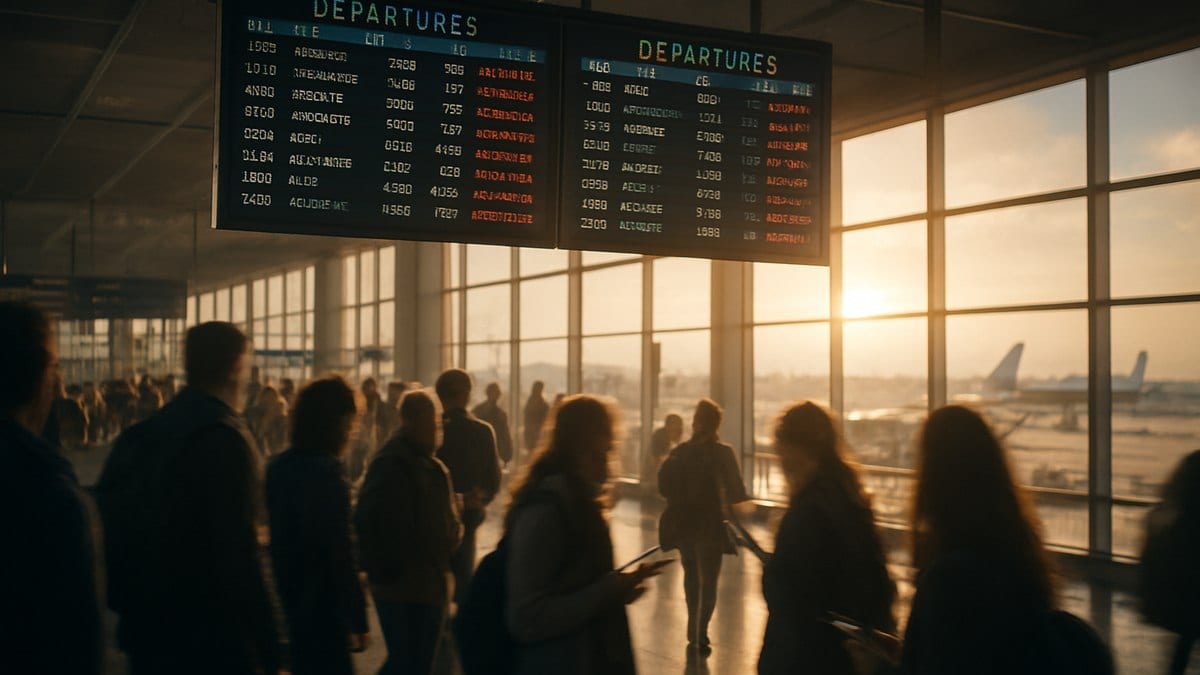
For travelers, the outcome is familiar: crowded departure halls, extended waits at customer service desks and a scramble to secure scarce rebooking options at the height of the spring break and early holiday travel period.
How Delays at JFK Ripple Through the Domestic Grid
Operational reports and academic research on U.S. aviation performance indicate that large, schedule dense hubs such as JFK function as nodes in a tightly coupled network. When a flight departs late from New York, the aircraft and crew involved are frequently scheduled to operate subsequent legs to other cities, carrying that delay forward across multiple routes.
In practice, a late morning departure from JFK to a Midwest or Southern hub can arrive behind schedule, compressing turn times on the ground and forcing airlines to push back later departures. As the day progresses, these small increments accumulate into significant knock on impacts across the domestic system, particularly on busy trunk routes and evening banked connections.
Recent delay statistics from other major airports underscore the scale of the problem. Separate coverage this week highlights more than 300 delays at Atlanta’s Hartsfield Jackson, over 260 at Miami International and several hundred more at LaGuardia, Orlando and Houston over various days. Together with New York’s disruptions, these figures illustrate how congestion at a handful of large hubs can influence reliability across an entire national network.
Transportation Department performance data published for prior years show that New York airports consistently rank among the most delay prone large hubs in the country. Analysts note that limited runway capacity, complex airspace and tightly packed schedules leave carriers with little margin to recover once disruptions begin to cascade.
Weather, Staffing and Structural Strain Behind the Numbers
Multiple factors appear to be converging behind the latest wave of delays. Meteorological summaries for early April point to unsettled weather patterns across both the Northeast and key connecting regions, including lingering storm systems and high winds that have periodically slowed arrivals and departures. When air traffic managers impose spacing restrictions for safety reasons, airlines must hold or reroute flights, feeding delays into the system.
At the same time, ongoing staffing challenges in several parts of the aviation ecosystem continue to limit operational flexibility. Publicly available reports since late March describe pressure on security screening, air traffic control and ground handling teams at some major hubs. When resources are stretched, it becomes more difficult to clear backlogs once a disruption is under way.
Longer term structural issues are also in play. Federal data and industry analyses over the past few years have documented a domestic system that is operating near capacity on peak travel days, with airlines striving to maximize aircraft utilization and fill factors. While efficient under normal conditions, this model leaves limited buffer for irregular operations, making sharp spikes in delays more likely when adverse weather or technical issues arise.
Experts studying delay propagation across the U.S. network have found that high volume hubs such as JFK, LaGuardia and Atlanta can act as amplifiers for relatively small initial disruptions. Once a threshold is crossed and schedules fall significantly out of sync, recovery may require schedule thinning or extended overnight resets rather than incremental fixes.
Travelers Confront Tough Choices and Limited Workarounds
For passengers caught in the current disruption, the immediate concern is often simply getting to their destination. Recent travel advisories from consumer advocacy groups emphasize the importance of monitoring flight status closely, using airline apps and text alerts, and checking alternative routings through nearby airports such as Newark or LaGuardia when JFK options become constrained.
Public guidance from compensation and passenger rights organizations notes that travelers on domestic routes will generally have fewer formal protections than those on certain international itineraries governed by stronger regulatory regimes. However, published policies for major U.S. carriers indicate that rebooking, meal vouchers or hotel accommodations may be offered in some circumstances, particularly when overnight stays become unavoidable.
Travel planners also suggest practical tactics to reduce exposure to cascading delays. Early day departures are often less vulnerable to systemwide knock on effects, while slightly longer connection windows can provide a buffer when inbound flights arrive behind schedule. Choosing routings that avoid multiple known congestion hotspots on the same itinerary may further improve reliability during volatile periods.
Even so, the scale of disruption reported across the U.S. in recent days means that many passengers will face limited options once widespread delays are underway. With aircraft and crews out of position across the network, spare capacity for last minute reaccommodation is often scarce, especially on popular leisure routes.
What the Latest JFK Disruption Signals for the Months Ahead
The cluster of 127 delays tied to JFK’s domestic operations is being watched closely by aviation analysts as an indicator of how the system may perform heading into the peak summer travel season. The pattern of rapid delay propagation across multiple hubs in early April suggests that the network remains acutely sensitive to shocks.
Industry forecasts for the remainder of 2026 point to sustained high demand on U.S. domestic routes, combined with a continued emphasis on dense hub and spoke scheduling. Without significant gains in staffing, infrastructure capacity or operational resilience, observers warn that similar episodes of cascading disruption are likely to recur during holiday peaks and busy weather periods.
Policy discussions in Washington and among airport authorities increasingly focus on measures to improve throughput and flexibility, from incremental investments in air traffic technology to revised scheduling practices at the most constrained hubs. Analysts argue that even modest improvements in on time performance at bottleneck airports such as JFK could yield outsized benefits for passengers across the country.
For now, the events surrounding JFK’s latest disruption provide a clear reminder that individual delays at a single airport rarely remain local. In an interconnected system stretched close to its limits, a day of 127 late flights at New York’s marquee gateway can quickly become a nationwide story for travelers from coast to coast.