


More news on this day
Recent flight delays and congestion at Nairobi’s Jomo Kenyatta International Airport (JKIA) are underscoring a persistent tension in Kenya’s aviation strategy: the country’s main gateway is critical to regional ambitions, yet it is operating close to its limits.
Get the latest news straight to your inbox!
A regional hub under strain
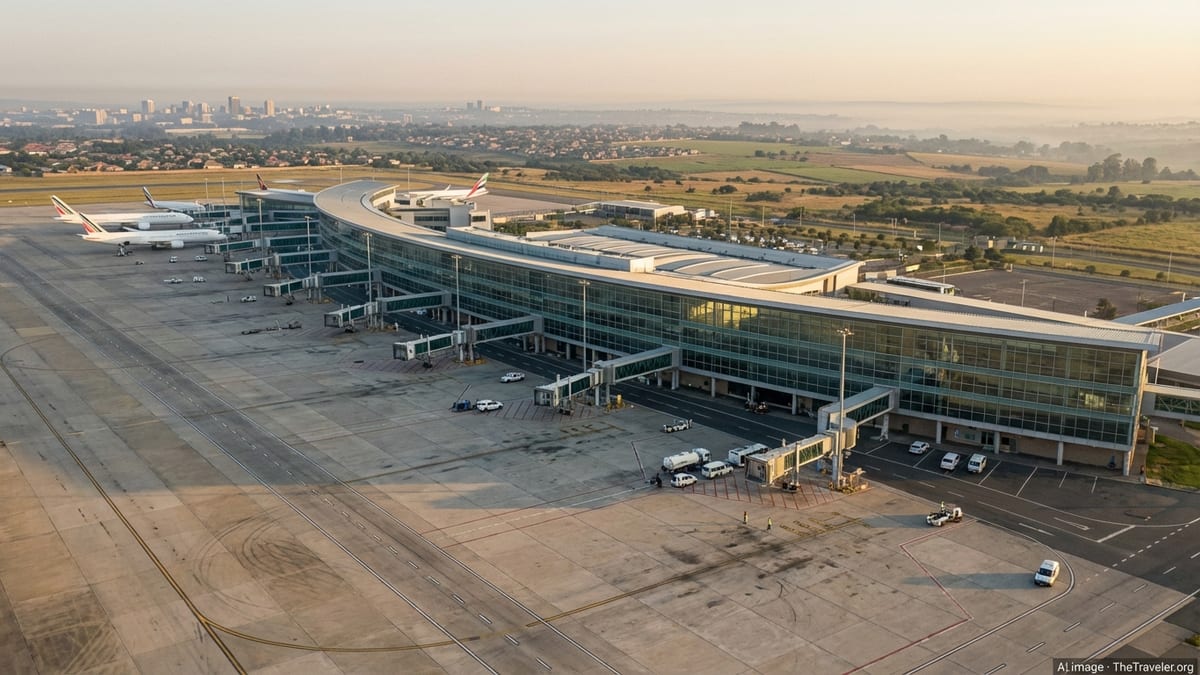
Jomo Kenyatta International Airport is widely described in public documents as Kenya’s primary international gateway and a key regional hub for East Africa. Master planning and advisory reports prepared for the government note that the single-runway airport now faces peak-hour bottlenecks across its runway system, terminal buildings and aircraft parking stands, reflecting sustained growth in both domestic and international traffic.
According to figures cited in recent coverage of the government’s expansion plans, JKIA was designed to handle around 7.5 million passengers a year, but traffic has risen to roughly 8.9 to 9 million passengers annually. This mismatch between design capacity and actual demand is increasingly visible to travelers in the form of longer queues at security and immigration, aircraft holding patterns before landing, and departures delayed during busy bank periods.
The airport’s role as the main hub for Kenya Airways, one of Africa’s largest airlines by passenger numbers, further concentrates traffic at specific times of day. Wave-style scheduling, which allows passengers to connect between regional African services and intercontinental flights, is central to Kenya’s connectivity strategy but also heightens pressure on infrastructure whenever operations are disrupted.
Recent episodes of delays at JKIA have therefore resonated beyond Kenya’s borders. Disruptions to connecting itineraries through Nairobi can affect passengers and cargo headed across East and Central Africa, highlighting how the airport’s performance has implications for the broader region’s mobility and trade.
Capacity gaps exposed by delays
Operational data and third-party analyses point to several structural factors that make JKIA vulnerable to delays. The airport currently relies on a single main runway and a network of taxiways and aprons that have become congested at peak times. Airside advisory notes explain that limited rapid-exit taxiways and tight apron space can slow aircraft movements, causing knock-on effects for departure and arrival punctuality.
On the landside, existing terminals were designed decades ago for much lower passenger volumes. Earlier expansion programmes lifted capacity from about 2.5 million passengers a year to more than 7 million, but subsequent traffic growth has outpaced those upgrades. Despite incremental improvements to check-in areas and boarding gates, public-facing assessments continue to describe terminal capacity as insufficient for anticipated demand through the late 2020s.
These constraints mean that when an external shock occurs, such as a weather disruption, technical outage or staff-related slowdown, the system has limited resilience. Flights can be forced into extended ground times as aircraft wait for stands or delayed passengers, further compressing the carefully timed connectivity banks that underpin JKIA’s hub model.
The pattern of disruptions has helped crystallise debate in Kenya about the pace and scale of investment at the airport. While contingency measures and airline-level schedule adjustments can reduce individual delays, planners increasingly frame the issue as one of structural capacity and layout rather than purely operational performance.
New master plan, old challenges
In response to mounting pressure, Kenya has adopted a new integrated master plan for JKIA that maps development from 2025 to beyond 2045. The phasing strategy published by the Ministry of Roads and Transport outlines a first phase focused on immediate airfield upgrades and terminal enhancements, followed by a second phase from 2030 that includes major airfield expansion and a substantial new terminal complex.
The plan builds on earlier, partly implemented expansion schemes and supersedes the cancelled Greenfield Terminal project, which was terminated in 2016 after financing and contractual problems. Current documentation shifts emphasis from a single stand-alone mega-terminal to a more incremental approach: upgrading existing facilities while adding new capacity in stages linked to demand thresholds.
Recent government communications put the overall budget for the modernization and expansion of JKIA at around 154 billion Kenyan shillings. The programme is described as broader than just a terminal project, with funds earmarked for runway and taxiway improvements, reconfigured terminal layouts, upgraded passenger-processing systems and redesigned access roads and parking.
Despite this renewed push, the history of delayed or reshaped airport projects in Nairobi has tempered expectations among observers. Some feasibility and advisory reports commissioned over the past decade have warned that inadequate or slow delivery of new capacity could compromise JKIA’s role as a competitive regional hub, particularly as other African airports pursue expansion and modernization plans of their own.
Regional competition and connectivity stakes
JKIA’s performance is central to Kenya’s wider economic strategy, which relies heavily on aviation to support tourism, horticultural exports and regional services. International airport statistics compiled by industry bodies place Nairobi among Africa’s busier gateways, with strong growth in domestic and international passengers over recent years.
At the same time, competing hubs in Addis Ababa, Kigali and Johannesburg have invested in expanded terminals and, in some cases, additional runways. These improvements are intended to attract airlines seeking efficient transfer points and to support national carriers that are enlarging their networks. Analysts note that if delays and congestion persist in Nairobi while rivals gain capacity, airlines may gradually adjust schedules or routings in ways that divert some connecting traffic away from Kenya.
Studies of regional air connectivity in Kenya underscore the importance of seamless links between short- and medium-haul African routes and long-haul services to Europe, the Middle East and Asia. Reliable on-time performance at JKIA is a critical ingredient in that model, affecting everything from minimum connection times to cargo transfer windows for perishable exports.
In this context, recent delay episodes have been interpreted as early warning signals. While they have not fundamentally altered JKIA’s status as East Africa’s busiest hub, they show how narrow the margin has become between strong growth and infrastructure strain, and how closely Kenya’s regional ambitions are tied to the airport’s ability to handle the next wave of demand.
A race to match infrastructure with ambition
The modernization of JKIA is now framed by Kenyan planning documents as a race to align infrastructure with ambition. Phase one works through 2029 aim to deliver targeted capacity relief, while later phases envisage new terminal facilities and airfield enhancements designed to push annual capacity well beyond current levels.
Publicly available feasibility reports indicate that various scenarios for a new terminal have been assessed, with concepts ranging from an integrated passenger facility designed for around 15 million passengers per year to more modular developments that could ultimately support more than 20 million. The goal is to create enough flexibility to accommodate future traffic growth without repeating past patterns of congestion.
For travelers, the near-term impact is likely to be mixed. Construction and reconfiguration can introduce their own disruptions, even as they are intended to solve longer-term bottlenecks. Airport advisories already emphasize that terminal assignments, access roads and parking arrangements may shift as works progress, requiring passengers and airlines to adapt.
What remains clear from recent delays is that JKIA’s role extends well beyond Nairobi. Each on-time departure or missed connection ripples through networks that link East Africa to the rest of the world. The extent to which Kenya can sustain its regional aviation ambitions will depend in large part on whether the current expansion drive succeeds in turning its busiest airport from a constrained chokepoint into a resilient, future-ready hub.