

More news on this day
International visitors planning a rail-focused trip to Japan have a powerful new option, as JR East prepares to roll out a next-generation rail pass that links Tokyo with the hot springs, castles, coastal towns and countryside of Tohoku and wider eastern Japan in a single, flexible ticket.
Get the latest news straight to your inbox!
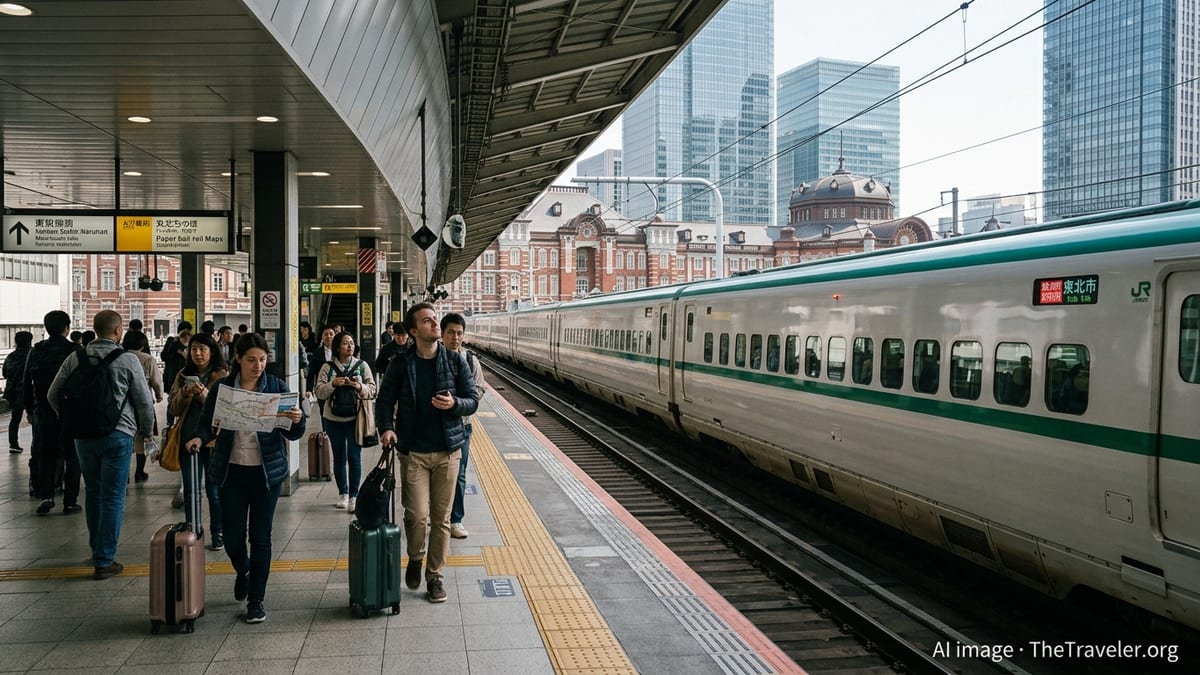
A New Flagship Pass Covering All JR East Lines
Publicly available information from JR East shows that the company is introducing a revamped JR EAST PASS product that unifies coverage across its network, replacing the long-running regional passes focused on the Tohoku and Nagano Niigata areas. The new pass is designed specifically for non-Japanese passport holders visiting Japan, with pricing and conditions that aim to make medium-length itineraries in eastern Japan more attractive.
Press materials indicate that the new JR EAST PASS will be available in two durations: a 5-day version priced at around 35,000 yen and a 10-day version priced at around 50,000 yen, both valid on consecutive days. The passes offer unlimited rides in standard-class reserved or non-reserved seats on JR East-operated Shinkansen and limited express services, as well as local and rapid trains across the company’s service area.
Coverage extends beyond core JR East tracks to include partner and third-sector lines that are important to tourists heading out of Tokyo. These include the Tokyo Monorail to and from Haneda Airport, the Aoimori Railway and Iwate Galaxy Railway in northern Tohoku, the Sendai Airport Transit Line, portions of the Sanriku Railway on the Pacific coast and the Hokuetsu Express in the Niigata region. Some JR and Tobu limited express services to Nikko and Kinugawa are also included in ordinary reserved seats.
The move consolidates several overlapping products into a single, network-wide pass that is easier to understand for first-time visitors. Travel media reports note that it is timed to capture growing inbound demand as Japan targets tens of millions of annual international arrivals, many of whom base themselves in Tokyo before branching out by rail.
From Tokyo Station to Tohoku’s Hot Springs and Coastal Towns
For travelers, the most visible impact of the new pass is the ability to treat Tokyo as a flexible hub for deep excursions into Tohoku. The coverage includes the Tohoku, Akita and Yamagata Shinkansen lines, which connect the capital to Sendai, Morioka, Akita, Yamagata and Shin Aomori, along with branch lines into smaller destinations that rarely appear on first-time itineraries.
Tourism organizations highlight that with unlimited rides within the pass period, visitors can combine headline destinations with lesser-known stops. A Tokyo to Sendai round trip on the Tohoku Shinkansen can approach 22,000 yen in reserved seats on its own, and longer journeys toward Morioka or Shin Aomori climb higher, meaning that even a small number of long-distance trips can match or exceed the cost of the 5-day pass.
Beyond major cities, the inclusion of local and rapid services opens up onsen towns, coastal scenery and rural landscapes. Travelers can reach the temple town of Yamadera from Sendai, explore the dramatic cliffs and fishing ports along the Sanriku Coast using JR East and Sanriku Railway sections, or connect through Morioka and Hachinohe onto Aoimori Railway to access small stations along the Pacific coastline of Aomori Prefecture.
Because Tokyo’s urban JR lines are also covered, many visitors are expected to combine everyday city transport on the Yamanote and Chuo lines with one or two longer Shinkansen rides during the validity period. This creates opportunities to schedule day trips or overnight stays in Tohoku without needing to purchase separate long-distance tickets or constantly recalculate fares.
Replacing Older Regional Passes and Simplifying Choices
The launch of the new all-line product coincides with a broader reshaping of JR East’s foreign visitor passes. Previous options such as the JR EAST PASS (Tohoku area) and JR EAST PASS (Nagano, Niigata area) have been widely covered in guidebooks and online forums as cost-effective tools for repeat visitors who knew the network well.
According to JR East’s published notices, these legacy passes will be phased out, with final sales and start dates scheduled ahead of the introduction of the unified pass. Existing passes purchased before the cutoff will continue to be honored through their stated validity, but prospective visitors planning trips from 2026 onward are being directed to the new product.
Travel industry commentary suggests that the change reflects both operational simplicity and shifting patterns in inbound tourism. Instead of asking overseas travelers to choose between multiple regional maps with complex boundaries, JR East is offering a straightforward option that covers its entire domain. This can reduce confusion at the planning stage, particularly for travelers combining coastal Tohoku, alpine Nagano and the Niigata region in a single trip.
At the same time, recent documentation from JR companies across Japan records a wave of price revisions for regional rail passes, reflecting higher operating costs and strong post-pandemic demand. Within that context, the new JR East product is positioned less as a deeply discounted ticket and more as a flexible travel tool that still provides value when used for multiple long-distance journeys.
Practical Details: Eligibility, Booking and Seat Reservations
The new JR EAST PASS is targeted at visitors holding non-Japanese passports, in line with existing conditions for most inbound-focused rail passes. JR East materials indicate that the pass is intended for short-term stays, and users are advised to check the latest eligibility terms when purchasing, as conditions can vary between regional and nationwide products.
As with current JR East passes, sales are expected through the company’s online reservation platforms, selected overseas travel agents and major railway stations and airports within the coverage area. Many stations in the Tokyo region and larger Tohoku hubs already feature multilingual ticket machines equipped with passport readers, allowing travelers to collect passes and seat reservations without queuing at a staffed counter.
Holders can use the pass to secure reserved seats on Shinkansen and limited express services within the free travel area, subject to availability. JR East’s existing systems typically allow advance reservations both online and at station machines, an important consideration during peak travel seasons such as the cherry blossom period, the August Obon holidays and autumn foliage season in northern Japan.
Because the pass is valid on consecutive calendar days, planning is essential to extract the maximum value. Rail specialists recommend grouping the longest journeys into the active period, while leaving highly localized city sightseeing or day-to-day transport to a separate IC card such as Suica or PASMO when the pass is not in use.
Opening Up Hidden Gems Beyond the Standard Japan Itinerary
The breadth of the new pass’s coverage makes it especially appealing for travelers looking beyond the classic Tokyo Kyoto Osaka triangle. With easy rail access from the capital, Tohoku offers mountain valleys, quiet onsen towns and coastal villages that contrast strongly with the dense urban landscapes of central Tokyo.
Promotional content from tourism boards highlights destinations that can now be reached more easily on a single pass. Examples include the Oirase Gorge and Lake Towada area in Aomori Prefecture, where buses connect from JR stations; the samurai district and castle town atmosphere of Hirosaki; and the zunda mochi sweets and beef tongue cuisine associated with Sendai. Inland, visitors can pivot southwest to Nagano and Niigata for ski resorts and highland hiking, or east to Nikko and Kinugawa for shrines, river valleys and hot spring resorts.
Regional revitalization efforts in Tohoku and surrounding prefectures increasingly lean on rail connectivity as a selling point, and JR East’s new pass directly supports these strategies by lowering the marginal cost of adding one more stop or detour to an itinerary. Travelers who might have limited themselves to a single Tohoku city break can now consider stringing together multiple towns over five or ten days, with predictable transport costs and minimal ticketing hassles.
For international tourists, the result is a more accessible map of eastern Japan. With one pass, a traveler can arrive at a Tokyo airport, transfer into the city, ride north on the Shinkansen, hop between regional lines to small stations and return to the capital, all while tapping into the reliability and frequency for which Japan’s rail system is known.