

More news on this day
In a move aimed at easing festive-season congestion for pilgrims and long-distance travellers, Indian Railways has increased sleeper capacity on the Kolkata–Jammu Tawi Express ahead of Navratri, creating more affordable reserved berths on the busy corridor between eastern India and Jammu.
Get the latest news straight to your inbox!
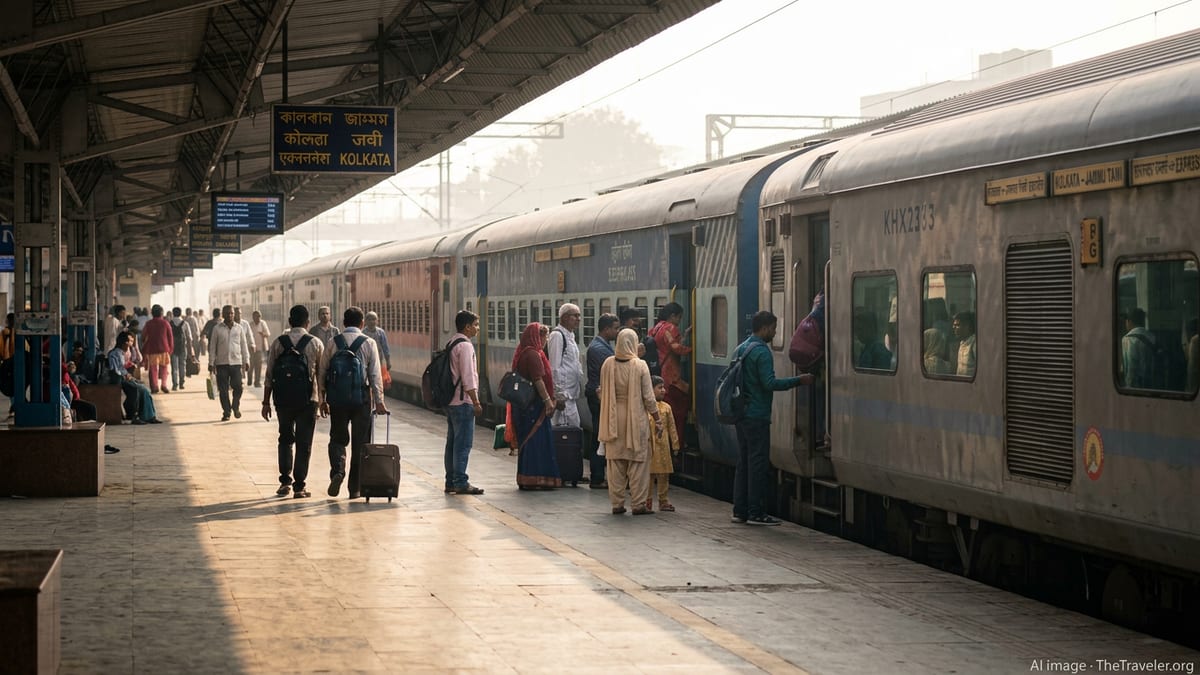
Additional Sleeper Coach Targets Festive Rush
According to published timetable updates and regional media coverage, the Kolkata–Jammu Tawi Express, operating as train numbers 13151 and 13152, is being strengthened with an extra sleeper-class coach to handle the anticipated Navratri rush. The enhancement is focused on improving comfort for passengers heading towards the Jammu region, a key gateway for pilgrims visiting shrines and hill temples during the festival period.
The train, which already runs with a mix of AC and sleeper accommodation, will now feature expanded non-AC sleeper capacity on selected Navratri-season trips. Publicly available rake-composition data shows that the service typically operates with around two dozen coaches, including multiple sleeper-class and general unreserved coaches. The new augmentation is designed to create additional reserved berths without altering the core schedule of the train.
Reports indicate that the decision aligns with a broader pattern of targeted capacity additions by Indian Railways during high-demand religious and holiday periods. In recent seasons, extra coaches have been attached to several Jammu-bound trains to manage spikes in demand, and the Kolkata–Jammu Tawi Express now forms part of that capacity-boost strategy for Navratri travellers.
Rail travel analysts note that, for many pilgrims, sleeper class remains the most cost-effective reserved option on long routes such as Kolkata to Jammu Tawi, where journeys can stretch across more than 36 hours. Increasing the number of sleeper berths directly addresses one of the most visible pressure points in India’s festive travel network.
Key Route for Pilgrims Between East and North India
The Kolkata–Jammu Tawi corridor is a critical link between eastern India and the plains of Jammu, providing access to onward road and rail connections for religious tourism. The express service traverses several populous states and important junctions, drawing passengers not only from Kolkata but also from intermediate cities that feed into the northbound pilgrimage stream.
Navratri, which culminates in large-scale celebrations and temple visits, typically generates heavy demand on northbound trains serving destinations associated with major shrines. Published coverage on festival travel patterns highlights Jammu Tawi as a recurrent focal point, with long waiting lists appearing on many trains well before the start of the festivities.
By enhancing sleeper capacity on the Kolkata–Jammu Tawi Express, planners are seeking to make it easier for families and group travellers from eastern India to secure confirmed berths without resorting to multiple ticket combinations or last-minute alternatives. The route also serves migrant workers and students who often time their trips to coincide with major festivals, further intensifying seasonal demand.
The coach addition is expected to be particularly significant for passengers boarding from smaller stations along the route, where confirmed sleeper accommodation can be harder to obtain when berths are heavily booked from originating cities. Extra sleeper berths increase the likelihood that quotas for intermediate stations will see some relief during the Navratri period.
Part of a Wider Capacity Push on Jammu-Bound Trains
The move on the Kolkata–Jammu Tawi Express mirrors a wider capacity push across the Indian Railways network on trains heading towards Jammu and other pilgrimage-linked hubs. Recent months have seen additional AC and sleeper coaches attached on select Rajdhani, express, and long-distance services to Jammu Tawi and neighboring destinations, particularly when advance reservation charts signal sustained high demand.
Publicly accessible coach-allocation notices and railway timetables indicate that Northern Railway and other zones have repeatedly relied on temporary and seasonal augmentation to handle rushes linked to major festivals, school vacations, and, more recently, disruptions in other modes of transport. The decision to prioritize sleeper-class expansion on the Kolkata–Jammu Tawi Express is consistent with this pattern, but tailored to a passenger segment that is especially price-sensitive.
While many recent capacity initiatives have focused on premium AC classes on high-profile services, travel demand analysis suggests that sleeper and general classes continue to bear the brunt of overcrowding in peak seasons. Adding a sleeper coach addresses this imbalance more directly for the Kolkata–Jammu Tawi route, where the majority of long-distance pilgrims still travel in non-AC accommodation.
Railway-focused observers point out that such targeted augmentations are often the most practical short-term solution when full-scale timetable overhauls or additional special trains are not immediately feasible. Attaching extra coaches to an established service allows the network to respond quickly to demand spikes while maintaining crew rosters, maintenance cycles, and pathing on already familiar schedules.
What Travellers Can Expect During Navratri
For passengers planning Navratri journeys on the Kolkata–Jammu Tawi Express, the additional sleeper coach translates into more available berths, but demand is still expected to remain intense. Historical booking patterns for similar festival periods suggest that tickets in sleeper and lower AC classes are likely to be snapped up quickly once reservation windows open, particularly around key Navratri dates and weekends.
Travel information platforms tracking reservation trends on the route indicate that waiting lists often build up weeks in advance. With the extra coach, some of this pressure may ease, especially for travellers flexible with dates or boarding from intermediate stations. However, early booking remains strongly advisable for those seeking specific berth preferences or travelling in larger groups.
In terms of onboard experience, passengers will see the familiar long-distance sleeper layout, with side berths and bay sections, expanded across an additional coach. The service continues to operate as a conventional mail/express train with multiple halts, catering primarily to budget and mid-range travellers. The key change lies not in product type but in the volume of seats available.
Rail-fan communities and passenger forums are likely to monitor the impact of the augmentation on crowding in both sleeper and general coaches during Navratri. If the added capacity succeeds in reducing the number of unreserved passengers spilling into reserved compartments, travellers could see modest improvements in comfort and corridor congestion, particularly on the busiest stretches approaching major junctions.
Implications for Future Festival Travel Planning
The decision to boost sleeper capacity on the Kolkata–Jammu Tawi Express during Navratri may also serve as a template for future festival-season planning on other long routes. Publicly discussed proposals around rail capacity have increasingly emphasized targeted augmentation on existing services as a cost-effective tool for handling predictable demand surges.
By observing booking data, on-board occupancy, and feedback during this Navratri cycle, planners can gauge how far a single additional sleeper coach improves conditions for passengers on a route of this length. If successful, similar measures could be repeated or scaled up on other trains connecting major metropolitan centers with pilgrimage and tourism hubs.
For the wider travel ecosystem, enhanced sleeper availability on this route may slightly rebalance demand between rail and bus services in some corridors, particularly for budget-conscious travellers who might otherwise consider overnight road journeys. It could also encourage more first-time pilgrims from eastern India to attempt the long rail journey to Jammu Tawi during Navratri, confident of better odds of securing reserved accommodation.
As Indian Railways continues to modernize its rolling stock and expand premium offerings, the Navratri-focused capacity boost on the Kolkata–Jammu Tawi Express underlines the continuing importance of affordable sleeper travel in connecting distant regions for religious, social, and family journeys. For many travellers this season, the added coach may be the crucial difference between a waitlisted ticket and a confirmed berth.