

More news on this day
Kolkata Metro has unveiled a dedicated Platform Screen Door (PSD) model room for Green Line staff, signaling a fresh push to strengthen frontline safety training, fine-tune maintenance practices and deliver a smoother experience for passengers using India’s first underwater metro corridor.
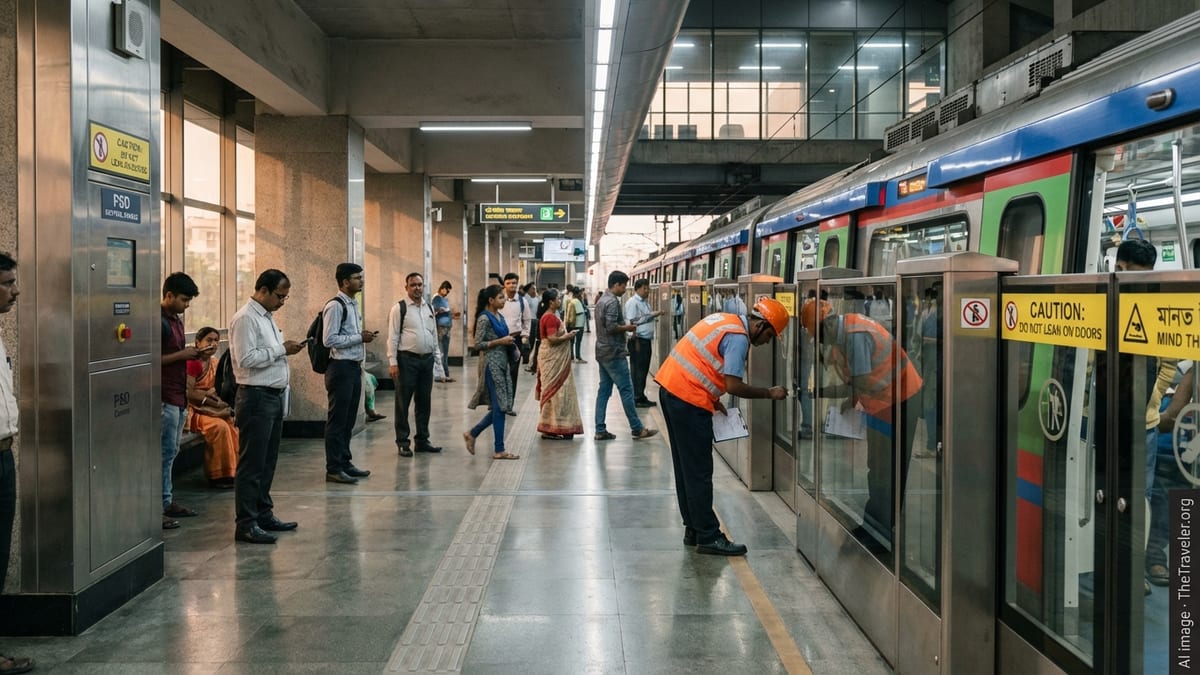
A Training First for India’s Underwater Metro Corridor
The new PSD model room has been set up as an in-house training and demonstration facility for employees working on Kolkata Metro’s Green Line, the East-West corridor that connects the satellite township of Salt Lake with Howrah via an underwater tunnel beneath the Hooghly River. The Green Line is the only metro line in India where every station is equipped with platform screen doors, making operational familiarity and fast troubleshooting a priority for staff.
Located within Metro Railway’s technical premises rather than on a live platform, the model room replicates the configuration of the actual PSD installations on both elevated and underground Green Line stations. It includes working door panels, control consoles, communication interfaces with train-borne systems and simulated fault scenarios, allowing technicians and station staff to practice on full-scale equipment without disrupting daily services.
Metro officials say the initiative reflects a broader strategic shift toward hands-on, system-specific training as the network expands and adopts more advanced technology. With additional stretches of the Green Line recently opened and daily ridership steadily climbing, the ability to keep PSDs operating reliably across a growing footprint has become essential for service quality and passenger confidence.
The model room is also intended to serve as a reference facility for future corridors where platform doors are planned, providing a test bed for procedures and protocols that could be replicated on new lines as they come on stream in the second half of the decade.
Strengthening the Safety Envelope on Busy Platforms
Platform screen doors have emerged as a central safety feature on the Green Line, physically separating passengers from the tracks and moving trains. With more commuters flocking to the underwater corridor and interchange stations, Metro authorities have been under pressure to reinforce the safety envelope at platform level, particularly during peak hours when crowding intensifies and dwell times are short.
The model room allows instructors to demonstrate how the doors work as a safety system rather than as standalone hardware. Training sessions walk staff through the integration between the PSD controller, the signaling system and the train’s own door circuits, emphasizing how precise train stopping, correct door alignment and robust interlocking logic work together to prevent unsafe situations.
For station teams, role-play exercises in the model room focus on crowd management and communication when PSDs detect an obstruction, fail to close or receive conflicting commands. Staff rehearse how to coordinate announcements, deploy on-platform personnel and liaise with drivers and the central control room, reducing reaction time during real incidents.
Metro management has framed the initiative as part of a layered approach to safety that also includes penalties for unsafe behavior near the platform edge, increased surveillance and regular public messaging. By raising the technical competence of staff responsible for PSD operation, officials hope to cut the remaining margin for error on some of the system’s most constrained stations.
Hands-On Maintenance to Minimize Disruptions
Beyond frontline operations, the PSD model room is expected to reshape maintenance practices on the Green Line. Platform screen doors are complex electro-mechanical systems that endure constant cycling during the operating day and are exposed to Kolkata’s heat, humidity and dust, particularly at elevated stations.
In the past, technicians typically refined their skills during overnight maintenance windows on live platforms, balancing learning needs against the pressure to complete inspections and repairs before first train. With the model room now available, teams can practice detailed procedures during daytime off-duty hours, disassembling and reassembling components, testing sensors and recalibrating actuators without the clock ticking toward the next morning’s service.
The facility incorporates diagnostic panels that replicate fault codes seen in the field, allowing engineers to simulate common and rare failures. Trainees learn to trace issues from the control unit to individual door leaves, guide rails, drive mechanisms and communication links, building a mental map of how faults propagate and how they can be isolated quickly.
Metro officials expect that this deeper familiarity will translate into shorter repair times and fewer door-related disruptions on the Green Line. A reduction in unplanned door outages can have a cascading effect on punctuality, as station dwell times become more predictable and trains can adhere more closely to scheduled headways on the high-demand corridor.
Supporting a Growing Passenger Experience Mission
For passengers, platform screen doors are often experienced primarily as a comfort and convenience feature, shielding platforms from wind, noise and the intimidation of open trackways. On the Green Line, where modern station architecture and the novelty of an underwater journey have become selling points, the consistency and smoothness of door operations play directly into the perception of service quality.
The PSD model room is being positioned by Metro Railway as an investment in that broader passenger experience mission. Training modules place explicit emphasis on how operational choices affect commuters, from minimizing the time that doors remain closed when a packed train arrives to ensuring that visual and audio cues remain synchronized for clear boarding guidance.
With Kolkata increasingly marketing the Green Line’s underwater section as a signature urban attraction, tourism and first-time riders now represent a noticeable slice of ridership on some stretches. Metro managers say that seamless door performance, coupled with visible staff confidence in handling the system, can help nervous or unfamiliar passengers feel more at ease when navigating busy platforms and confined underground spaces.
The model room also gives the operating agency more scope to experiment with passenger-facing innovations. Future trials could include fine-tuning door closing chimes, improving visual indicators that show where doors will open and testing new signage layouts, all in a controlled setting before they are rolled out systemwide.
Preparing Staff for Future PSD Expansion
While the Green Line is currently the only corridor in Kolkata where platform screen doors are standard at all stations, Metro and rail authorities have repeatedly indicated that PSDs are likely to become more common across the city’s expanding network. Plans discussed in recent years include introducing doors at underground stations on other lines and retrofitting busy legacy stations where crowding is most severe.
By creating a dedicated PSD model room now, Kolkata Metro is effectively building a core of trainers and technicians who can be deployed as subject-matter experts when new installations come online. The experience of designing curricula, running drills and maintaining training hardware on the Green Line can be transferred to future corridors that adopt similar technology.
The facility also provides a neutral space where standards can be harmonized. As different lines may involve multiple contractors and door suppliers, the model room can be used to validate operating procedures, emergency protocols and maintenance benchmarks so that passengers encounter consistent practices regardless of which line they use.
Industry observers note that such institutional preparation is critical as metro systems become more technologically layered. The Green Line’s integration of underwater tunneling, advanced signaling and full-length platform doors has already elevated Kolkata’s profile in India’s urban rail landscape, and the new PSD model room is seen as another step in aligning staff skills with the system’s technical ambitions.
Aligning with National Trends in Metro Safety
Kolkata Metro’s decision to invest in a PSD training environment mirrors a broader national trend toward standardized safety infrastructure across India’s urban rail networks. Cities such as Delhi, Chennai, Mumbai and Bengaluru have been steadily rolling out platform barriers or full-height doors at selected stations, particularly on congested corridors and airport links.
As more Indian cities adopt platform doors, the operational challenges and best practices associated with them have begun to converge. Kolkata’s model room positions the city to contribute to that learning curve, offering a tangible case study in how to embed PSD expertise at the staff level rather than relying solely on vendor support and automated safeguards.
The move also aligns with national-level conversations about reducing accidents and suicides on rail networks, a concern that has driven interest in physical separation between passengers and tracks. By doubling down on training and maintenance rather than treating PSDs as a set-and-forget technology, Kolkata Metro signals that design features and human preparedness must work together to deliver lasting safety gains.
Transport analysts suggest that as metro ridership grows and more lines interconnect, the role of platform doors will expand beyond safety into network resilience. Trained staff capable of keeping doors functioning smoothly under pressure will be key to maintaining throughput on crowded interchanges and preserving timetable reliability during peak demand.
A Model Room as a Window Into Tomorrow’s Metro
For now, the PSD model room will remain largely behind the scenes, accessible to staff, engineers and occasional visiting delegations rather than to the general public. Yet officials and planners see it as emblematic of the kind of backstage infrastructure that will increasingly underpin the passenger experience on modern metro systems.
By blending real equipment, simulated scenarios and structured instruction, the facility offers a glimpse into how Kolkata Metro is preparing for a future in which technology-rich stations will demand not only sophisticated hardware but also a deeply trained workforce. The Green Line’s platform doors, once a headline-grabbing innovation tied to the underwater tunnel, are now being treated as an everyday system that must be understood in detail at multiple levels of the organization.
In that sense, the model room’s unveiling marks a subtle but important shift from showcasing marquee infrastructure to consolidating the expertise needed to run it reliably. As Kolkata’s metro map continues to expand and more riders depend on it for daily travel, such behind-the-scenes investments may prove just as critical as the opening of new stretches of track.
For commuters boarding a Green Line train, the effect of this initiative will likely be noticed not in grand gestures but in small, consistent comforts: doors that align and open precisely where expected, clear signals about when to board, and fewer unexplained delays on the crowded platforms of a system that is quietly learning from its own technology.