

More news on this day
Korean Air managed to cut its carbon emissions in 2025 even as it added more flights worldwide, a rare achievement in commercial aviation that is drawing attention from climate-conscious travelers eyeing the busy Seoul–Atlanta corridor.
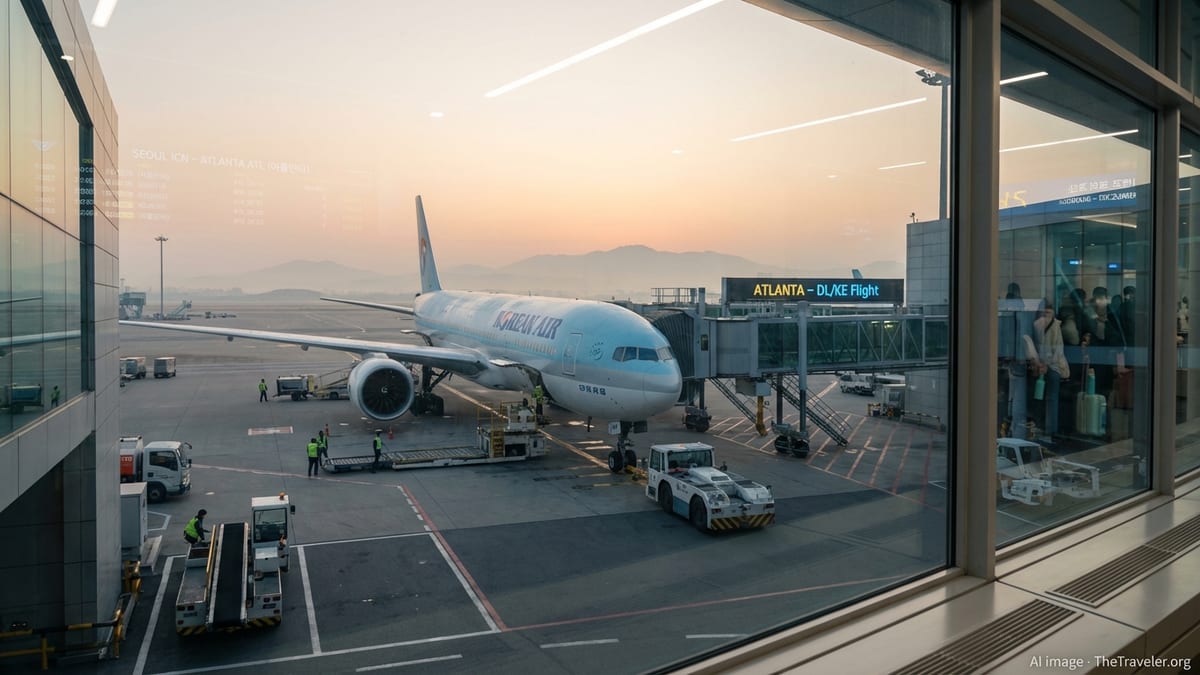
A Year of Lower Emissions and More Flights
Korean Air reported that its 2025 flight operations generated 12.18 million tons of carbon emissions, down about 420,000 tons, or 3.3 percent, from 2024. The reduction came despite a 2.6 percent rise in flight activity to nearly 190,000 services worldwide, underscoring how operational changes and new technologies can soften aviation’s environmental footprint.
For travelers, the numbers matter because they show that growth in long-haul connectivity, including transpacific services to the United States, no longer has to move in lockstep with rising emissions. Instead, airlines can begin decoupling expansion from climate impact through a mix of newer aircraft, improved fuel management and more efficient route planning.
Korean Air said the 2025 gains stemmed from a broad fuel-efficiency drive, including the deployment of more modern twin-engine jets and the selection of alternate airports on short-haul routes to minimize unnecessary fuel burn. The carrier has also leaned on artificial intelligence tools that fine-tune flight paths, speed and weight to squeeze more mileage from every ton of fuel.
These network-wide measures affect passengers on flagship routes such as Seoul Incheon to Atlanta, a transpacific link that sits at the heart of the airline’s joint venture with Delta Air Lines and increasingly serves as a gateway for sustainable-minded travelers connecting between Asia and the American Southeast.
Seoul–Atlanta: A Growing Green Transpacific Corridor
The Seoul–Atlanta route has become one of Korean Air’s most important long-haul markets, both commercially and strategically. The carrier is set to increase frequencies from March 29, 2026, moving first to 11 weekly round trips and then to a double-daily schedule from May 11, all operated by Boeing 777-300ER aircraft. That expansion will substantially increase capacity while maintaining a focus on more fuel-efficient widebodies.
In the nearer term, Korean Air is already rebalancing its fleet on the corridor. From March 30, 2025, the airline is phasing out the four-engine Boeing 747-8i on the Atlanta route in favor of the twin-engine 777-300ER. While the change trims overall seat numbers, it delivers a significant cut in fuel burn per flight, an important factor in the carrier’s 2025 emissions performance.
For travelers, the switch to modern twinjets is one of the clearest visible signs of lower-carbon flying. New-generation aircraft typically offer double-digit gains in fuel efficiency compared with the older models they replace, which translates directly into fewer emissions per passenger, even on long sectors of 14 to 15 hours between Seoul and Atlanta.
The Atlanta gateway also benefits from the Korean Air–Delta joint venture, which coordinates schedules, pricing and connections. As Delta scales up its own use of more efficient Airbus A350s on the route, passengers booking either carrier are increasingly likely to travel on aircraft that outperform earlier widebodies on fuel consumption and noise.
Inside Korean Air’s Broader Sustainability Playbook
The emissions gains reported for 2025 sit within a wider sustainability strategy that touches nearly every part of Korean Air’s operation. Beyond fleet choices and flight-planning algorithms, the airline has begun reshaping what passengers experience on board, starting with the cabin itself.
From December 2025, Korean Air is rolling out plant-based meal containers made from agricultural byproducts such as straw, sugarcane and bamboo. These lighter, non-wood-pulp containers are expected to cut the carbon footprint of in-flight catering by around 60 percent compared with traditional plastic options, while also reducing waste.
The carrier is also edging into the use of sustainable aviation fuel, or SAF, on select routes. A 1 percent SAF blend is being introduced on some Japan services from late 2025, a modest share by global climate targets but a signal that Korean Air is preparing for a future in which low-carbon fuel plays a larger role in long-haul flying, including eventual deployment on transpacific routes like Seoul–Atlanta.
Complementing these technical measures are community-focused projects run jointly with Delta, such as the “Suits on the Sand” beach clean-up in California and tree-planting and river clean-up work in Asia. While such initiatives do not substitute for direct emissions cuts, they reflect mounting pressure on airlines to show progress on environmental stewardship across their global footprint.
What Eco-Minded Travelers Should Watch on the Seoul–Atlanta Route
For passengers trying to make lower-impact choices, the details of aircraft type, schedule and onboard product now matter more than ever. On the Seoul–Atlanta route, travelers booking Korean Air can expect the Boeing 777-300ER to become the mainstay of the operation from 2025 onward, replacing older, less efficient aircraft on most dates.
That shift offers a practical rule of thumb. When comparing flights, choosing services operated by newer twin-engine widebodies such as the 777 or A350 typically results in fewer emissions per seat than older four-engine types. It can also mean quieter cabins, more modern interiors and, often, a better chance that the airline has optimized weight and fuel use.
Travelers connecting through Atlanta will also benefit from investments aimed at easing congestion and cutting ground-time emissions. The Korean Air–Delta partnership has supported new baggage-handling systems and streamlined transfers, changes that reduce the time aircraft spend on the ground with engines or auxiliary power units running, and shorten passengers’ overall journey times.
For those looking to go a step further, Korean Air’s evolving mix of plant-based catering materials and early-stage SAF use may become visible options in the booking flow or at check-in, as the airline looks to showcase its emissions reductions. Passengers can combine these airline-led measures with their own actions, such as packing lighter and choosing daytime departures that align better with efficient flight profiles.
The Future of Sustainable Long-Haul Travel From Seoul
Korean Air’s 2025 performance will likely be seen as an early test of whether a full-service global carrier can expand its network while steadily lowering its carbon intensity. With emissions down year-on-year despite more flights, the airline has given regulators and travelers a concrete example of progress at a time when aviation’s climate impact is under close scrutiny.
As the Seoul–Atlanta corridor grows into a double-daily transpacific bridge in 2026, the challenge will be to keep that trajectory intact. Continued fleet renewal, broader use of sustainable aviation fuel and deeper operational efficiencies will be essential if the airline is to keep absolute emissions in check as seat numbers rise.
For travelers, the message is that long-haul air travel is unlikely to become carbon-free in the near term, but it can become measurably cleaner. Paying attention to aircraft type, connection quality and airlines’ published sustainability metrics offers a way to support carriers that are moving faster on climate action.
On Korean Air’s growing Seoul–Atlanta route, those choices are already beginning to reshape the experience in subtle ways, from the wing design outside the window to the material of the meal tray on the seat-back table, giving passengers more to weigh than price and schedule alone.