

More news on this day
Kraków is racing ahead in Europe’s tourism stakes, underpinned by a railway building spree worth more than 750 million euros that is transforming how visitors move in and out of Poland’s former royal capital and through the wider Małopolska region.
Get the latest news straight to your inbox!
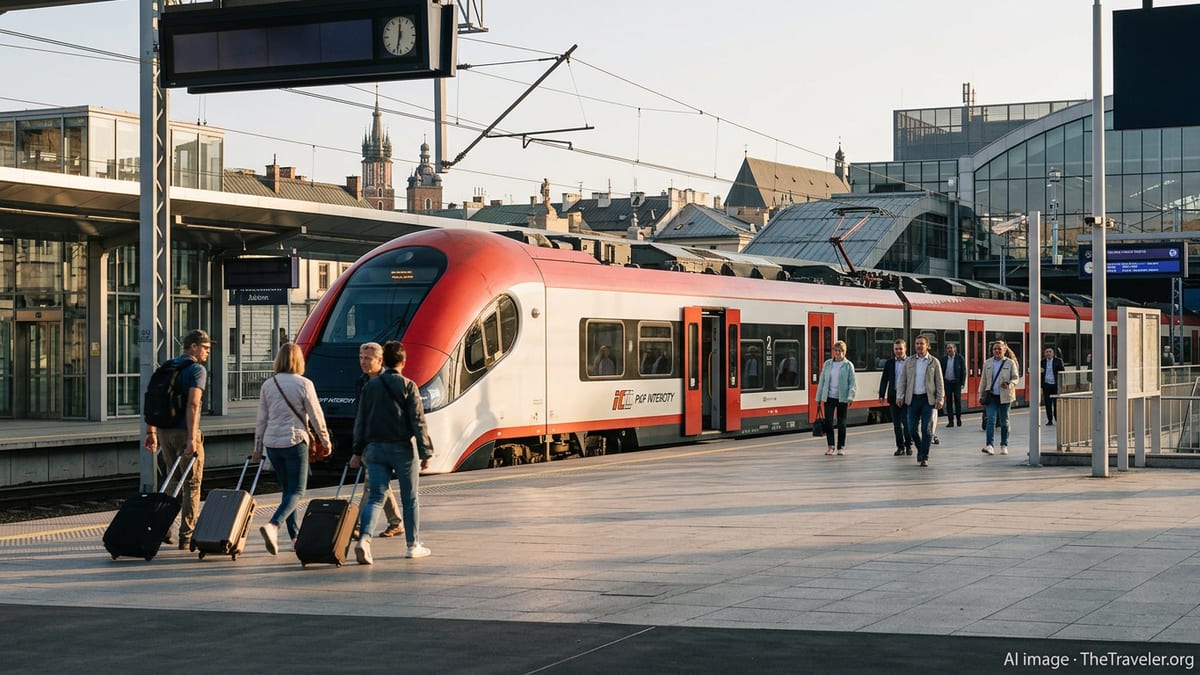
A New Golden Age for Rail and City‑Break Tourism
The surge in rail investment comes as Poland enjoys record visitor numbers, with government and industry data pointing to steady double‑digit growth in both domestic and international arrivals in 2024 and 2025. Analysts say Kraków, long one of Central Europe’s most recognisable heritage cities, is now leveraging trains rather than planes as its most powerful tourism catalyst.
National operator PKP Intercity has positioned rail at the heart of this strategy, supported by substantial allocations from the EU‑backed National Recovery Plan and cohesion funds aimed at decarbonising transport and shifting travellers from road to rail. New rolling stock orders, modernised lines and upgraded stations are designed to cut journey times between Kraków, Warsaw and other regional hubs while raising comfort standards to match Western European benchmarks.
Tourism researchers note that the timing is fortuitous. As travellers increasingly seek lower‑carbon, short‑haul city breaks, Kraków’s enhanced rail offer is helping Poland move from a perceived “emerging” destination to a mainstream choice alongside Central European rivals such as Prague and Budapest. Rail’s reliability and expanding timetable, they say, is encouraging visitors to tack on side trips across southern Poland rather than limit stays to the Old Town and Wawel Hill.
Underground Links and Mountain Corridors Reshape Access
At city level, 2025 has been billed by local officials as a breakthrough year for the long‑planned underground rail system threading through Kraków’s urban fabric. Tunnelling and station works have advanced under and around the historic core, laying the groundwork for a fast suburban and regional rail network that will connect key districts, business zones and interchange hubs with the main station and airport.
The underground spine is being complemented by upgrades across the broader Małopolska rail grid. South of Kraków, work has accelerated on one of Poland’s most ambitious schemes: a multi‑billion‑złoty project to link the city more efficiently with Nowy Sącz and the mountain gateway of Zakopane via a new tunnel and modernised tracks. The government frames the corridor as both a tourism lifeline and a climate measure, intended to lure skiers and hikers out of private cars and onto electrified trains.
Elsewhere in southern Poland, recent high‑speed and regional rail modernisation in the Tatra foothills has already shortened journeys to popular resort areas, with over 100 kilometres of line upgraded to support faster, more frequent services. Tour operators report that easier, direct rail access from Kraków to mountain villages is changing travel behaviour, with more weekend visitors arriving by train and staying in smaller, previously overlooked destinations.
EU Money and National Ambition Power the €750m Push
Behind the construction sites sits a dense web of European and national funding. Poland has emerged as one of the largest beneficiaries of EU‑level recovery and cohesion instruments for rail, with Brussels singling out rail electrification, safety upgrades and cross‑border links as priorities. A significant share of this capital is flowing into southern corridors and urban nodes that directly feed Kraków’s visitor economy.
City officials and rail planners say the combined value of current and recently contracted works touching the Kraków metropolitan area now exceeds 750 million euros when tallying tunnelling, station modernisations, signalling upgrades and depot expansion. Add in national programmes to purchase new intercity trains and expand regional services, and the figure rises further, underscoring how quickly Poland’s rail map is being redrawn.
Construction consortia from across Europe have secured multi‑hundred‑million‑euro contracts to deliver key nodes and junctions, from new platform halls and traffic‑control systems to upgraded bridges and viaducts. Industry reports highlight the Kraków agglomeration as a proving ground for Polish engineering firms that are now exporting rail‑construction expertise elsewhere in the EU.
Tourism Businesses Adapt to a Rail‑First Future
The ripple effects across Kraków’s tourism sector are already visible. Hoteliers and short‑stay rental operators report a rise in guests arriving by train from neighbouring countries rather than via regional airports, encouraged by competitive advance‑purchase fares and improved onboard standards. Travel agencies are bundling rail tickets with city passes, museum entries and excursions to nearby UNESCO‑listed sites.
Local authorities are actively steering this modal shift. Marketing campaigns now spotlight rail‑based itineraries, positioning Kraków as the starting point for multi‑day journeys that stitch together wooden churches, spa towns and mountain trails along electrified lines. Urban planners are reconfiguring public transport around stations, adding tram and bus interchanges, bike‑sharing docks and pedestrian‑friendly forecourts to smooth the last mile for visitors.
For small businesses, the change is both challenge and opportunity. Restaurants, cafes and cultural venues in neighbourhoods once considered peripheral are seeing new footfall as suburban stations gain prominence. At the same time, there is concern that success could strain housing and public space unless growth is carefully managed, prompting calls for stricter zoning and stronger support for resident communities.
Balancing Growth with Sustainability and Heritage
As Kraków cements its status as Poland’s rail‑connected showpiece, the city faces the delicate task of keeping tourism growth compatible with its fragile heritage and liveability. Conservationists have long warned that unmanaged visitor flows threaten to overwhelm the medieval core. Rail‑led development, they argue, must disperse rather than concentrate tourism pressure.
City hall has responded by tying rail investments to broader sustainability goals, including low‑emission zones, limits on coach traffic near historic sites and incentives for longer, slower stays beyond the Old Town. The emerging underground network and regional rail links are expected to make decentralisation more realistic, routing visitors through alternative gateways and encouraging exploration of lesser‑known districts and satellite towns.
For national policymakers, Kraków’s experience is being closely watched as a model for how modern rail infrastructure can underpin a resilient tourism economy. If the 750‑million‑euro wave of projects delivers on its promises of faster, cleaner and more comfortable journeys, it could set a template for other Polish cities seeking to harness Europe’s rail renaissance for sustainable growth.