

More news on this day
While geopolitical tensions and shifting airspace risks have disrupted flight patterns across the Middle East, Kuwait is quietly repositioning itself, using infrastructure upgrades and agile airlines to turn regional turbulence into new route opportunities.
Get the latest news straight to your inbox!
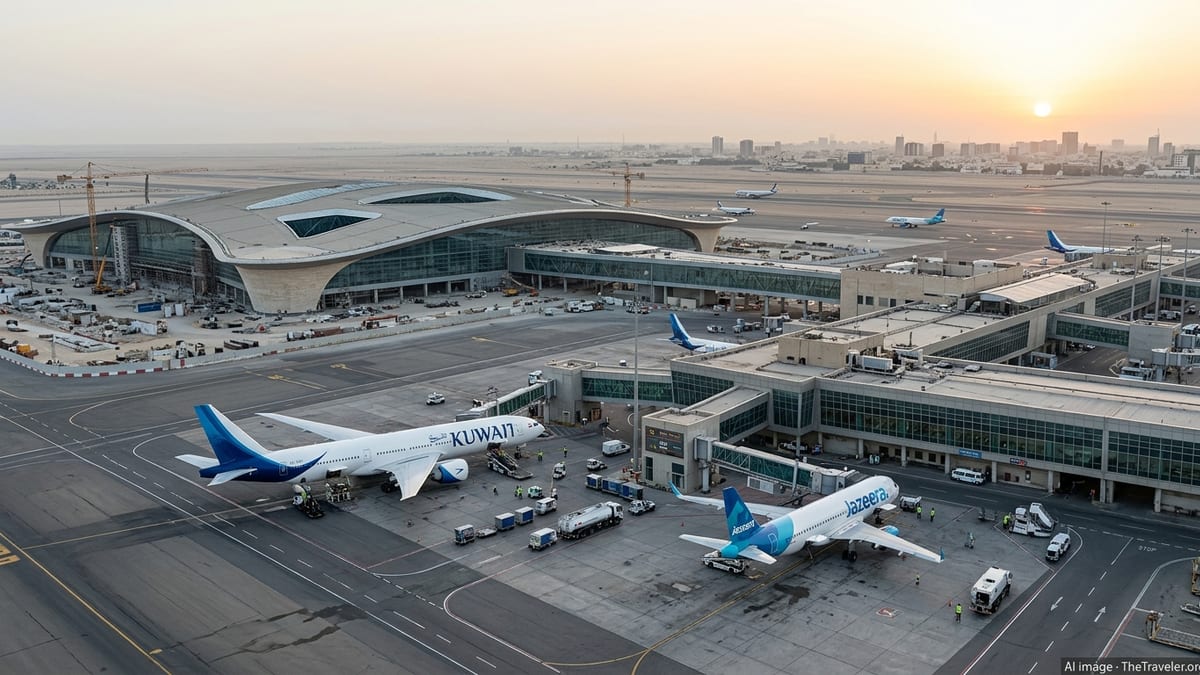
Image by Travel and Tour World – Tourism, Airline, Destination, MICE, Gobal Travel Market, Hotel news that you will find only over here.
Big-Budget Airport Overhaul Sets the Stage
Kuwait’s bid to capture more global traffic is anchored in one of the country’s largest infrastructure programs, centered on the expansion of Kuwait International Airport. Publicly available information shows that the multi‑billion‑dollar program includes a new Y‑shaped Terminal 2, a freshly opened 4.58‑kilometer runway and a new air traffic control tower intended to support long‑term growth in movements and connectivity.
Terminal 2 is designed to lift the airport’s capacity far beyond today’s levels. Sector coverage indicates that the building contract, led by a major Turkish construction group, is valued at more than 4 billion dollars, with the wider airport modernization package estimated at around 5.8 billion dollars. Once fully operational, T2 is expected to handle at least 25 million passengers annually, with scope to scale toward 50 million, positioning Kuwait as a more competitive transfer and origin‑destination market.
Traffic figures reinforce why this capacity is needed. Aviation industry reports show that Kuwait International handled more than 15.6 million passengers in 2023, a year‑on‑year rise of around 26 percent, even as some foreign carriers reduced presence in the market. National statistics comparing 2014 and 2023 point to passenger growth of more than one‑third and a near 30 percent increase in aircraft movements, underscoring a sustained upward trend that the new infrastructure is intended to support.
Officials have also emphasized service quality and network breadth as core goals of the airport plan. Upgrades to technical systems, apron areas and taxiways, along with new parking stands and engine‑run‑up facilities, are being pursued in parallel with terminal construction. Publicly available briefings indicate that these elements are scheduled to come together around the middle of this decade, with projections that Kuwait International could exceed 20 million passengers annually by 2027 if demand continues to build.
National Carriers Pivot Toward Underserved Markets
While the airport is being rebuilt, Kuwait’s homegrown airlines are making network decisions that seek to take advantage of shifting regional dynamics. Kuwait Airways has focused on renewing its fleet and gradually restoring or expanding services to Europe, Asia and North Africa, with schedules in recent seasons pointing to increased frequencies on trunk routes and selective additions in secondary markets where competitors have trimmed capacity.
Jazeera Airways, Kuwait’s low‑cost carrier, has taken a notably opportunistic approach. Its latest annual report highlights the strongest summer season in the airline’s history in 2024, driven in part by new point‑to‑point links from Kuwait to leisure cities that had limited nonstop coverage. Among the additions were routes such as Krakow, reflecting a strategy of pairing Kuwait’s outbound demand with emerging inbound tourism flows from Central and Eastern Europe.
These moves come as several large international airlines reassess their Kuwait schedules. Independent business media coverage in 2025 described a gradual exit or downsizing of some foreign carriers, even as rival Gulf hubs reported strong growth. That reshuffle has opened space for Kuwait‑based operators to consolidate share on key corridors and to experiment with niche city pairs that might not attract wide‑body service from larger network airlines.
Industry analysts note that the combination of a high‑capacity new terminal and agile local carriers could allow Kuwait to pursue a hybrid model, mixing traditional hub‑and‑spoke connections with point‑to‑point routes aimed at price‑sensitive travelers. If regional competitors face intermittent restrictions or route detours, Kuwait’s carriers may find pockets of demand where they can offer shorter journey times or more stable schedules via their home airport.
Regional Turbulence Reshapes Airspace and Flows
At the same time, Kuwait must contend with airspace volatility linked to conflict zones stretching from the Eastern Mediterranean to the Gulf of Oman. Travel advisories and flight tracking analysis in 2024 and 2025 have highlighted a pattern of rerouted services, temporary airspace closures and elongated flight paths for carriers seeking to avoid high‑risk regions. These changes have affected not only overflights but also direct services into Gulf markets, including Kuwait.
Reports indicate that during spikes in regional tension, airlines such as Turkish Airlines, British Airways and several Asian carriers have at times curtailed or canceled flights to Gulf destinations, Kuwait among them. Broader Gulf coverage has also pointed to temporary suspensions and diversions by multiple airlines when risk assessments changed, leading to sudden shifts in how traffic flowed between Europe, the Middle East and Asia.
For Kuwait, this environment presents both setbacks and possibilities. A 2025 analysis in a regional outlet noted that overflight numbers through Kuwaiti airspace fell as airlines bent routes around perceived hotspots, reducing airspace usage fees and complicating target revenue projections. Yet those same disruptions also redirected some passengers onto remaining corridors and carriers, creating windows for Kuwait‑based airlines to capture rerouted demand or to step into markets temporarily underserved by foreign competitors.
Whether Kuwait ultimately gains or loses from these patterns depends on how consistently it can keep its own operations stable while others adjust. Industry observers suggest that a reputation for predictable schedules, reliable handling at the airport and clear communication regarding any risk‑related changes could make Kuwait more attractive to both airlines and travelers when neighboring states face more frequent interruptions.
Turning Investment Into Route Opportunities
The core question now facing Kuwait’s aviation sector is how to translate large‑scale capital spending into tangible route wins. The new runway and control tower already in service broaden the range of aircraft types and traffic volumes that Kuwait International can accommodate, including very large wide‑bodies on long‑haul routes. Terminal 2’s eventual opening, coupled with expanded apron and taxiway capacity, is expected to give airlines more scheduling flexibility and gate availability, crucial for building connecting banks and efficient turnaround times.
Public sector planning documents and business commentary describe a strategy that hinges on three levers: attracting back foreign airlines that have reduced operations, supporting Kuwait Airways and Jazeera Airways as they build new city pairs, and using improved facilities to target high‑yield segments such as premium business traffic and transit flows between Europe, South Asia and East Africa. The airport’s geographic position on eastbound corridors from Europe to the Indian subcontinent and Southeast Asia remains a structural advantage when regional airspace is fully accessible.
Some of the early network moves point to how this strategy might unfold. Jazeera Airways’ push into secondary European cities and new leisure destinations reflects an attempt to bypass crowded legacy hubs and tap direct demand. Kuwait Airways, meanwhile, has focused on strengthening long‑haul connectivity and modernizing its fleet to improve fuel efficiency on routes that may now require longer detours around conflict zones.
As neighboring hubs in Dubai, Doha and Riyadh continue to expand, Kuwait is unlikely to displace them as primary super‑connectors. However, analysts argue that the combination of a brand‑new terminal, renewed runway infrastructure and nimble local carriers could allow Kuwait to carve out a complementary role, capturing specific flows that favor a smaller, less congested airport with room for tailored services.
Balancing Risk, Competition and Long-Term Growth
The outlook for Kuwait’s aviation surge remains closely tied to external variables. Regional security dynamics, global fuel prices and competitive responses from other Gulf hubs will influence how rapidly new routes can be added and sustained. Passenger confidence and airline risk assessments may shift quickly in response to headline events, potentially erasing or amplifying gains in traffic.
Nonetheless, the structural elements now being put in place are significant. By pairing a major physical expansion of Kuwait International Airport with more targeted network strategies at Kuwait Airways and Jazeera Airways, the country is attempting to move beyond a purely reactive posture. Instead of viewing regional turbulence solely as a threat, policymakers and industry stakeholders appear to be treating it as a catalyst to reconfigure routes, refine market positioning and accelerate long‑planned upgrades.
In practical terms, the next few years will test whether Kuwait can convert infrastructure into influence. If the new terminal opens on schedule, service quality improves and carriers use the additional capacity to launch and sustain routes that were previously unviable, Kuwait’s aviation sector could emerge from a period of regional upheaval with a stronger global footprint. If delays or renewed instability dominate, the opportunity may prove more elusive.
For now, the trajectory suggests a sector in transition rather than retreat. Passenger volumes are higher than a decade ago, long‑term investments are well advanced and local airlines are experimenting with new markets. In a region where airspace maps and route networks are being rewritten, Kuwait is seeking to ensure that turbulence in the skies translates into lasting gains on the ground.