

More news on this day
High on a windswept plateau in Ladakh, far from city lights and at more than 4,500 metres above sea level, India’s first Dark Sky Reserve is rapidly transforming the tiny village of Hanle into one of the world’s most spectacular astro tourism hotspots.
Get the latest news straight to your inbox!
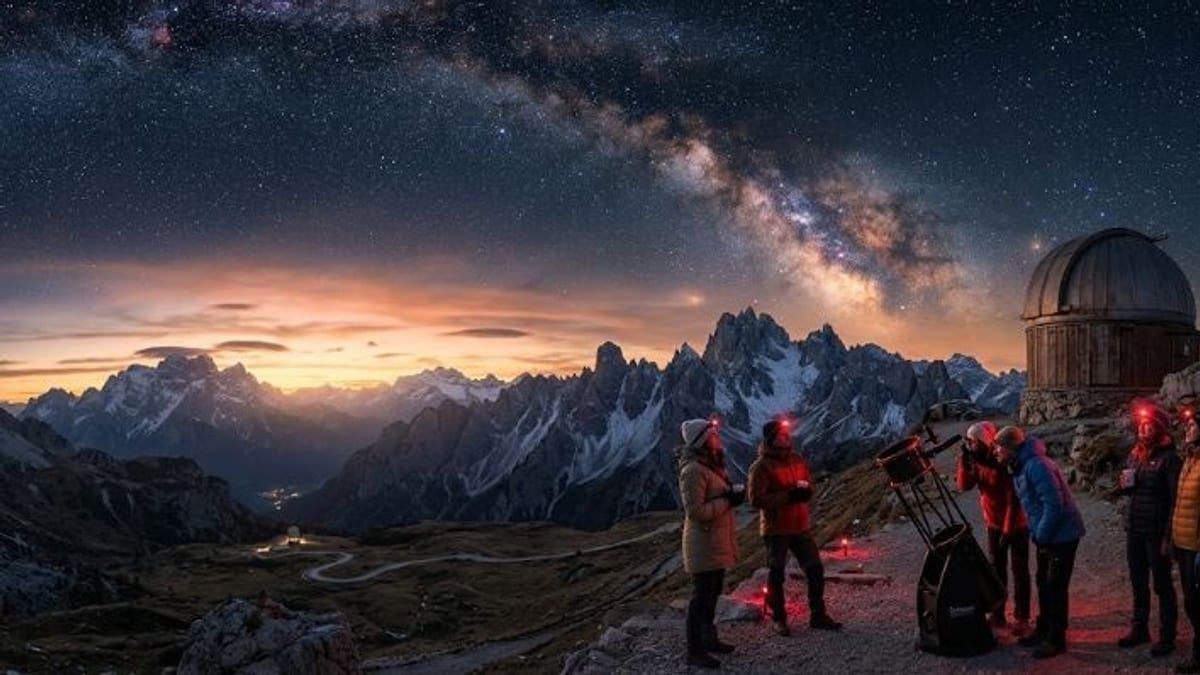
Image by Latest International / Global Travel News, Breaking World Travel News
From Remote Border Hamlet To Dark Sky Trailblazer
Hanle, tucked inside the Changthang Cold Desert Wildlife Sanctuary in southeastern Ladakh, was long known mainly to astronomers and a trickle of adventure travellers. That changed after the union territory administration notified the Hanle Dark Sky Reserve in December 2022, creating India’s first legally protected night-sky destination across more than 1,000 square kilometres of high-altitude desert.
Publicly available information shows that the designation built on two decades of scientific investment, including the Indian Astronomical Observatory and a cluster of powerful research telescopes installed on nearby peaks. Clear, dry air, minimal light pollution and over 250 photometric-quality nights a year give Hanle night skies that specialists describe as comparable with some of the best observatory sites on Earth.
Since the reserve was created, travel coverage indicates that visitor numbers have climbed sharply, with estimates of around 10,000 tourists in 2024, up from just a few thousand annually before the pandemic. Once a sparsely visited corner of Ladakh, Hanle is now appearing on itineraries for domestic and international travellers seeking an offbeat, science-focused alternative to crowded hill stations.
A Night Sky That Looks Almost Unreal
What draws travellers to this remote plateau is the sheer intensity of the night sky. On moonless nights, the Milky Way appears as a bright, textured river of light stretching from horizon to horizon, with naked-eye views of constellations, star clusters and even faint nebulas that are usually lost to urban glare.
Travel photography and social media posts from recent seasons show vivid bands of the Milky Way arching over whitewashed homestays, prayer flags and the silhouette of surrounding mountains. Long-exposure images taken from Hanle capture intricate dust lanes and deep-sky objects in as little as a few minutes, illustrating just how dark the reserve has become.
The high elevation further intensifies the experience. At roughly 4,500 metres, the thinner atmosphere scatters less light, making stars appear sharper and more numerous than at lower-altitude dark-sky sites. Visitors frequently describe being able to see their own shadows cast by starlight, a phenomenon rarely encountered outside the world’s most pristine night environments.
Community-Led Astro Tourism On The Roof Of India
Unlike many observatory complexes that remain closed to the general public, Hanle’s astro tourism model is centred on village participation. Reports on the reserve describe a growing network of homestays, many run by families who have received basic astronomy training and small telescopes to introduce guests to the night sky.
Local youth have been trained as “astronomy ambassadors,” leading guided stargazing sessions that blend scientific explanations with Ladakhi folklore about the stars. Public accounts indicate that more than 20 such guides now operate in the village cluster, a majority of them women, reflecting a deliberate effort to link the new night-sky economy with social empowerment.
Homestay capacity has expanded rapidly, with dozens of simple but comfortable guest rooms now available across several hamlets. For households that once relied largely on subsistence pastoralism and seasonal labour, astro tourism has opened a new revenue stream, helping to slow outward migration and create incentives to protect the area’s fragile environment.
Balancing Cosmic Dreams With Conservation
The Hanle Dark Sky Reserve is designed not only as a tourism magnet but also as a laboratory for dark-sky conservation in India. Official policy documents outline a light management plan for the area, including guidelines on shielded fixtures, warm-colour bulbs and limitations on outdoor lighting to keep skyglow to a minimum.
This approach is critical in a landscape that is both a biodiversity hotspot and a frontline site for climate change. The wider Changthang region hosts endangered species such as the snow leopard and black-necked crane, which are sensitive to disturbance. By limiting artificial light and encouraging low-impact tourism, the reserve aims to protect both wildlife and astronomical observations.
Travel advisories emphasise that visitors are asked to follow strict rules: minimising vehicle headlights at night, avoiding bright phone screens during stargazing sessions and respecting designated observation zones. The model is being closely watched by other Indian destinations that hope to develop astro tourism without repeating the uncontrolled expansion seen in some popular mountain towns.
India’s New Frontier For Space-Inspired Travel
Hanle’s rise as an astro tourism hotspot is unfolding alongside a wider wave of space-related initiatives in Ladakh, from high-altitude solar telescopes to proposed Mars and Moon analogue research sites elsewhere in the region. Together, these projects are positioning Ladakh as a natural laboratory for both professional astronomy and public skywatching.
For travellers, the emerging dark-sky circuit offers a new kind of Indian Himalayan experience, where the main draw is not only snow peaks and passes but also the chance to witness meteor showers, trace the arc of the Milky Way and photograph deep-sky objects against a foreground of monasteries and yak pastures.
Industry observers suggest that if infrastructure, local capacity building and conservation efforts keep pace with demand, Hanle could become a flagship for sustainable astro tourism across Asia. For now, the village remains a remote, difficult-to-reach destination, but the images streaming out of Ladakh’s night skies are already reshaping how travellers think about India as a place to look up and travel among the stars.