

More news on this day
At nearly 4,500 metres above sea level, a remote corner of Ladakh is rapidly emerging as one of the world’s most dramatic places to travel after dark, as India transforms the high-altitude village of Hanle into a flagship astro tourism hub with night skies so pristine they barely seem real.
Get the latest news straight to your inbox!
India’s First Dark Sky Reserve Becomes a Global Magnet
Hanle, a wind-swept settlement on the Changthang plateau close to the India China border, was formally notified as India’s first Dark Sky Reserve in late 2022. The protected zone spans more than 1,000 square kilometres, ringed by rust coloured peaks and open desert, with almost no industrial activity and very low light pollution. Publicly available information shows that the reserve was created to protect the inky night skies around the Indian Astronomical Observatory while opening the area to carefully managed tourism.
In the past three years, that decision has quietly reshaped India’s travel map. Travel industry coverage indicates that Hanle is now regularly listed among the country’s top destinations for stargazing and astrophotography, often compared with established dark sky hotspots in Chile and Hawaii. For many visitors to Ladakh, a night in Hanle has moved from a niche detour to the centerpiece of an itinerary.
The appeal lies in visibility that is hard to find elsewhere. Reports from recent visitors describe the Milky Way stretching from horizon to horizon, planets visible to the naked eye and shooting stars flashing across the sky within minutes. On moonless nights, the glow of the galaxy is bright enough that some travelers say they can make out the outlines of nearby ridgelines without artificial light.
Tourism planners see the site as a test case for how India can channel a growing global fascination with the night sky into sustainable, science centered travel products. If Hanle succeeds, the model is expected to influence new dark sky initiatives in other Himalayan and desert regions.
Astronomy Meets Village Life in a High Himalaya Setting
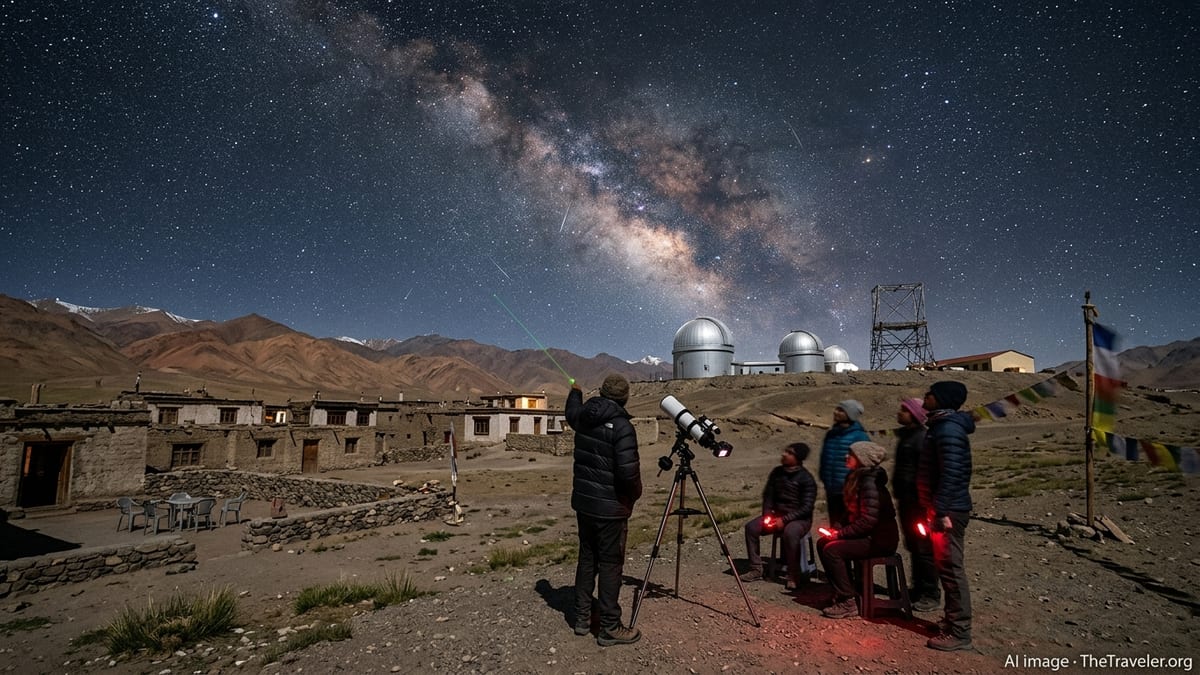
What makes Hanle striking is not only what appears overhead, but how closely the cosmic spectacle interlocks with everyday life in this high altitude community. The skyline is punctuated by the domes of the Indian Astronomical Observatory and the towering structure of the Major Atmospheric Cerenkov Experiment Telescope, described in scientific briefs as one of the world’s highest imaging Cherenkov facilities.
Below the telescopes, traditional stone homes cluster along the valley floor, fields of barley and peas trace green stripes through the desert, and a 17th century hilltop monastery looks across to snow tipped summits. Visiting stargazers now move between homestays, small cafés and observation points, often within sight of the observatory’s silver domes glowing faintly against the dusk.
This fusion of frontier science and remote village life is central to Hanle’s appeal. Travel reports highlight that evenings can pivot from simple Ladakhi meals and butter tea in family kitchens to structured sky sessions in open courtyards, where constellations are traced with laser pointers and visitors learn how astronomical research conducted a short drive away helps decode distant galaxies.
Daylight hours reveal an equally otherworldly landscape. Roads to Hanle cross high passes and broad river valleys, with long stretches where the only companions are herds of kiang, or wild ass, and strings of prayer flags snapping in the wind. For many travelers, the journey feels like a slow ascent to a natural planetarium perched on the edge of the Himalayas.
Astro Ambassadors and Community-Led Tourism
A key element in Hanle’s rise has been a deliberate effort to put local residents at the heart of astro tourism. Coverage in Indian and international outlets describes training programmes that have created a cadre of “astro ambassadors” village youth and homemakers who guide stargazing sessions, operate telescopes and interpret the sky for visitors.
These initiatives, led by scientific institutions in partnership with the Ladakh administration, have provided telescopes and basic equipment to homestays and community facilities. Public information notes that dozens of local guides have been equipped to run small group night sky experiences, from introductory constellation tours to more advanced astrophotography workshops.
The approach is reshaping livelihoods in a village where harsh winters and limited agricultural options traditionally pushed many residents to seek seasonal work elsewhere. Reports indicate that guiding, hosting and related services linked to astro tourism now provide a growing share of household income, while allowing families to remain rooted in Hanle and keep alive local language and customs.
For visitors, the result is a style of stargazing that feels intimate rather than transactional. Observing sessions often take place in homestay courtyards or on nearby hillocks, with stories about the sky interwoven with explanations of local history, Buddhism and life on the Changthang. The cosmos becomes a backdrop for cultural exchange as much as scientific curiosity.
Light Management, Festivals and a New Kind of Nightlife
Protecting Hanle’s darkness is as important as promoting it. The Hanle Dark Sky Reserve is governed by a light management plan that sets limits on outdoor lighting, encourages the use of shielded, low intensity fixtures and asks drivers to avoid high beams near observation zones. Regional policy documents show that new infrastructure is screened for its impact on the night sky, an unusual level of scrutiny in a tourism project.
Astro themed events are further amplifying the village’s profile. Travel calendars list dedicated star parties and an annual Ladakh Astro Festival, typically timed around the clearest, darkest nights of the year. These gatherings bring together amateur astronomers, students, photographers and curious travelers for telescope viewings, talks and night sky walks under some of the most reliable clear-sky conditions in the Himalayas.
Local homestays, tour operators and transport providers are increasingly tailoring offerings around these dates. Some arrange late night transfers from nearby settlements, while others advertise “Milky Way weekends” and photography camps that span several nights to maximize the chances of cloud-free skies.
Unlike conventional nightlife, the focus here is on preserving quiet and darkness. Visitors are encouraged to carry red torches, dim smartphone screens and dress warmly enough to stand still for long periods under the open sky. As awareness of astro tourism grows across India, Hanle’s rules-based, low-impact approach is watched closely by other regions seeking to balance visitor numbers with environmental protection.
How Hanle Is Repositioning India on the Global Astro Map
The rapid evolution of Hanle illustrates how India is seeking to compete in a niche once dominated by destinations in North and South America, and parts of Europe. With its combination of high altitude, dry air and year-round clear nights, Ladakh offers observing conditions that professional astronomers regard as among the finest in Asia.
Recent policy documents note that national budgets have earmarked funds for additional telescopes in Ladakh, bolstering the scientific clout of the region. At the same time, tourism bodies are marketing the dark sky reserve as a signature experience that sets India apart in an increasingly crowded field of adventure and nature travel.
For international visitors, the message is that the country’s travel story now extends far beyond palaces, beaches and tiger safaris. Hanle positions India as a place where a trip can culminate not in city lights, but in a silence broken only by the wind, under a sky dense with stars that many urban travelers have never properly seen.
For Ladakh itself, the new astro tourism hotspot signals both opportunity and responsibility. The challenge will be to keep Hanle’s skies as pristine as the images that now circulate widely on social media, even as more travelers arrive, drawn by the promise of a night where the universe feels close enough to touch.