

Laganas Beach on the Greek island of Zakynthos is one of the Mediterranean’s most paradoxical stretches of sand. By day it fronts a protected marine park that is among the most important nesting grounds for the endangered loggerhead sea turtle, Caretta caretta.
By night it is the epicenter of Zakynthos’s hedonistic party scene, backed by bars, beach clubs and late-opening venues. Navigating these two faces of Laganas responsibly is the key to enjoying your stay here, whether you are coming for warm, shallow waters with the family, to look for turtles, or to dance until sunrise.
Laganas Beach At A Glance
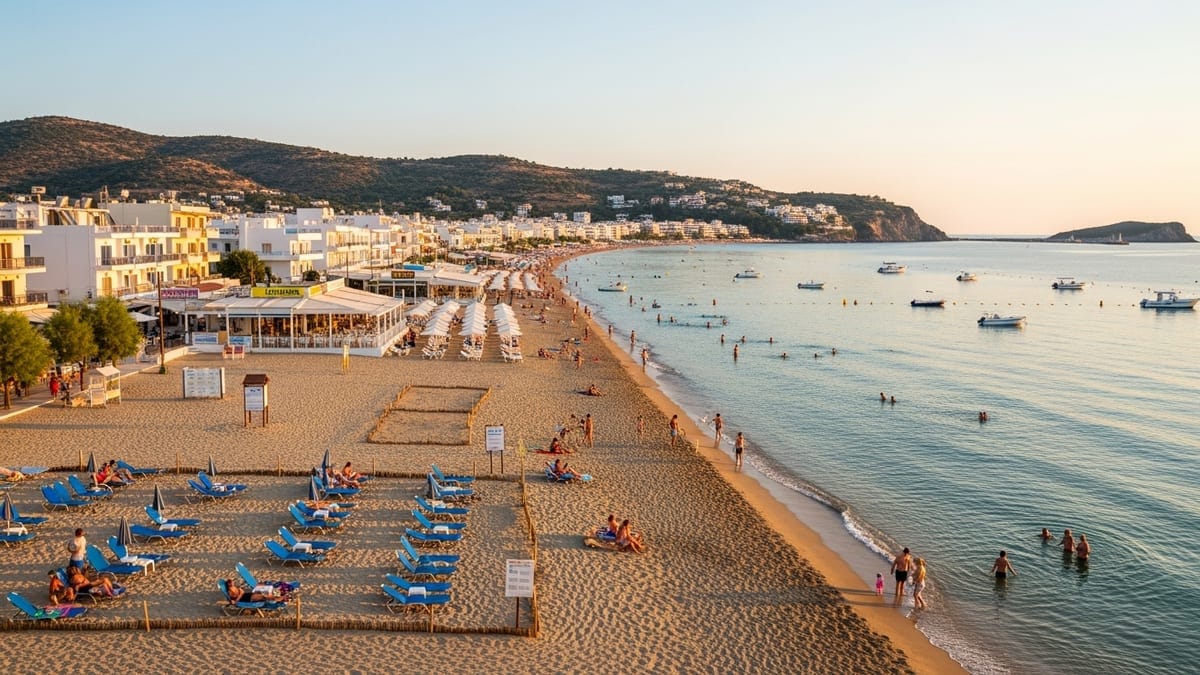
Laganas Beach sweeps in a wide arc across the southern shore of Zakynthos, forming the heart of Laganas Bay and the core of the island’s National Marine Park. The beach itself is long and broad, with around 5 kilometers of soft golden sand shelving gently into calm, shallow water. This geography is exactly what adult female loggerheads look for when they come ashore between roughly late May and August to dig nests and lay their eggs.
The resort of Laganas runs behind the sand, a dense ribbon of hotels, apartments, tavernas, rental shops and nightlife venues. The busiest, loudest stretches sit toward the central part of the bay, where the main strip meets the beach. Quieter, more spacious sections fan out toward the eastern end near Kalamaki and westward toward Agios Sostis, where development thins and the sand feels more natural.
Because Laganas sits inside a protected marine area with strict regulations, the beach experience here differs from other Greek resorts. There are zones where umbrellas and sunbeds are limited or removed at night to make room for nesting turtles, and access to some beaches in the wider bay is confined to daylight hours only. With a little understanding of how the marine park works, you can still swim, sunbathe and party comfortably while staying within the rules that keep this fragile ecosystem functioning.
Swimming, Sun & Sea Conditions
Laganas Beach is especially forgiving for swimmers of all levels. The shoreline shelves very gradually, creating an extended belt of waist-deep water that feels more like a natural lagoon than an open bay on windy days. In summer the sea temperature typically warms to a balmy range that encourages long swims and lazy floating. Many visitors spend hours wading far out from shore, which is convenient but also requires awareness of boats operating in the bay.
Thanks to its southern exposure and the shelter provided by the curve of the bay, Laganas often enjoys relatively calm conditions, particularly in the mornings before any afternoon breeze picks up. The lack of significant waves makes it a good choice for families with younger children and for less confident swimmers who still want to enjoy the sea. Standard precautions apply: keep an eye on flags and any posted notices from lifeguards, watch for sudden dips in the sandy bottom, and be especially cautious where the swimming area meets boat lanes.
Water clarity is usually excellent, particularly early in the day before the sand is stirred up by swimmers and boat traffic. On clear days visibility can be good enough to spot fish and occasionally turtles cruising in the shallows. Simple snorkeling close to shore reveals sea grass meadows and small marine life rather than dramatic reefs. For most visitors, the appeal here is not so much underwater spectacle as it is the sheer comfort of warm, shallow, accessible sea that you can step into right from a sunbed.
Because Laganas sits within the National Marine Park, high-powered water sports that you might expect at other Mediterranean resorts are restricted in much of the bay. Jet skis and fast tow-sports in particular are limited or pushed away from core turtle habitats, and there are speed caps for boats inside the protected area. This quietens the water somewhat and suits swimmers, although you should still remain alert for slow-moving pleasure craft and tour boats operating on the margins of the swimming zone.
Caretta Caretta Turtles & The Marine Park
Laganas Bay is one of the most important loggerhead turtle nesting grounds in the Mediterranean. Conservation organizations have recorded well over a thousand nests per season in recent years around the bay’s sandy beaches, with Laganas itself hosting a significant concentration. The turtles return to these sands year after year, instinctively seeking out warm, soft, undisturbed sand above the tide line to dig their nests.
The National Marine Park of Zakynthos, established in the late 1990s, covers a wide marine area of roughly 89 square kilometers that includes Laganas Bay and several surrounding beaches and islets. Within this park there are four main zones, with the strictest protections applied to key nesting beaches such as Sekania, Dafni and Marathonisi Island. Some of these are completely off limits at night or have heavy restrictions on how far up the beach visitors may walk, where towels and umbrellas can be placed, and how boats may approach.
For Laganas Beach itself, the practical implications are easiest to see during nesting and hatching season. Sections of the sand are marked off with small wooden cages or stakes indicating a nest lies underneath. Beach businesses are required to remove or rearrange rows of sunbeds and umbrellas at night so that females can access the sand. Nighttime access and lighting are carefully managed on neighboring nesting beaches, and even on Laganas visitors are urged to minimize light and noise on the sand after dark so that turtles are not driven away from suitable nesting spots.
Visitors sometimes underestimate the cumulative impact of their holiday habits. Bright lights, loud beach parties, discarded litter and umbrellas punched into the sand can have very real consequences for these endangered animals. When hatchlings emerge from a nest, usually between late July and autumn, they rely on natural light over the sea to orient themselves. Artificial lighting from beachfront businesses can cause them to crawl inland instead, where they quickly die. Respecting park rules, keeping noise low on the beach at night and resisting the urge to handle hatchlings if you encounter them are crucial steps that every visitor can take.
Responsible Turtle Encounters & Best Seasons
The most intense period of turtle activity in Laganas Bay typically begins around late May, when the first females start hauling themselves ashore at night to nest. Nesting continues through June, July and into August. Beach patrols by conservation groups and park rangers identify fresh nests at dawn, recording them and usually protecting them with a small barrier or cage. If you rise early for a morning walk along Laganas Beach at this time of year, you may see distinctive tractor-like tracks in the sand where a turtle came and went before sunrise.
Hatching season follows later, from late July through the end of summer and, in some years, into October and early November. Tiny hatchlings emerge mostly at night when the sand cools and make their frantic dash to the sea. This is a magical sight, but it is tightly controlled in order to limit disturbance. Organized turtle spotting at night on the nesting beaches is not permitted, and visitors are asked to avoid sandy nesting beaches after dark throughout the core season to prevent trampling nests or disrupting females and hatchlings.
Boat-based turtle-watching trips are heavily marketed in Laganas, but the conservation community on Zakynthos increasingly discourages joining mass-market turtle-spotting cruises. Some operators crowd turtles, cut across their paths or encourage swimmers to enter the water around them, all of which cause stress and can even disrupt nesting. If you choose to go out on the water, seek smaller, conservation-minded operators who follow slow-speed limits, cap the number of boats watching a single turtle, maintain a respectful distance and keep viewing times short.
The most responsible way to experience turtles in Laganas is often indirectly: by visiting local turtle information centers, attending educational talks arranged through your hotel or conservation organizations, and simply following best-practice guidelines. These include staying off nesting beaches at night, never driving or cycling on the sand, not using umbrellas on unmarked sandy areas during nesting season, and keeping the beach meticulously free of plastic and other trash. With these measures in mind, you can enjoy the privilege of sharing Laganas Bay with one of the Mediterranean’s most charismatic and threatened species.
Nightlife, Beach Clubs & The Laganas Strip
While the marine park side of Laganas operates on a language of regulations and quiet respect, the resort behind the beach is unapologetically geared toward nightlife. The Laganas strip, a road running roughly parallel to the sea, is lined with bars, clubs, late-opening takeaways and ticket offices selling packages to organized events. During the main season from late June through August it attracts a predominantly young, international crowd drawn to cheap drinks, big-name DJs and themed parties.
On and near the beach itself, venues morph through the day from laid-back seafront bars with sunbeds and coffee to full-scale party spaces as the sun sets. Beach clubs promote daytime pool parties, champagne spray events and full-moon themed gatherings that usually start late afternoon and run into the night. Many are tightly programmed, with headline events on specific days of the week and ticketed entry that includes drinks or extras such as VIP cabanas.
If you are interested in the beach-club side of Laganas, most travelers find it helpful to base themselves close to, but not directly on, the noisiest central stretch of the strip. This makes it easier to sleep when you are not out late and gives you the option of retreating to quieter sections of the beach during the day. The area around Pure-style beach venues, for example, tends to host major daytime events with high-energy music and dense crowds around the pools and dance floors, while further along the sand things calm considerably.
Balancing nightlife with the marine park’s conservation rules is an ongoing challenge for Laganas. While party venues cluster behind the beach and many of the largest events take place in clubs set just off the seafront, noise and light can spill onto the sand. Visitors who enjoy the nightlife can help by keeping beach-facing doors and curtains closed during late-night parties, by taking their gatherings into enclosed clubs rather than onto the open sand, and by respecting any local restrictions or requests from wardens on the beach.
Where To Stay & How To Choose Your Base
Accommodation around Laganas Beach ranges from small, family-run studios and apartments to large all-inclusive hotels with pools and on-site entertainment. Where you choose to stay will shape your experience at Laganas more than almost any other decision, because the character of the area shifts dramatically over a distance of just a few hundred meters.
The central zone behind the midpoint of the beach is the loudest and most intense. Here you are within a short walk of the main strip, with its bars, clubs and late-night noise. Hotels and apartments in this area suit travelers who want to be in the thick of the action and are not overly concerned about sleep before the early hours. You will also be closest to the largest selection of beach clubs, rental shops and eateries, and only steps from the busiest parts of the sand.
Toward the eastern side of the bay, as Laganas merges into Kalamaki, development becomes a little more low-key and family-oriented. Properties here still offer easy access to the sand but are further from the heaviest nightlife. This side also sits closer to some of the most important nesting areas, so regulations on lighting and beach use can be more visible. For visitors who prioritize early-morning swims, quieter evenings and the chance to join educational turtle activities, this zone can be a good compromise.
On the western flank toward Agios Sostis and beyond, accommodation is more scattered. Small hotels and villas dot the coastline, sometimes with their own small strips of sand or jetties. This is where you go if you want to experience Laganas Bay without feeling embedded in the resort machine. You may still head into the strip at night by taxi or on foot, but you will return to a base where the dominant sounds are likely to be cicadas and the sea rather than amplified music.
Practical Tips, Rules & Safety
The dual identity of Laganas as both party hub and marine sanctuary means there are more rules and practical considerations here than at many other Greek beaches. Understanding them before you arrive will reduce friction with wardens, help protect wildlife and make your time on the sand more relaxed. First and foremost, remember that sandy beaches in the bay are not simply leisure spaces but critical turtle nesting sites for much of the summer and autumn season.
Visitors are generally allowed on the main nesting beaches of the National Marine Park only from early morning, around 7 am, until sunset. Even where there is no physical gate on Laganas Beach itself, it remains good practice to avoid sitting or walking on the sand after dark during nesting and hatching periods, especially higher up the beach. Activities must usually be kept within about five meters of the waterline in the strictest nesting zones, and umbrellas or sunbeds may be prohibited or confined to this narrow strip to avoid penetrating nests with poles or crushing unmarked eggs.
Boat operators in the bay are required to obey reduced speed limits and to maintain minimum distances from turtles when observed at sea. As a visitor, you can support this framework by choosing operators who clearly describe their conservation commitments, refuse to chase turtles and avoid crowded “turtle circles” where multiple boats converge on a single animal. If you rent your own small boat, observe posted speed limits, keep a close watch for surfacing turtles in shallow water and maintain at least a several-meter buffer if you see one.
On land, simple behaviors go a long way. Do not drive or park vehicles on or near the sand. Do not light fires, launch lanterns or hold loud, bright beach parties at night. Take all litter back with you, including cigarette butts and small plastics that turtles may mistake for food. Avoid digging deep holes or building large sand structures that can trap hatchlings. These measures are as important as any formal regulation, because they directly affect an endangered species sharing the same strip of sand you are using for your holiday.
The Takeaway
Laganas Beach is a rare place where mass tourism and sensitive wildlife coexist along the same shoreline. The warm, shallow waters and broad sands that make it such a comfortable holiday beach are exactly what loggerhead turtles have relied on for generations to reproduce. The resort behind the sand has grown rapidly into one of Greece’s major party destinations, and the resulting tension between nightlife and nature is still being worked out in real time.
As a visitor in 2026, you have more information at your disposal than ever before about how to minimize your impact. Conservation groups, marine park authorities and educational centers on Zakynthos provide clear guidance on when and where to use the beach, how to behave around turtles and which types of activities to avoid. Following this advice is not about sacrificing your holiday fun but about ensuring that Laganas remains both a vibrant destination and a functioning habitat for an endangered species.
If you come for the swimming and sunshine, you will find long hours of warm water and plenty of space along the five-kilometer curve of sand, especially if you drift a little away from the noisiest central strip. If you come for the nightlife, you will encounter one of the liveliest club scenes in the Ionian, concentrated into a compact strip of venues behind the beach. And if you come for the turtles, you will witness the subtle signs of one of nature’s oldest migrations playing out each season along the tide line.
The key is to move through Laganas with awareness: enjoy the sea, support responsible operators, respect the rules of the marine park and remember that beneath your feet, just a short distance under the sand, a future generation of loggerheads may already be waiting for its own journey into Laganas Bay.
FAQ
Q1: When is the best time of year to visit Laganas Beach for swimming?
The sea around Laganas is warm enough for comfortable swimming from roughly late May through October, with peak temperatures and the calmest conditions usually in July and August.
Q2: Can I see turtles directly on Laganas Beach?
You may see signs of turtles such as tracks or protected nests marked in the sand, and sometimes turtles in the water, but actual nesting happens at night when the beach should be left undisturbed, and organized night visits to watch nesting are not permitted.
Q3: Are turtle spotting boat trips recommended?
Large, high-pressure turtle spotting cruises are increasingly discouraged because they can stress the animals; if you choose a boat trip, look for small, conservation-focused operators who keep their distance, move slowly and limit viewing time.
Q4: Is Laganas suitable for families, given its party reputation?
Laganas can work for families if you stay in quieter areas toward Kalamaki or Agios Sostis, use the beach mainly during the day and avoid the central strip late at night where nightlife is most intense.
Q5: What rules should I follow on the beach during turtle nesting season?
Stay close to the waterline, avoid placing umbrellas or digging in the upper beach, keep off the sand at night, never disturb marked nests or hatchlings and take all rubbish away with you.
Q6: Are water sports allowed at Laganas Beach?
High-speed water sports are restricted inside the marine park to protect turtles, so you will find fewer jet skis and tow-sports than at some other resorts, though slower activities and boat rentals are still available under speed limits.
Q7: How late do the clubs and beach bars stay open in Laganas?
During peak summer, many bars and clubs operate well into the early hours, with the main strip staying lively until around 3 am or later on big event nights.
Q8: Do I need a car to stay in Laganas?
You can easily get by without a car if you plan to stay mainly in Laganas, as most beaches, shops and nightlife are walkable, but hiring a car or using organized excursions helps if you want to explore quieter parts of Zakynthos.
Q9: Is it safe to swim at night in Laganas Bay?
Night swimming is not recommended, both for your own safety and because human presence and light on the beaches at night can disturb nesting female turtles and disorient hatchlings.
Q10: How can I support turtle conservation during my stay?
Follow all beach and boat rules, avoid intrusive turtle tours, attend educational talks or visit a turtle information center, donate to reputable conservation groups if you wish, and lead by example by keeping the beach clean and quiet during sensitive hours.