

More news on this day
New York’s LaGuardia Airport is working to restore operations by 2 p.m. local time after a late-night collision between an Air Canada Express jet and an airport fire truck left two pilots dead and prompted an hours-long closure.
Get the latest news straight to your inbox!
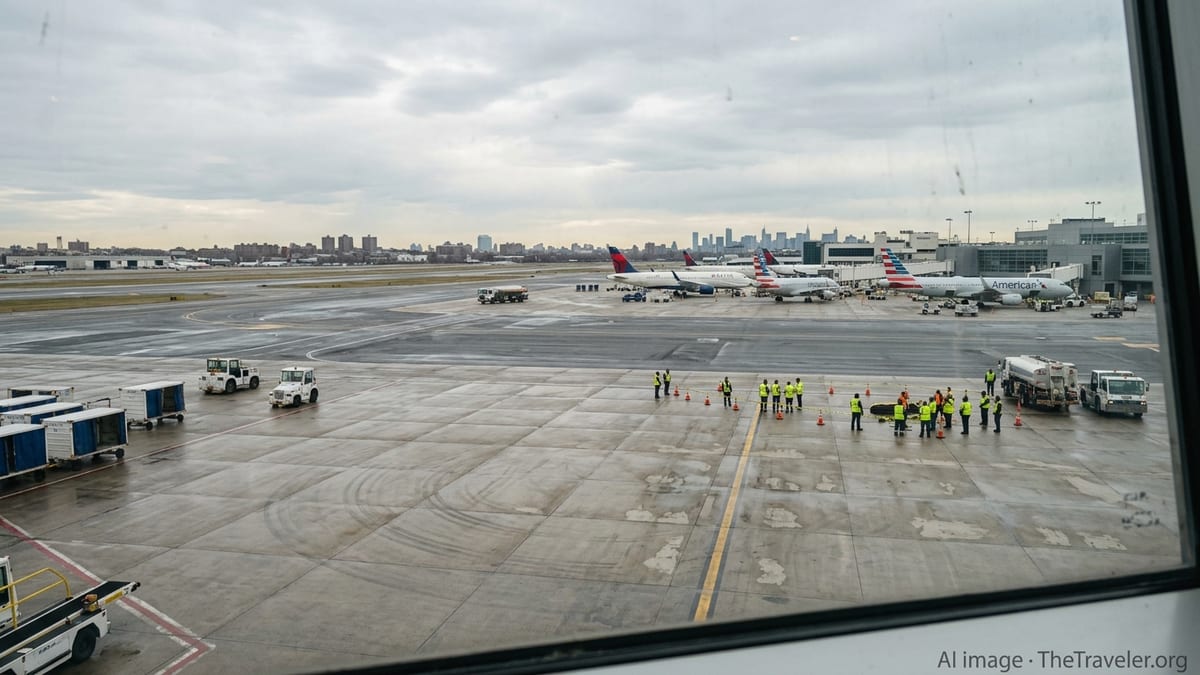
Overnight Collision Halts Flights at One of the Busiest U.S. Airports
According to published coverage, the crash occurred shortly before midnight on Sunday, March 22, when an Air Canada Express regional jet landing from Montreal struck a firefighting vehicle that was crossing the runway at LaGuardia. The impact destroyed the forward section of the Bombardier CRJ900, killing the Canadian captain and first officer and injuring dozens of passengers and crew, as well as occupants of the truck.
Reports indicate that the aircraft, operating as Air Canada Express Flight 8646 on behalf of Jazz Aviation, was touching down on a rain-soaked runway when it collided with the Port Authority Aircraft Rescue and Firefighting truck. Investigators have noted that the vehicle had been dispatched to check a separate aircraft that reported an unusual smell and warning indications, highlighting how a routine airfield response escalated into a rare fatal accident at a major U.S. airport.
Publicly available information shows that the crash prompted an immediate ground stop at LaGuardia, with all arrivals and departures suspended in the overnight hours as first responders worked at the scene. Early assessments pointed to a runway incursion as a central factor, with federal investigators now focusing on air traffic control instructions, vehicle movements and visibility conditions at the time of the collision.
The accident is being described in multiple reports as LaGuardia’s first fatal aviation incident in more than three decades, underscoring the severity of the event and its impact on an airport already operating near capacity on a typical day.
Runway Inspection and Repairs Under Way Before Planned 2 p.m. Reopening
By Monday morning, the Port Authority of New York and New Jersey and the Federal Aviation Administration had shifted from emergency response to recovery operations, concentrating on clearing wreckage and assessing damage to the runway and associated infrastructure. Published accounts describe a careful process of debris removal, pavement inspection and systems testing before any traffic could resume.
Statements cited in local and national coverage indicate that officials overseeing the airfield were “on track” to reopen LaGuardia to limited operations at approximately 2 p.m. Eastern time. That target reflects the time needed to document the crash site for the safety investigation, evaluate the runway surface and confirm that lighting, signage and navigational aids meet regulatory standards for safe use.
With only two runways handling a dense schedule of domestic and regional flights, LaGuardia experiences immediate strain when one strip is taken out of service. Even once the field reopens, early reports suggest that traffic will return gradually, with priority given to aircraft and crews already positioned on the ground and to flights that can be accommodated within revised air traffic management plans.
Travelers are being advised in media reports to treat the 2 p.m. reopening as a turning point rather than an instant return to normal. Flight tracking data cited in coverage of similar incidents shows that it can take many hours, and sometimes days, for schedules to realign after a full-field shutdown at a constrained urban airport.
Wave of Delays and Cancellations Ripples Across Airline Networks
Even before the anticipated reopening, the overnight closure at LaGuardia triggered hundreds of delays and cancellations, affecting passengers across the United States and Canada. Publicly available flight tracking data highlights LaGuardia as one of the country’s top sources of disruptions in the 24 hours following the accident, with ripple effects extending to major hubs such as Chicago, Atlanta, Toronto and Montreal.
Airlines that rely on LaGuardia as a key business and shuttle market have responded by consolidating flights, rebooking affected travelers and, in some cases, issuing temporary travel waivers for customers willing or able to shift to nearby airports. According to airline advisories summarized in industry reporting, carriers have encouraged passengers to consider alternatives such as Newark Liberty International, John F. Kennedy International and smaller regional fields including Westchester County Airport.
Published coverage notes that the timing of the crash, at the start of a busy spring travel period, has intensified the disruption. With many flights already operating close to capacity, re-accommodating stranded passengers has required a mix of same-day rebookings, overnight hotel stays and multi-leg itineraries that bypass LaGuardia entirely until the airport’s schedule stabilizes.
For those still booked to travel through LaGuardia later in the day, reports consistently recommend checking flight status frequently, leaving extra time for security and ground transport and being prepared for gate changes or extended tarmac holds as airlines work through the backlog.
Investigators Focus on Runway Incursion and Airfield Safety Protocols
Federal safety investigators have opened a formal inquiry into the ground collision, deploying specialists in operations, human factors and air traffic control to examine how a firefighting vehicle came to be on the runway as a passenger jet was landing. Publicly released summaries of the investigation’s early stages indicate that audio recordings from the control tower and communications with the truck are central pieces of evidence.
Reports from multiple outlets describe air traffic control audio in which a controller clears an operations or firefighting vehicle to cross the active runway, then urgently attempts to halt the movement when the landing jet is already committed. Analysts cited in that coverage are raising questions about controller workload during overnight shifts, staffing levels, the use of ground radar or alerting systems and how clearly the vehicle crew understood the instructions they received.
In addition to procedures in the tower, investigators are expected to review airfield signage, lighting and markings to determine whether anything on the ground environment contributed to confusion. Given that the truck was reportedly responding to a separate aircraft issue, examination of emergency response protocols, training and coordination between airport operations and the control tower will also be key threads.
Safety experts quoted in previous studies of runway incursions have long identified vehicle movements as a complex challenge at busy airports, particularly in low visibility or during off-peak hours when staffing and traffic patterns differ from daytime operations. The LaGuardia collision is already being cited in commentary as a case that may shape future recommendations on ground surveillance technology, standardized phraseology and redundant safeguards for vehicles crossing active runways.
What Travelers Can Expect as LaGuardia Ramps Back Up
As LaGuardia moves toward its projected 2 p.m. reopening, travelers can expect a phased return to service rather than an immediate restoration of full schedules. Based on operational patterns observed after previous runway closures, airlines typically start by launching a limited number of departures, focusing on routes with high demand and aircraft that are already in position.
Reports suggest that some flights originally scheduled for the morning and early afternoon may remain canceled even after the airport resumes activity, simply because aircraft and crews are out of place. Those whose flights are listed as on time may still experience delays while ground handlers, security staff and air traffic controllers adapt to revised plans and higher-than-usual congestion on taxiways and at gates.
Ground access to the airport has also been affected. Earlier in the day, local traffic advisories noted temporary closures of roads and highway exits leading into LaGuardia to accommodate emergency vehicles and investigative teams. As operations normalize, those restrictions are expected to ease, but travel publications continue to recommend building extra time into any trip to or from the terminals.
For many passengers, the lingering effects of the incident may be felt less in logistics and more in confidence. LaGuardia is a vital gateway for business travelers and tourists alike, and coverage of the deadly collision has drawn renewed attention to the complexities of running a dense airfield in a tight urban footprint. As investigators work to understand exactly what went wrong, airlines and airport managers face the immediate task of restoring a smooth, predictable operation for the thousands of travelers counting on LaGuardia every day.