

More news on this day
Hundreds of travelers at New York’s LaGuardia Airport faced unexpected overnight stays and missed connections after more than 70 flights were cancelled, snarling one of the United States’ busiest urban hubs and raising fresh questions about aviation resilience during severe weather and operational strain.
Get the latest news straight to your inbox!
Severe Weather and Congestion Trigger Sweeping Disruptions
Recent days have seen an already turbulent late-winter travel season tip into fresh disruption at LaGuardia Airport, with publicly available flight-tracking data showing over 70 cancellations in a single day and many more delays across the schedule. The scrapped departures and arrivals quickly cascaded through the system, leaving aircraft and crews out of position and passengers without clear options.
The latest wave of cancellations has coincided with a broader pattern of disruptive winter storms across the United States, including powerful systems that have blanketed the Northeast in snow and high winds while triggering thousands of flight cancellations nationwide. Reports indicate that New York’s three major airports, including LaGuardia, have repeatedly been placed under traffic management programs that slow the rate of arrivals and departures whenever visibility drops or crosswinds pick up.
LaGuardia is particularly vulnerable to these constraints. The airport operates with short runways, tightly packed airspace and limited room to absorb schedule shocks. When weather or air-traffic flow restrictions tighten, airlines often cut multiple regional and short-haul flights at once to keep the rest of their networks moving, a strategy that can leave large numbers of passengers stranded at a single terminal.
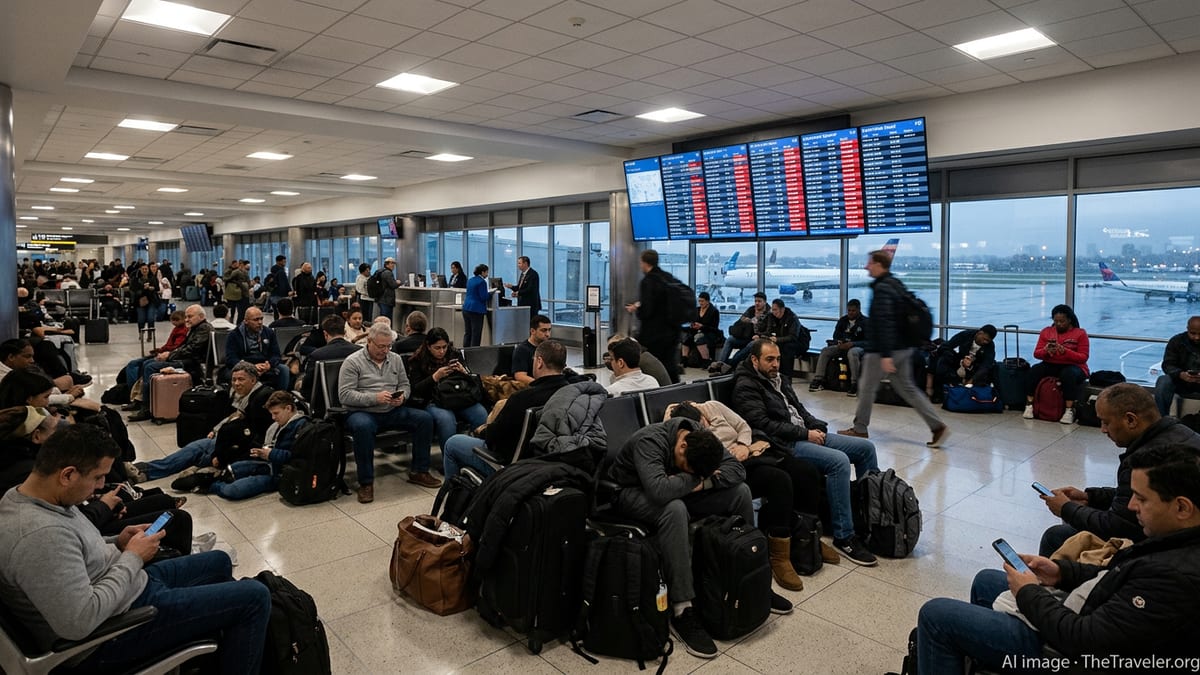
Recent traveler accounts from LaGuardia describe long security lines, crowded gate areas and flight boards filled with rolling delay notices that ultimately converted to cancellations. For many, the first indication of serious disruption arrived via push notification or a gate-screen update only hours before departure.
How Many Passengers Are Affected and Where They Are Going
While exact headcounts vary by aircraft type and airline, canceling more than 70 flights at LaGuardia in one day can easily disrupt travel for several thousand people. A typical narrow-body jet leaving the airport carries between 120 and 180 passengers, and even smaller regional jets often seat 70 or more. With most flights in peak travel periods running near capacity, the number of stranded or diverted travelers climbs quickly.
The impact is felt across a wide geography. LaGuardia’s schedule is dominated by high-frequency routes to business and political centers such as Washington, D.C., Chicago, Boston and Toronto, as well as key hubs in the Southeast and Midwest. When multiple rotations on these routes are cancelled, the disruption extends beyond New York, affecting travelers attempting to connect onward to domestic and international destinations.
Publicly available airline timetables indicate that many of the affected flights are shorter-haul services operated several times a day. When one or two of those rotations are scrapped, remaining services often depart full, leaving limited room to reaccommodate travelers from cancelled flights. That combination of high load factors and tight schedules is a key reason some passengers find themselves waiting until the next day, or even longer, for an open seat.
The strain is particularly acute for passengers with separate onward tickets or tight international connections out of other gateways. If a cancelled LaGuardia departure causes a missed long-haul flight from airports such as JFK, Newark or a mid-continent hub, rebooking becomes more complex and expensive, and travel plans may need to be completely reworked.
What Airlines Are Doing for Stranded Travelers
According to published coverage from major U.S. outlets, airlines facing clusters of cancellations at LaGuardia typically roll out a mix of standard disruption policies. These measures often include fee waivers for changing to a new flight within a specified date range, rebooking onto alternative routes through different hubs and, when schedules allow, deploying larger aircraft on remaining flights to absorb more passengers.
In many cases, travelers can rebook within the airline’s mobile app or website, which may offer more options than airport kiosks during peak disruption periods. Some carriers also encourage passengers to accept connections through less congested hubs or fly at off-peak times, increasing the chances of securing a seat sooner.
Assistance on the ground is more limited and heavily dependent on the cause of the disruption. In the United States, airlines are not generally required to provide hotel rooms or meal vouchers when cancellations are driven by weather or air-traffic control restrictions. However, publicly available customer-service commitments show that some carriers voluntarily offer meal credits, hotel discounts or amenity kits on a case-by-case basis, especially when large numbers of passengers are stranded overnight.
Travelers who purchased tickets through online travel agencies or third-party platforms may face additional hurdles, as rebooking permissions and refund rules can differ from those applied to tickets bought directly from the airline. Industry advisories often recommend dealing directly with the operating carrier once a flight is cancelled, since agents at the airport typically have more up-to-date information about seat availability and rerouting options.
What Passengers Can Do Right Now
For those currently stuck at LaGuardia or scheduled to pass through in the coming days, preparation and rapid communication are crucial. Travel industry guidance emphasizes checking flight status frequently before leaving for the airport, as schedules can change repeatedly within a few hours during severe weather or air-traffic disruptions.
Once a cancellation appears likely, acting quickly can make a major difference. Seats on remaining flights are limited, and early movers often secure the most convenient alternatives. Using an airline’s mobile app or website can be faster than waiting in line at a service desk, while calling the customer-service line or messaging the airline through digital channels can provide additional options.
Travel experts also highlight the value of knowing passenger rights and airline policies in advance. The U.S. Department of Transportation publishes guidance on refunds when an airline cancels a flight or makes a significant schedule change, and individual carriers outline their rebooking and voucher policies on their own sites. Having this information at hand helps travelers understand when they are entitled to a cash refund versus a credit or rebooking.
At the airport itself, travelers are turning to practical strategies to weather long waits, including charging devices early, keeping essential medications and valuables in carry-on bags and arranging flexible accommodation that can be changed without heavy penalties if flights move again. For those with time-sensitive commitments, such as cruises or important events, some advisories recommend building in additional buffer days or considering rail and road options when feasible.
Why LaGuardia Remains a Hotspot for Flight Disruptions
The current episode of more than 70 cancellations in a day fits into a broader pattern at LaGuardia, where a combination of layout, demand and geography frequently makes operations fragile during bad weather or high winds. The airport’s short runways and waterfront location subject it to strict safety margins in gusty conditions, which can prompt air-traffic controllers to reduce the number of allowed movements per hour.
LaGuardia’s dense schedule of frequent shuttle flights and regional services leaves little slack in the system. When even a few hours of arrivals and departures are curtailed, the backlog can take the rest of the day to unwind. Airlines then face difficult choices about which flights to operate and which to cut, typically prioritizing routes that connect to global networks or carry the largest number of passengers.
The broader U.S. aviation system is also under strain, with recent government and industry reports pointing to staffing gaps in key air-traffic control centers, aging infrastructure and the growing impact of extreme weather on flight operations. When storms ripple through multiple regions at once, congestion builds quickly at nodes like LaGuardia, and small operational issues can snowball into large-scale disruption.
For travelers, that reality means New York’s close-in airport will likely remain a high-risk departure point during peak weather seasons, even as terminal upgrades and airfield improvements continue. As the latest round of cancellations has shown, a single day of severe conditions can be enough to leave hundreds of passengers stranded and travel plans across the country upended.