

More news on this day
Travelers across the United States faced cascading disruption on Sunday as more than 60 cancellations and roughly 205 flight delays centered on New York’s LaGuardia Airport rippled through key hubs including Chicago, Miami, and Los Angeles, affecting operations at Delta Air Lines, Southwest Airlines, American Airlines, and United Airlines.
Get the latest news straight to your inbox!
Systemwide Disruption Radiating From New York
According to live flight-tracking dashboards and airport status boards, LaGuardia emerged as a significant pinch point in the national air network, with dozens of departures and arrivals canceled and hundreds more operating behind schedule. The disruption has been most visible on heavily traveled domestic routes linking New York with Chicago, South Florida, and Southern California.
Publicly available data shows that Delta, American, United, and Southwest all reported schedule changes tied to LaGuardia, with knock-on delays for aircraft and crews operating through other hubs. Once a rotation is disrupted in New York, aircraft due to continue on to cities such as Chicago, Miami, and Los Angeles often depart late or are reassigned, amplifying the impact for passengers who are nowhere near the original problem airport.
Flight operations specialists note that LaGuardia’s tight runway configuration and limited airfield capacity can quickly turn modest slowdowns into wider congestion. When arrival spacing increases or ground holds are issued in New York, flights bound for the airport back up over a broad geographic area, and airlines begin trimming their schedules to protect the rest of their networks.
Major Carriers Confront Cascading Delays
Delta, American, United, and Southwest together operate a large share of LaGuardia’s domestic departures, and disruptions at the airport tend to show up quickly in their nationwide performance metrics. Recent federal Air Travel Consumer Reports highlight how concentrated cancellations and long delays at a few hub airports can skew on time performance for entire months, particularly when weather or air traffic constraints hit the busy Northeast corridor.
Industry analyses and previously published oversight reports describe how even a single day with dozens of cancellations at a key airport can reverberate across multiple days of operations. When crews exceed their duty limits or aircraft are out of position, later flights to and from cities such as Chicago, Miami, Dallas, Atlanta, and Los Angeles may operate with significant delays even after conditions improve at the original trouble spot.
Publicly available information on recent storms and air traffic flow programs in the Northeast indicates that airlines have increasingly relied on preemptive schedule cuts to manage congestion. By canceling a block of flights early, carriers attempt to reduce the risk of severe rolling delays and overnight strandings, though this strategy still leaves many passengers seeking last minute rebooking options.
Travelers Face Long Waits and Limited Options
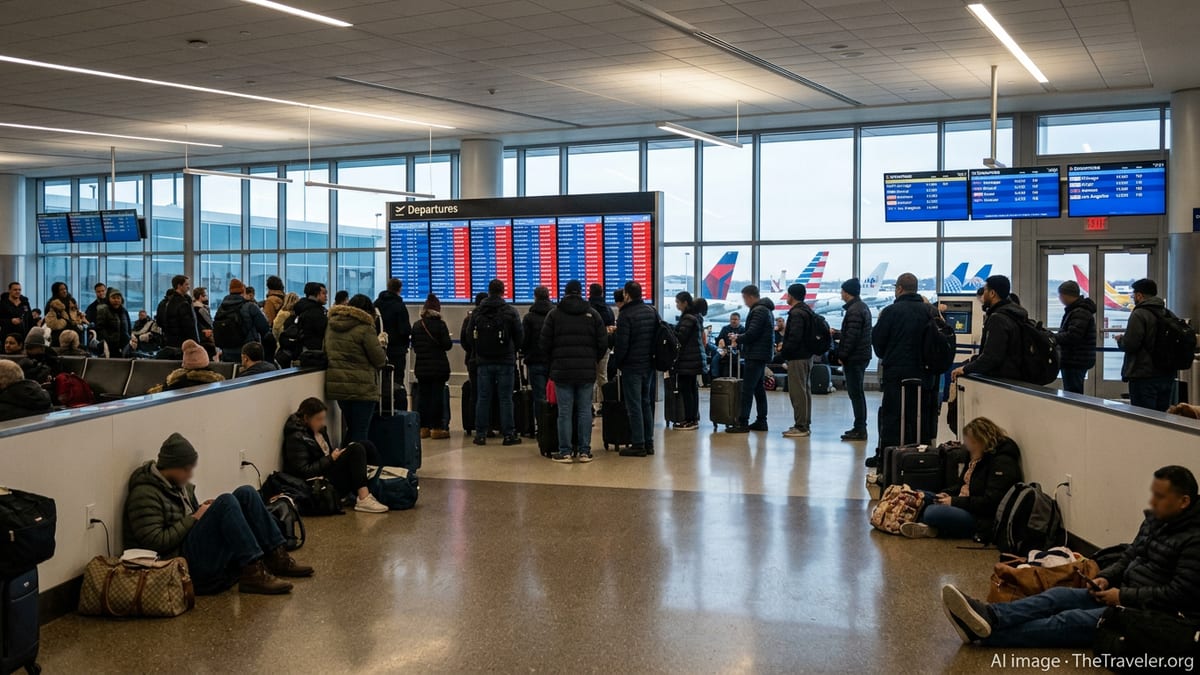
For passengers, the numerical tally of 60 cancellations and more than 200 delays translates into missed connections, unexpectedly long airport stays, and uncertain arrival times. Social media posts and public forums from recent disruption days at LaGuardia describe travelers sleeping in terminal chairs, waiting in multi hour customer service lines, and scrambling to secure scarce hotel rooms near the airport.
Consumer advocacy guidance emphasizes that rebooking can be particularly difficult when multiple carriers are affected at once. On busy routes between New York and major hubs like Chicago O’Hare, Miami International, and Los Angeles International, alternative flights may already be near capacity, leaving limited room to accommodate disrupted passengers from LaGuardia.
Travel experts often advise that during large scale irregular operations, travelers should use multiple channels at once, including mobile apps, airport kiosks, and call centers, to improve their odds of finding a workable itinerary. However, when a disruption is concentrated around a single chokepoint in the network, even proactive passengers may find that options are constrained for several hours or longer.
Weather, Congestion, and Infrastructure Constraints
While the precise mix of causes behind today’s pattern of cancellations and delays varies by flight, recent winters have underscored how vulnerable the Northeast air system can be to storms and low visibility. Published coverage of major weather events affecting New York in early 2026 shows how snow, strong winds, and runway contamination at LaGuardia and nearby airports can force airlines to pare back schedules dramatically.
Beyond weather, long standing infrastructure and airspace issues remain a factor. LaGuardia’s compact footprint and intersecting runways leave little margin when traffic volumes are high or when temporary maintenance closures are needed. Air traffic flow initiatives designed to safely meter arrivals and departures into New York area airspace can reduce throughput, leading to ground delay programs at origin airports as far away as the Midwest and the West Coast.
Transportation data released over recent years indicates that carrier controlled issues, such as staffing imbalances and aircraft maintenance needs, also play a role. When crews or aircraft are already stretched thin, a single disruption window at an airport like LaGuardia can tip more flights into delay or cancellation than would be the case in a less constrained system.
What Today’s Disruptions Mean for Upcoming Travel
A pattern of 60 cancellations and more than 200 delays centered on LaGuardia signals that airlines are again operating close to the limits of what the current infrastructure and staffing levels can reliably support, especially during peak travel periods. Industry observers note that while overall reliability has improved from the most volatile phases of the pandemic era, the margin for error at key nodes in the system remains slim.
For travelers with flights in the coming days, publicly available guidance from airlines and regulators consistently stresses the importance of monitoring itineraries closely. Same day schedule changes, rolling delays, and gate swaps are common when an airport has recently experienced a spike in disruptions, and crews and aircraft may still be returning to normal rotations.
Analysts suggest that passengers with flexible plans consider booking earlier departures on the day of travel, avoiding tight connections at congestion prone hubs, and building in extra time for onward ground transport from airports into city centers. As today’s situation at LaGuardia illustrates, a localized surge in cancellations and delays can quickly become a national issue when it affects large carriers and heavily traveled routes across multiple regions.