

More news on this day
What began as a winter sightseeing excursion on Russia’s storied Lake Baikal ended in catastrophe on 20 February, when a minibus carrying Chinese tourists and a local driver plunged through thinning ice near Olkhon Island, killing eight people and casting a harsh spotlight on the growing risks of ice tourism at the “Pearl of Siberia.”
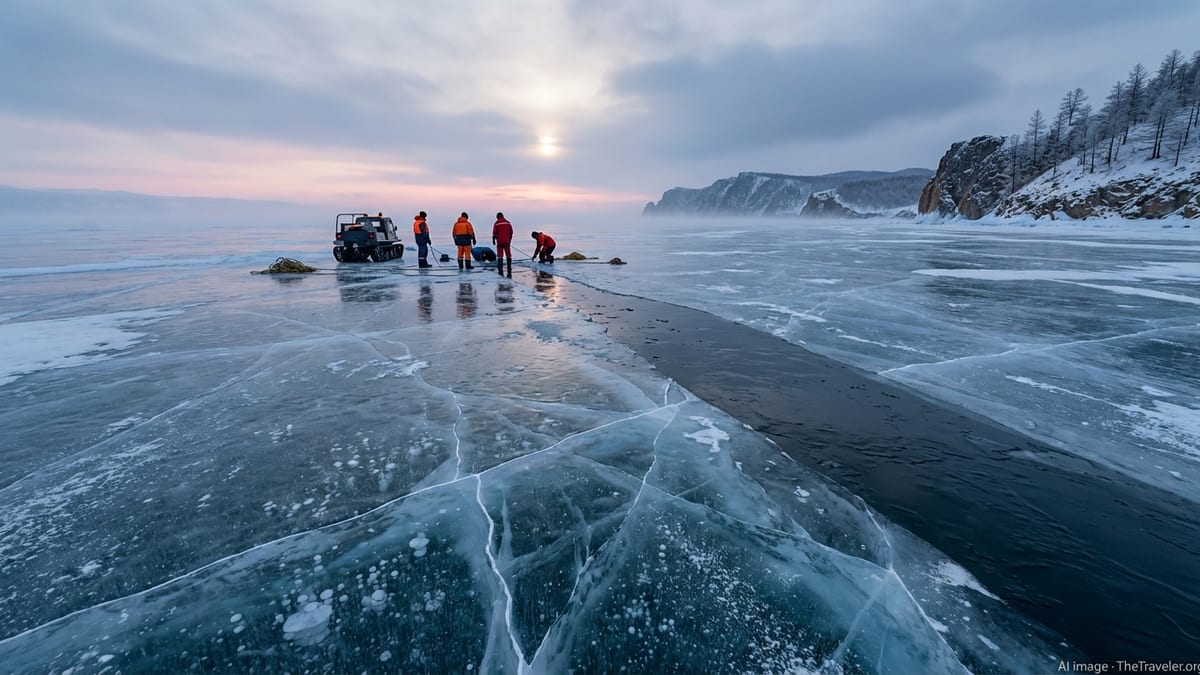
Deadly Excursion on the Pearl of Siberia
Regional authorities in Russia’s Irkutsk region confirmed that a UAZ minibus carrying nine people, including seven Chinese tourists and a Russian driver, broke through an ice fissure and sank in Lake Baikal near Cape Khoboy off Olkhon Island on Friday. Officials said the vehicle went into a three metre wide crack in the ice and came to rest about 18 metres below the surface, in water just above freezing.
Rescue teams using an underwater camera located the bodies of seven Chinese tourists inside and near the submerged vehicle. The body of the 44 year old Russian driver, identified by local media as Nikolay Dorzheev, was also recovered or presumed among the dead, bringing the confirmed toll to eight. One Chinese passenger managed to escape the sinking minibus and raise the alarm, becoming the sole known survivor of the crash.
Local emergency services reported that the vehicle was travelling on the frozen surface toward the popular viewpoint at Cape Khoboy, on the northern tip of Olkhon Island, when it struck the hidden fracture. The impact reportedly sent the minibus tilting into the gap before the ice collapsed fully beneath its weight, giving passengers only moments to react.
Victims Included Family Tourists and a Teenager
Irkutsk regional governor Igor Kobzev said investigators have identified at least five of those on board, including the driver and four Chinese tourists, among them a 14 year old child. Consular records and hotel logs indicate that several of the victims were travelling as a family, having arranged their own trip rather than joining a large package tour.
Authorities said eight of the passengers were Chinese nationals who had come to Lake Baikal for an ice sightseeing tour at the height of the winter season. Officials noted that Chinese visitors have become one of the largest foreign tourist groups in the region, attracted by Baikal’s clear ice, dramatic landscapes and relative proximity to northern China.
The surviving tourist, also a Chinese citizen, reportedly managed to escape through a window or door as the minibus began to sink. Local media said the survivor was able to reach solid ice and contact emergency services, prompting a rapid deployment of rescuers, divers and investigators to the remote site.
Illegal Ice Route and Banned Crossing Under Scrutiny
Preliminary findings from the Russian Investigative Committee and regional prosecutors suggest the minibus was travelling on an unauthorised route across the lake. Officials said the official ice road to Olkhon Island, which in some winters is opened after detailed inspections of ice thickness and stability, had not yet been cleared for use this season and was formally closed at the time of the accident.
Governor Kobzev stressed that all vehicle access to the lake’s ice near Olkhon had been prohibited in recent weeks due to warm weather and unstable conditions. He said shifting temperatures had created hidden fractures, pressure ridges and zones of thinner ice that can be difficult to spot even in clear daylight, increasing the risk for any drivers who ignore restrictions.
Investigators are examining whether the excursion was organised by an unlicensed operator. Russian and Chinese media have reported that the driver was associated with informal tours combining visits to Baikal’s scenic ice formations with local shamanic and pagan heritage sites, a niche that has flourished alongside the area’s tourism boom but often operates outside formal regulation.
Criminal Investigation Targets Safety Failures
The Irkutsk branch of the Investigative Committee has opened a criminal case on charges of providing services that did not meet safety requirements, resulting in the death of two or more people by negligence, as well as a separate count of official negligence. Prosecutors in Olkhon district have also launched a parallel inquiry into potential violations of transport and tourism safety laws.
Investigators will seek to determine why the minibus was on the ice despite the official ban, whether passengers were warned of the risks, and what role, if any, local oversight bodies played in monitoring activity on the frozen lake. Officials have already taken statements from the surviving tourist and from staff at nearby accommodations where the group stayed before the crash.
Regional authorities have promised to tighten enforcement on unregistered guides and drivers offering informal ice excursions. Governor Kobzev said law enforcement agencies would step up patrols and use drones, satellite imagery and local tip lines to detect and deter vehicles attempting to cross the ice illegally, especially in peak tourist months.
A Growing Toll on Lake Baikal’s Winter Ice
The Lake Baikal tragedy is the second fatal incident involving Chinese tourists on the ice in the Irkutsk region in less than a month. In late January, a Chinese visitor was killed and several others injured when a vehicle overturned on the frozen surface near Olkhon Island, prompting an earlier round of investigations and safety warnings.
At least 11 tourists are believed to have died on Lake Baikal in 2026 alone, according to Russian media tallies, underscoring mounting concern about the intersection of growing winter tourism, unpredictable weather and gaps in enforcement. While Baikal has long been prized for its thick, glass clear winter ice that can reach well over a metre in depth, climate variability and changing patterns of freeze and thaw have made the surface increasingly treacherous.
Experts note that even when the lake appears solid, powerful currents beneath the ice can thin it in certain stretches, particularly along capes and channels around Olkhon Island. Cracks and openings may be covered by windblown snow, leaving drivers with little warning until it is too late. Heavy vehicles such as minibuses are especially vulnerable when they stray from established and tested routes.
Chinese Consular Warnings and Rising Tourism Pressures
China’s Consulate General in Irkutsk confirmed the deaths and said it was working closely with Russian authorities to identify the victims, notify families and arrange the repatriation of remains. Consular officials dispatched staff and volunteers to the region to assist the survivor and liaise with local hospitals, investigators and tour providers.
The consulate had already issued a safety alert in late January warning Chinese citizens about the dangers of driving on Lake Baikal’s ice, especially given that the official ice road to Olkhon had not opened. The notice urged travellers to verify the licenses of local tour operators, refuse to ride in unregistered vehicles, and avoid crossing the lake in heavy cars or minibuses even when ice appears thick.
The latest accident has intensified scrutiny on how effectively those warnings have been heeded and communicated by travel agencies within China and on the ground in Siberia. Lake Baikal has become a coveted winter destination for Chinese holidaymakers, with social media and travel influencers promoting images of turquoise ice, frozen caves and off road drives far from the usual urban attractions.
Lake Baikal’s Allure and the Lure of Risky Experiences
Often called the “Pearl of Siberia,” Lake Baikal is both the world’s deepest and one of its oldest freshwater lakes, stretching more than 600 kilometres through south eastern Siberia just north of Mongolia. Designated a UNESCO World Heritage Site, it attracts visitors year round for its pristine waters, dramatic shorelines and endemic wildlife, from Baikal seals to unique fish species.
In winter, the lake transforms into a vast frozen expanse, with ice that can be clear enough to see several metres down and fractured into intricate patterns of blue and white. Tour operators offer a range of activities including ice hiking, skating, snowmobiling and guided drives over the frozen surface to reach remote capes and islands that are inaccessible by road for much of the year.
The very qualities that draw tourists, however, can also foster a casual attitude toward risk. Photographs and videos of vehicles parked on the transparent ice or speeding across wide open stretches have become staples of online promotion, sometimes overshadowing official guidance about where and when such activities are allowed. Local residents say that in recent years, a growing number of independent travellers and informal guides have ventured beyond designated ice roads in search of untouched views and quieter spots.
Calls for Tighter Controls on Ice Tourism
In the wake of Friday’s tragedy, Russian officials and safety experts are calling for a comprehensive reassessment of how winter tourism on Lake Baikal is managed. Proposals under discussion include tougher penalties for drivers and organisers who violate bans on ice crossings, clearer signage in multiple languages around popular access points, and closer coordination with foreign consulates whose nationals form a significant share of visitors.
Transport and tourism regulators are also weighing whether to shorten or delay the opening period of official ice roads, or to restrict vehicle types even when crossings are technically safe, in light of more variable winter temperatures. Some regional lawmakers have suggested that hovercraft and tracked vehicles operated by licensed companies should become the standard mode of winter transport over the lake for tourists, reducing private car traffic on the ice.
Local tour operators who comply with existing rules warn that repeated high profile accidents threaten to damage Baikal’s reputation and undermine livelihoods in communities that depend heavily on winter tourism. They argue that stronger enforcement against unlicensed competitors, combined with clear, accessible safety information for foreign guests, is essential to restoring confidence.
Grief, Recovery Efforts and Unanswered Questions
As divers continue recovery operations at the accident site near Cape Khoboy, both Russia and China are grappling with the human cost of a trip that turned fatal within seconds. The identities of all of the victims have yet to be publicly released, but early reports of a lost child and a family holiday cut short have resonated widely in both countries.
Specialist teams equipped for cold water operations are working in challenging conditions to secure the submerged minibus, recover bodies and search for any remaining personal effects that could aid identification and be returned to relatives. Authorities have cordoned off nearby ice access points and stationed rescuers in the area to prevent curious onlookers and other drivers from venturing close.
Investigators, meanwhile, face detailed questions about how widely the ice ban was communicated, whether previous accidents and warnings were adequately reflected in enforcement, and what obligations fall on travel booking platforms and agencies that market Lake Baikal winter experiences to foreign visitors. For families awaiting news in China, those answers will matter less than the safe return of their loved ones, but officials in both countries acknowledge that systemic changes will be needed if similar tragedies are to be avoided in future seasons.