

More news on this day
Lao Airlines is set to restore direct flights between Vientiane and Da Nang from March 29, reestablishing a fast, convenient air link between Laos and central Vietnam after a pause in operations.
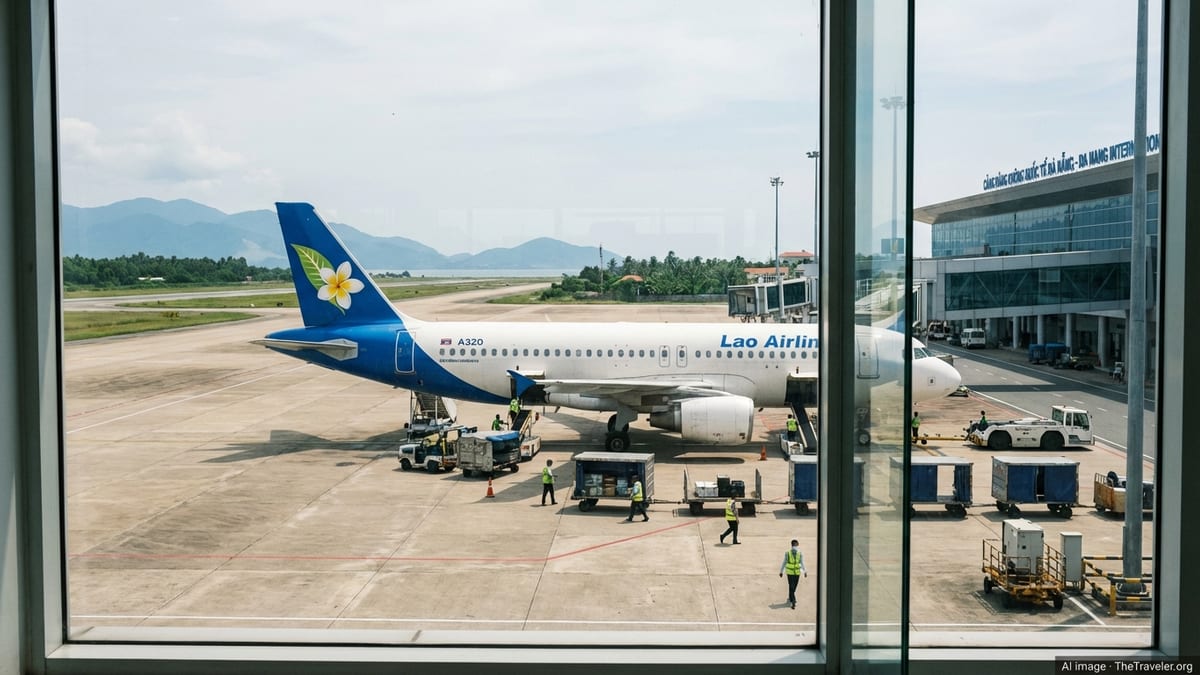
Nonstop Service Returns With Convenient New Schedule
The national carrier of Laos has confirmed that nonstop flights between Vientiane and Da Nang will resume on March 29, with services operating twice a week. The route will be served on Thursdays and Sundays, targeting both long-weekend holidaymakers and short-stay business travelers moving between the two neighboring countries.
Under the announced timetable, flight QV317 will depart Vientiane at 11:20 and arrive in Da Nang at 12:40 local time. The return sector, QV318, is scheduled to leave Da Nang at 13:50 and land in the Lao capital at 15:10. The midday schedule is designed to allow smooth same-day connections with domestic and regional flights at both ends, while still giving travelers usable daylight hours on arrival.
Lao Airlines will use the Comac C909 aircraft configured entirely with 90 economy-class seats on the relaunched route. Flight time is expected to be around one hour and 20 minutes, positioning the service as one of the quickest cross-border hops in mainland Southeast Asia and eliminating the need for time-consuming land or connecting journeys.
Tickets are being distributed through Lao Airlines ticket offices in Laos, authorized travel agencies and the airline’s digital channels, including its website and mobile application. Indicative round-trip fares published for April 2026 start from about 290 US dollars, placing the route in line with other short-haul international services in the region.
Strategic Aircraft Choice After Earlier Route Suspensions
The decision to resume the Vientiane–Da Nang connection comes after several earlier iterations of the route and reflects a more cautious, market-matched approach from Lao Airlines. Before the COVID-19 pandemic, the airline linked the two cities using ATR 72 turboprop aircraft, routing via Pakse in southern Laos. Travel restrictions and shifting demand patterns eventually forced that operation to be suspended.
In 2023, the carrier briefly launched a nonstop Vientiane–Da Nang service with larger Airbus A320 jets, but the route was again withdrawn as post-pandemic demand proved slower to recover than expected. The new phase, scheduled to start in late March 2026, is built around the 90-seat Comac C909, a capacity that sits between the 70-seat ATR 72 and the 148-seat A320.
Aviation analysts in the region note that this mid-size configuration is likely to improve load factors while maintaining frequency and competitive pricing. For Lao Airlines, the route serves as a test case for deploying the C909 on regional links where demand is promising but still maturing, allowing the carrier to calibrate supply more precisely to market conditions.
The airline has stated that traffic forecasts look considerably stronger than during the early recovery period, supported by broader tourism rebounds in both Laos and Vietnam and by growing interest in multi-country itineraries across the Mekong region.
Tourism Growth Drives Demand Between Laos and Central Vietnam
The relaunch of direct Vientiane–Da Nang flights comes at a time when both countries are prioritizing tourism as a key economic driver. Da Nang, home to sweeping beaches, modern resort infrastructure and easy access to nearby cultural centers, has set an ambitious target of welcoming around 19 million visitors in 2026. Laos, meanwhile, continues to promote its temples, river landscapes and UNESCO-listed heritage towns to regional travelers.
Visitor numbers between the two nations have been climbing steadily. Vietnam has emerged as one of the largest source markets for Laos, while Laos consistently ranks among the top tier of countries sending tourists to Vietnam. Double-digit percentage growth in bilateral tourist flows over the past two years has underscored the need for more direct, time-efficient air links.
Travel planners expect the restored route to appeal not only to point-to-point leisure travelers but also to organized tour groups combining beach stays in Da Nang with cultural and nature-focused excursions in destinations such as Vientiane and Luang Prabang. The simplicity of a nonstop flight, with mid-morning departures and mid-afternoon returns, is seen as a particular advantage for families and older travelers.
Beyond leisure travel, the service is also expected to support growing business exchanges and investment flows between Laos and central Vietnam. Da Nang’s expanding technology sector and logistics capacity, paired with Laos’s infrastructure and energy projects, provide a steady base of corporate demand for reliable, short-haul air links.
Regional Connectivity and Hub Potential in Da Nang
Da Nang has been positioning itself as a regional aviation and tourism hub, particularly for travelers from Northeast Asia. The city already draws substantial numbers of visitors from South Korea and China, many of whom use Da Nang as a gateway to other central Vietnamese destinations such as Hoi An and Hue.
The resumption of Vientiane flights fits into this broader hub strategy. With the new schedule, travelers from markets such as Seoul, Busan, Shanghai or Guangzhou can potentially connect via Da Nang onto Lao Airlines services, creating a compact air corridor between Northeast Asia and Laos without routing through larger, more congested airports.
On the Lao side, the link supports improved access not only to Vientiane but also to domestic destinations served from the capital, including tourist favorites and emerging secondary cities. For regional tour operators, this simplifies the construction of cross-border itineraries that combine beaches, historic towns and inland landscapes across multiple countries.
Industry observers say that if the twice-weekly flights perform well, it could pave the way for increased frequencies or seasonal adjustments to match peak travel periods. The route is also viewed as a possible foundation for future cooperative arrangements between Lao Airlines and Vietnamese carriers, including code sharing and coordinated schedules on key feeder routes.
Optimism and Watchful Caution for the New Season
While sentiment around the route relaunch is broadly positive, both tourism officials and airline planners remain aware of the challenges that affected earlier attempts to maintain stable Vientiane–Da Nang operations. Demand from Laos is highly seasonal, with strong peaks during school holidays and the hot-weather months when travelers seek coastal escapes, and softer shoulder periods that can test route profitability.
To address this, Lao Airlines and its partners are expected to lean heavily on regional and international transit traffic, marketing Da Nang as both a destination and a convenient transfer point. Coordinated campaigns with tourism boards, hotel groups and tour operators are being prepared to highlight the ease of combining Laos and central Vietnam within a single trip.
Local industry voices in Da Nang have also pointed to the potential impact of forthcoming transport projects within Laos, including improved rail links to Luang Prabang and other northern destinations. Easier domestic connectivity could make it more attractive for Vietnamese and international visitors to use Vientiane as a springboard for exploring the country, further strengthening the case for sustained direct air service.
For now, the focus is on a smooth restart at the end of March. If load factors meet expectations through the first northern summer season, the revived Vientiane–Da Nang route could become a permanent fixture in Lao Airlines’ regional network, reinforcing one of mainland Southeast Asia’s most promising short-haul corridors.