

More news on this day
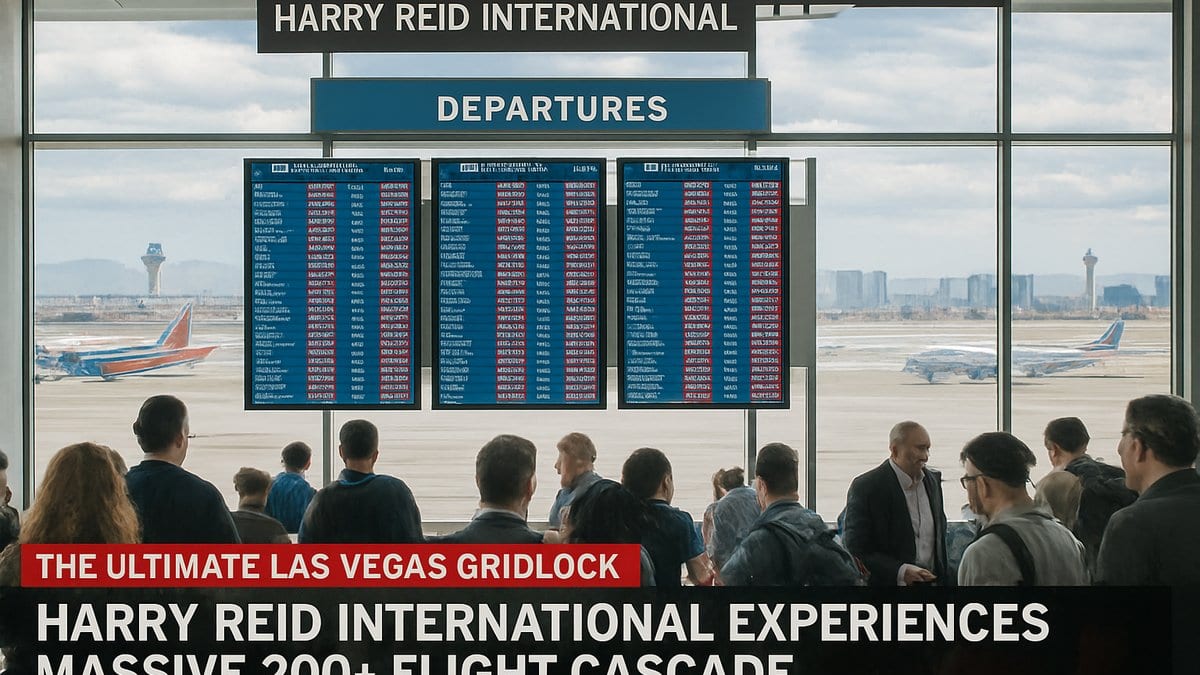
Las Vegas visitors expecting a quick getaway instead encountered a sprawling aviation bottleneck as more than 200 flights linked to Harry Reid International Airport became entangled in a cascade of delays and cancellations across the U.S. network.
Get the latest news straight to your inbox!
A Weekend of Mounting Disruptions
Recent operational data from flight-tracking services and industry reports indicates that Harry Reid International endured one of its most challenging stretches in late March, with delay counts climbing into the triple digits on multiple consecutive days and cancellation totals stacking on top. One roundup of airline performance for March 27 pointed to 223 flight cancellations across several U.S. hubs, with Las Vegas listed among the hardest-hit airports as disruptions multiplied through the day.
In the immediate aftermath, Las Vegas-centric coverage highlighted how the turbulence continued into the weekend. Separate travel reporting for March 28 and March 29 described roughly 80 to 90 disrupted flights per day tied to Harry Reid International, as delayed aircraft and crew rotations collided with already tight schedules. Together, the multi-day sequence left hundreds of flights to, from, or through Las Vegas operating late, cancelled outright, or rerouted.
Publicly available figures from aviation data providers and trade publications portray a classic case of a localized problem that grew into a widespread gridlock. What began as weather and capacity constraints at several U.S. airports, combined with heavy leisure demand, quickly evolved into rolling schedule changes that affected Las Vegas-bound aircraft long before they ever reached Nevada airspace.
How a Single Day Becomes a Network-Wide Gridlock
Industry analyses emphasize that the visible problems in Las Vegas were the endpoint of a chain reaction unfolding across multiple hubs. When flights into one major airport experience lengthy weather or air traffic delays, airlines must re-sequence aircraft and crew assignments throughout their networks. Reports on the March 27 disruptions noted that the 223 cancellations recorded across six airports were accompanied by thousands of additional delays, a scale that virtually guarantees ripple effects far beyond the initial trouble spots.
For an airport like Harry Reid International, which relies heavily on tightly timed turns of aircraft serving short- and medium-haul routes, this kind of disruption can be especially punishing. Travel journalism focused on Las Vegas has repeatedly pointed out that the city’s high proportion of quick leisure trips, convention traffic, and weekend events leaves little slack in the system. If an inbound plane arrives hours late, the outbound passengers waiting in Las Vegas often face extended holds or last-minute cancellations.
Operational planning documents and historical coverage of Las Vegas air traffic explain that even routine capacity restrictions, such as ground delay programs or temporary runway constraints, can sharply reduce the number of arrivals per hour. Once those caps are in place, flights destined for Las Vegas may be held at their departure airports, pushing back subsequent flights that use the same aircraft. The result, as the latest gridlock demonstrated, is a cascading effect where each delay feeds the next.
Weather, Winds, and Runway Constraints Add Fuel
While no single factor fully explains the latest wave of gridlock, recent reports point to a combination of adverse weather, high winds in the desert corridor, and ongoing capacity limitations at select U.S. airports. National coverage of March’s severe-weather systems documented thousands of cancellations across the country, making it difficult for airlines to reposition aircraft and crews to their planned routes. Las Vegas, sitting at the junction of numerous West Coast and Midwest flows, was pulled into that broader disruption pattern.
Regional reporting has also highlighted how changes in wind direction and speed around Las Vegas can force unusual arrival and departure configurations at Harry Reid International. Past episodes show that when strong crosswinds or low ceilings combine with heavy traffic, federal traffic managers sometimes order ground stops or ground delay programs for flights bound for Las Vegas. When that happens, departures in distant cities wait on the tarmac or at the gate, absorbing delays before ever taking off.
Longer-running infrastructure and capacity issues amplify the impact. Previous analyses of runway maintenance and airfield construction in Las Vegas describe how closing even one runway or altering standard approach paths can reduce the airport’s ability to absorb surges of arrivals. In a period of already elevated demand, those constraints turn what might be a routine weather challenge into what many travelers experienced as a near-standstill of the system.
Travelers Face Stranded Bags and Shattered Itineraries
For visitors and locals moving through Las Vegas during the latest disruption cycle, the statistical story of 200-plus affected flights translated into personal scenes of missed connections, rebooked red-eyes, and crowded concourses. Consumer-focused travel outlets report that passengers encountered hours-long waits at customer service desks as airlines tried to reassign seats on the few flights that were still operating on time.
Some coverage described departure boards filled with rolling delay notices, with new estimated times creeping later into the night as aircraft failed to arrive from other cities. With hotels near full capacity due to events and weekend tourism, travelers who lost evening flights sometimes had limited options for overnight stays, particularly those on low-cost carriers that operate infrequent schedules on certain routes.
Checked baggage became another flashpoint. When cancellations stack up, bags often continue to move even when their owners do not, leading to temporary backlogs in baggage claim areas and behind-the-scenes sorting facilities. Social media posts and user accounts compiled in travel reporting on Las Vegas disruptions frequently reference long waits to locate luggage or being asked to return to the airport the following day once backlogs clear.
What the Las Vegas Meltdown Reveals About U.S. Air Travel
The latest gridlock episode at Harry Reid International underscores how vulnerable the U.S. air system remains to large, multi-day disruptions. Analysts cited in aviation and travel publications note that airlines have largely restored capacity to pre-pandemic levels while keeping schedules tightly optimized for aircraft utilization. That approach improves efficiency during normal operations but leaves less buffer when something goes wrong.
For destinations like Las Vegas, which rely on a constant churn of short-stay visitors, such fragility can have outsized economic and reputational effects. Canceled or severely delayed flights not only upend individual trips but can also shorten casino stays, disrupt convention attendance, and complicate staffing for major events, from sports tournaments to concert residencies.
Travel experts writing about recent disruptions consistently recommend that visitors headed to Las Vegas build more contingency into their plans, particularly during peak weekends or periods of active weather elsewhere in the country. Flying earlier in the day, allowing longer layovers on connecting itineraries, and monitoring real-time flight information are among the steps suggested to reduce the risk of being caught in a similar cascade when the next round of gridlock hits the desert hub.