

More news on this day
London’s fast-evolving Canary Wharf district is preparing to welcome a major new arrival, as lifestyle aparthotel brand Locke readies a 279-key property with a rooftop restaurant that is set to reshape the area’s appeal for extended stays and business travellers.
Get the latest news straight to your inbox!
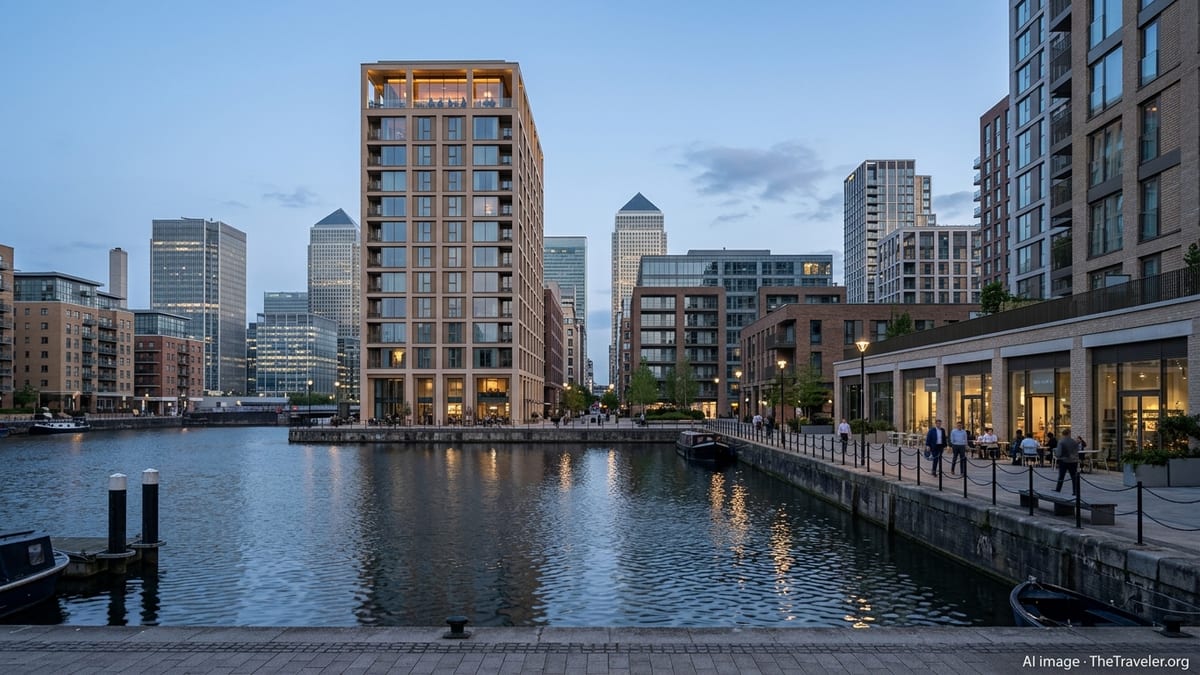
Design-Led Aparthotel Arrives in London’s Financial Docklands
Publicly available information from Locke and Canary Wharf Group indicates that Locke London Canary Wharf will open in 2026 as part of the Wood Wharf development, a newer mixed-use quarter east of the main estate. The project, located at One Charter Street close to Blackwall Basin, is described as a 20-storey building combining hotel-style amenities with fully equipped apartments.
Developer documentation shows the scheme comprises 279 serviced residential units branded under Locke, alongside a rooftop restaurant, ground-floor retail and amenity space. Earlier construction and financing updates describe the building as roughly 130,000 square feet, with a mix of compact studios and larger apartments designed to offer more space than a typical central London hotel room.
Locke positions its properties as “aparthotels” that sit between traditional hotels and serviced apartments, emphasizing contemporary interiors, generous living areas and kitchens, and social spaces aimed at guests staying for anything from a few nights to several months. The Canary Wharf opening continues that model in one of London’s most prominent business districts.
Recent “coming soon” listings indicate the property will offer 279 rooms across 19 floors, with views across the Canary Wharf skyline and over the docks. The development is framed as bringing a modern blend of home-style living and hotel services to a market long dominated by corporate hotels and conventional residential towers.
Rooftop Restaurant and Social Spaces Aim to Elevate the Experience
Project descriptions and investor reports highlight the planned rooftop restaurant as a signature feature of the new aparthotel. While detailed branding and concept information have not yet been made public, the venue is expected to make use of the tower’s upper floors to deliver panoramic views across the Docklands and east London, tapping into continued local demand for high-level dining and bar spaces.
The aparthotel is also set to include co-working areas, private meeting and event spaces, and a workout studio, according to previously released development material. These components reflect a broader hybrid-hospitality trend in which properties function simultaneously as places to stay, work and socialize, rather than purely as overnight accommodation.
Locke properties elsewhere in the UK and Europe commonly incorporate collaborations with independent food and beverage operators, as well as cultural programming designed to attract both guests and local residents. Industry analysis of the brand’s portfolio suggests the Canary Wharf project is likely to follow a similar approach, using the rooftop restaurant and communal spaces to build a neighborhood presence beyond the traditional hotel lobby bar.
The inclusion of ground-floor retail in the scheme also points to a more porous relationship with the surrounding Wood Wharf streetscape. Retail units and café-style spaces at street level are expected to complement existing offerings nearby, encouraging foot traffic between the aparthotel, office buildings and new residential blocks around the docks.
Extended-Stay and Business Travel at the Heart of the Concept
From early planning stages, the Canary Wharf aparthotel has been described in corporate filings as an extended-stay focused property designed to respond to shifting business travel patterns. The unit mix of compact studios and larger apartments, each with kitchen facilities and living areas, is aimed at guests needing flexible stays of weeks or months, as well as short-stay visitors seeking more space to work.
Hospitality sector commentary on Locke’s performance during recent years points to relatively strong occupancy across its existing portfolio, particularly in city locations where guests combine work and leisure. The brand’s focus on apartment-style layouts, integrated workspaces and on-site social amenities has been cited as aligning with post-pandemic expectations for flexible, longer-term accommodation.
Canary Wharf’s role as a hub for global finance, professional services and increasingly technology firms makes it a natural fit for this model. The district attracts consultants, project teams and relocating staff who often require mid-term accommodation options that sit between a serviced apartment and a standard hotel room, with reliable Wi-Fi, areas to work and the ability to self-cater.
By adding nearly 300 design-led units into this market, the new Locke property is expected to increase competition with existing extended-stay operators and nearby build-to-rent schemes. Observers of the local market note that the scheme’s scale and branding could help reposition Canary Wharf as a more appealing base for visitors who previously gravitated to the City or West End for longer work trips.
Strategic Location within the Wood Wharf Masterplan
The aparthotel sits within Wood Wharf, a multi-billion-pound expansion of Canary Wharf that has been gradually transforming former dockland into a high-density neighborhood of offices, homes, retail and cultural attractions. Planning documents and independent commentary describe Wood Wharf as a more mixed and residentially focused extension to the original, office-led Canary Wharf estate.
One Charter Street, the aparthotel’s address, occupies a prominent position on the edge of Blackwall Basin, with mostly unobstructed water views and direct pedestrian links to the main Canary Wharf transport nodes. Guests are expected to be within walking distance of the Jubilee line, Docklands Light Railway and Elizabeth line stations, reducing travel times to the City, the West End and London’s airports.
Local development analysis notes that the Locke project will be the first major hotel in the Wood Wharf area, complementing nearby build-to-rent towers and adding hospitality capacity to support new office occupations. It also feeds into a broader effort to diversify Canary Wharf’s image from a nine-to-five financial enclave to a neighborhood with a fuller residential and leisure offer.
Alongside other recent additions in Wood Wharf such as new public spaces, gyms and waterfront dining, the aparthotel is seen as helping to animate the docks throughout the day and evening. The rooftop restaurant, in particular, is anticipated to join a growing cluster of elevated bars and terraces across east London that appeal to both office workers and residents.
Competitive Edge in a Crowded London Hospitality Market
The launch of Locke London Canary Wharf comes as London’s hospitality market continues to adjust to evolving travel patterns and economic headwinds. Analysts describe strong but increasingly selective demand, with guests showing heightened interest in properties that combine design quality, flexibility and amenities suited to hybrid work.
Within that context, the Canary Wharf aparthotel is positioned as a differentiated entrant. Its emphasis on spacious, apartment-style units with kitchens, coupled with shared work and social spaces, sets it apart from many legacy corporate hotels in the Docklands area. The addition of a rooftop restaurant is likely to bolster its visibility in a competitive environment where distinctive dining and bar concepts can significantly influence booking decisions.
Industry coverage of hybrid hospitality indicates that brands blending hotel services with extended-stay functionality have gained traction with both corporate travel buyers and individual guests seeking better value for longer trips. Locke’s incoming Canary Wharf property is expected to tap into that momentum, offering businesses a flexible accommodation option for project teams, relocations and training programs, while also appealing to leisure visitors drawn by waterfront views and fast transport connections.
As London approaches another busy travel cycle, the opening of this aparthotel is being watched as a test of how far Canary Wharf can broaden its identity beyond office towers. Its performance may provide a useful barometer for the future of extended-stay and hybrid hospitality in one of the city’s most closely tracked business districts.