


More news on this day
Exceptionally low water levels on the Danube River in Hungary have brought some of Europe’s most popular cruise itineraries to an abrupt standstill, with vessels stranded in ports, sightseeing services suspended and travel plans for thousands of passengers thrown into uncertainty at the height of the summer season.
Get the latest news straight to your inbox!
Near-Record Low Water Hits Core Cruise Corridors
Publicly available hydrology data show that the Danube has fallen to near-record lows at several measuring points in Hungary and southern Slovakia in mid-July 2026, following weeks of scant rainfall and high temperatures across Central Europe. Local coverage in Hungary indicates that gauges at Baja, Mohács and other key river locations have dropped close to or below historic minimums, leaving long sections of the channel too shallow for safe navigation by modern cruise vessels.
The impact is concentrated along some of the most heavily trafficked cruise corridors between Bratislava, Budapest and the scenic Danube Bend north of the capital. River cruise companies that normally run multi-country itineraries through Germany, Austria, Slovakia and Hungary are facing constrained options once ships approach the Hungarian frontier, where unregulated stretches of river and the convergence of tributaries have amplified the effect of drought.
Operationally, river vessels rely on a minimum draft to clear sandbanks and submerged obstacles, and operators use ballast management to adapt to moderate fluctuations. Current levels in parts of Hungary are low enough that, according to published travel industry reports, this flexibility has been exhausted, forcing companies to hold ships in port rather than risk groundings in narrow, shifting channels.
Ships Waiting in Ports as Sightseeing Routes Fall Silent
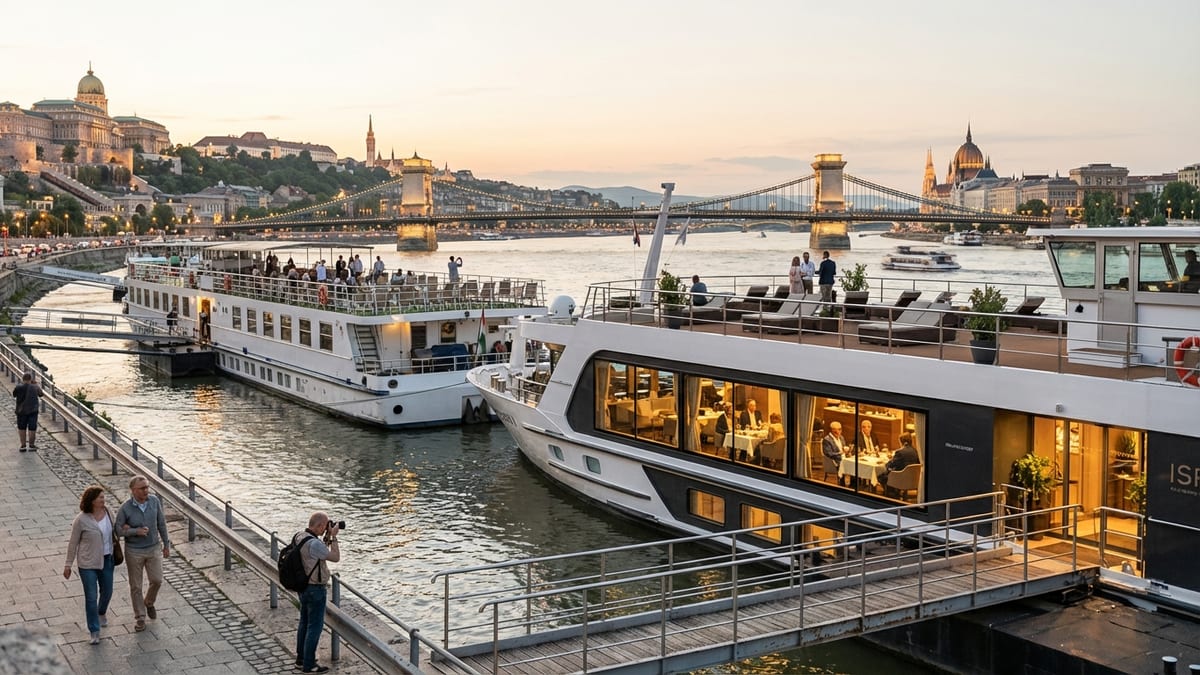
Reports from Hungarian media and international travel outlets describe multiple cruise ships sitting idle at ports such as Komárom and along quays north of Budapest, effectively turning floating hotels into stationary accommodation. Reuters photo documentation from July 16 shows lines of vessels moored side by side on exposed riverbanks, highlighting how quickly the navigable channel has contracted.
Domestic sightseeing traffic has been hit just as hard. Information published by Hungarian passenger-shipping companies and local newsrooms indicates that daytime sightseeing services from Budapest to Danube Bend towns such as Szentendre, Visegrád and Esztergom have been temporarily suspended. Hop-on sightseeing routes within the capital, popular with city-break visitors using river passes, are operating with curtailed stops or not at all where quays have become inaccessible at low water.
North of Budapest, operators report that several ships are either stranded mid-itinerary or waiting in ports for conditions to improve, with itineraries adjusted day by day. While smaller excursion boats can sometimes continue under shallower conditions, the large international cruise ships that dominate peak-season traffic are particularly affected, leading to a visible slowdown along what is normally one of Europe’s busiest summer riverfronts.
Tourism and Local Economies Face Peak-Season Disruption
The Danube is central to Hungary’s tourism economy, connecting Budapest with regional cultural sites, wine regions and historic river towns. Industry analyses and tourism board materials typically cite dozens of embarkation and landing points along the Hungarian stretch of the river, many clustered in the capital, underlining how much local businesses depend on regular cruise calls.
This week’s disruption is rippling through that network. Riverfront restaurants, souvenir stalls and tour operators in Budapest and Danube Bend towns are seeing fewer same-day visitors arriving from ships. According to travel trade coverage, some cruise companies are attempting to salvage land-based experiences by substituting coach transfers from unaffected ports, effectively turning river cruises into road itineraries and overnight hotel stays.
Travel forums and consumer reporting suggest that while some guests accept these changes as an unavoidable response to extreme weather, others are questioning value for money when long-planned river voyages become bus-based tours. The situation is particularly challenging for passengers starting or ending multi-country cruises in Budapest, where low water can disrupt both upstream and downstream segments, complicating flight connections and pre- or post-cruise city stays.
Wider European Pattern Raises Climate Resilience Questions
The Hungarian emergency is part of a broader pattern of shrinking European rivers in mid-2026. Travel industry news outlets have documented similar low-water disruptions on parts of the Rhine, Main and upper Danube this summer, with multiple cruise lines announcing cancellations, ship swaps and extensive itinerary changes across Germany and Austria.
Hydrological agencies and climate researchers have previously linked more frequent and intense summer low-water events on major European rivers to shifting precipitation patterns and rising temperatures. While the current Danube situation is driven by regional weather in recent weeks, it is unfolding against a backdrop of longer-term concern about how inland waterways will cope with recurring extremes on both the low- and high-water side.
For the cruise sector, the episode underscores the operational and financial risks of relying on river levels that can no longer be assumed to follow historic norms. Industry planning documents for 2026 cruises already flag the possibility of itinerary changes in the event of high or low water, but this season’s widespread disruption is likely to intensify discussion about fleet design, alternative routing and the balance between river sailing and land-based components in future products.
What Travelers on Upcoming Danube Cruises Should Expect
For travelers with Danube cruises booked in the coming days and weeks, publicly available updates from river cruise companies and travel agents emphasize flexibility. Passengers are being advised to monitor operator communications closely, as decisions about whether a ship can sail a given stretch are frequently made only a day or two in advance based on the latest depth measurements.
Where navigation is not possible, companies are turning to a familiar set of contingency measures. These include transferring guests by coach between unaffected sections of the river, swapping them between ships positioned on either side of low-water bottlenecks, and turning some sailings into partial hotel stays in embarkation or turnaround cities such as Budapest. Travel trade reporting indicates that, in some cases, entire departures have been cancelled at short notice when workarounds are not feasible.
Travel specialists recommend that prospective passengers scrutinize booking terms related to itinerary changes, cancellations and refunds, and consider insurance products that address disruption caused by natural conditions. While the romance of gliding past Budapest’s Parliament at sunset remains a powerful draw, this summer’s emergency along the Hungarian Danube is underscoring that river cruising, more than ever, depends on a river that can be safely navigated.