

More news on this day
Lufthansa is preparing to retire its historic LH1 flight number on the Hamburg–Frankfurt route with the launch of the summer 2026 schedule, closing a symbolic chapter in German aviation while keeping the high-frequency shuttle itself firmly in place.
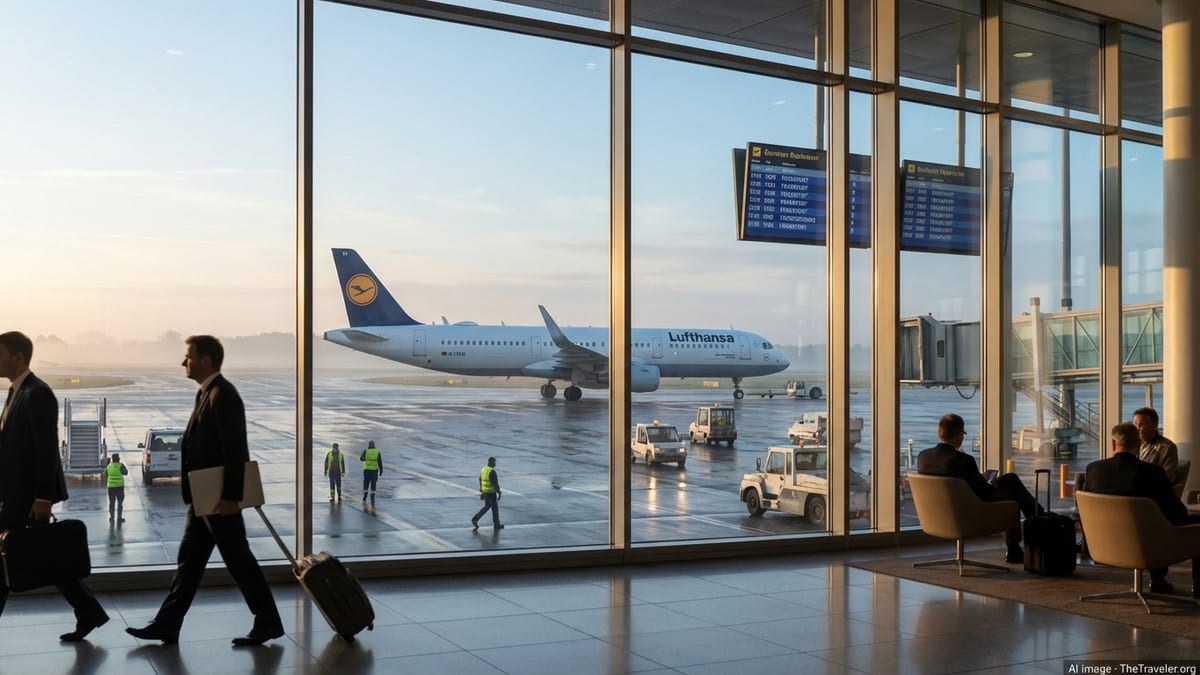
A Quiet Farewell to a Storied Flight Number
For decades, LH1 has been far more than a simple entry in Lufthansa’s timetable. The early-morning departure from Hamburg to Frankfurt has long been regarded as one of the airline’s most emblematic domestic services, a reliable shuttle that helped knit together Germany’s largest aviation hubs and fed long-haul departures across Europe and beyond.
That symbolism is now set to change. From the start of the summer 2026 schedule, the familiar LH1 designation will disappear from the Hamburg–Frankfurt roster and be replaced by LH33. The aircraft, departure time and role within the network will remain largely the same, but the renumbering marks a deliberate break with tradition as Lufthansa overhauls the logic of its flight codes.
In practical terms, passengers who have relied on the early Hamburg–Frankfurt hop to connect into transatlantic, Asian or southern European services at Frankfurt Airport will see minimal disruption. The 06:00 departure from Hamburg and 07:10 arrival in Frankfurt will continue, but boarding passes and booking confirmations will reference a new number that reflects revised internal rules for how Lufthansa assigns and groups its flights.
Yet within German and European aviation circles, the end of LH1 on this route resonates well beyond the operational tweaks. It underlines the extent to which Europe’s legacy carriers are reshaping their domestic networks, not only in response to rail competition and sustainability pressures but also in pursuit of cleaner, more consistent digital systems.
Why Lufthansa Is Renumbering Its Domestic Network
Lufthansa’s decision to retire LH1 is part of a broader restructuring of its flight numbering system, timed to coincide with the introduction of the summer 2026 timetable. The carrier is moving toward a more systematic approach: departures from key hubs such as Frankfurt and Munich are being assigned even numbers, while the corresponding inbound services will generally carry the next higher odd number.
Over time, as routes were added, adjusted or suspended, Lufthansa’s numbering conventions had become fragmented. It was no longer guaranteed that a flight labeled LH002 would be matched with an obvious return like LH003, making it harder for customers and staff to intuitively navigate the schedule. The new system aims to restore order and provide a more predictable pattern, especially across the busiest domestic trunk routes.
In this context, LH1 became a structural outlier. Under the revised logic, there is no room for a LH000 series, and therefore no standard LH001 either. Rather than continue with a one-off exception, the airline chose to reassign the Hamburg–Frankfurt shuttle to an entirely different block of numbers. The flight number LH33 was selected to fit the new framework while preserving a degree of simplicity and recognizability.
For Lufthansa’s operations teams, the cleaner numbering will support schedule planning, disruption management and digital wayfinding across websites, apps and third-party booking platforms. For regular travelers, especially those commuting between northern Germany and Frankfurt’s intercontinental hub, the change will be most noticeable in booking confirmations and mobile boarding passes rather than at the gate.
Hamburg–Frankfurt: The Domestic Shuttle That Shaped a Network
The Hamburg–Frankfurt route carries a significance that goes far beyond its relatively short 412-kilometer stage length. Historically, Hamburg played a central role in the rebirth of Lufthansa in the 1950s, including the establishment of a major maintenance base that would eventually evolve into Lufthansa Technik. The regular shuttle between Hamburg and Frankfurt thus became both a symbolic and practical bridge between two pillars of the airline’s operation.
As Frankfurt rose to prominence as Germany’s primary intercontinental hub, the early-morning LH1 service evolved into a cornerstone of the domestic feeder network. It was timed so that passengers from northern Germany could reach Frankfurt in time for morning long-haul departures to North America, Asia and the Middle East, making it a vital link in the wider European and global connectivity chain.
In 2012, Lufthansa formalized this role by integrating Hamburg–Frankfurt into a shuttle-style schedule, adding almost clockface departures on weekdays to mirror the patterns seen on other domestic trunk routes. LH1 anchored this cadence as the first flight of the day, often operating as one of the airline’s very first departures from any German airport each morning. The steady procession of Airbus narrowbodies leaving Hamburg for Frankfurt became a visible symbol of Germany’s postwar economic integration and business mobility.
Even today, the route remains one of the busiest domestic corridors in Germany, with multiple daily frequencies and high seat capacity operated mainly by Airbus A319, A320 and A321 aircraft. The elimination of the LH1 label has no impact on those frequencies, but it does draw a line under one of the best-known shorthand references to the Hamburg–Frankfurt commute in German corporate life.
From Legacy Codes to Digital Travel: What Changes for Passengers
For travelers, the direct implications of LH1’s disappearance are subtle but noteworthy. Timetables and airport displays will list the Hamburg–Frankfurt morning shuttle under its new LH33 designation, and connecting itineraries will pair that number with long-haul flights using the reworked system. Existing bookings for travel dates before the switch will still display LH1, while flights from the start of the summer season forward will carry the updated code.
Loyal customers who have long associated LH1 with a particular seat, gate or routine may feel a twinge of nostalgia. For business travelers catching the first flight out on Monday mornings, LH1 became part of a predictable rhythm: coffee at the terminal in Hamburg, a short Airbus sector to Frankfurt, then a brisk walk to onward departures. The renumbering disrupts that emotional shorthand, even if the overall experience from curb to gate remains familiar.
Operationally, the clearer numbering scheme is designed to reduce confusion during irregular operations, particularly when schedules are disrupted by weather, air traffic control issues or knock-on delays. With outbound flights grouped under even numbers from each hub and inbound services following predictable pairings, communications via airline apps and push notifications can be more consistent, aiding rebooking and wayfinding in high-stress situations.
Travel agents and corporate travel managers may see the biggest behind-the-scenes benefits. Simplified patterns help with automating itinerary building and integrating Lufthansa’s schedule into booking tools, especially on routes where the airline offers a shuttle-like frequency with numerous daily options. In the medium term, that may support incremental improvements in connection reliability and schedule clarity across the German and wider European network.
Symbolism of the Number One in Global Aviation
The retirement of LH1 is also resonant because of the symbolic weight that the number one carries within global aviation. Airlines often reserve single- or low-digit flight numbers for prestigious or historically important routes, using them as a subtle branding tool and a nod to aviation heritage. The association between “1” and flagship services is a long-standing tradition across the industry.
British Airways, for example, once used the BA001 designation on its Concorde services between London and New York, and later redeployed it on a premium transatlantic service from London City. Other carriers continue to operate route number ones on marquee long-haul connections, such as services linking national capitals or historic point-to-point pairings that helped define their international expansion.
For Lufthansa, LH1 has long served that role on the domestic front rather than on an intercontinental stage, highlighting the importance the airline has historically attached to its home market connectivity. Hamburg–Frankfurt may lack the glamour of New York, Tokyo or Dubai, but as a daily bridge for Germany’s export-driven economy, it has been no less central in strategic terms.
By stepping away from the LH1 code on a regular scheduled route, Lufthansa is signaling a shift from symbolic numbering toward a more utilitarian, system-first logic. The airline has indicated that the LH001 identifier could still be deployed for special occasions in the future, reserved for ceremonial flights or one-off operations rather than day-to-day shuttles.
European Aviation in Transition: Context Around the Change
The timing of LH1’s retirement coincides with a broader period of transition in European aviation. Legacy carriers are reassessing the role of short-haul flights within their networks, calibrating capacity between air and rail, and responding to regulatory and consumer pressure to decarbonize. Domestic routes that once epitomized growth are now being scrutinized through the lens of emissions, efficiency and multimodal connectivity.
Germany in particular has seen intensified debate over domestic air travel, with calls to shift more journeys on corridors such as Frankfurt–Hamburg or Frankfurt–Berlin onto high-speed rail where practical. Airlines and policymakers have been exploring ways to better integrate flight schedules with rail services, while still preserving critical early-morning and late-evening connections that rail cannot always replicate.
Lufthansa’s decision to focus its numbering system more tightly on hub-based logic can be viewed as part of that recalibration. By making the structure more transparent and easier to navigate, the airline is reinforcing the central role of Frankfurt and Munich as intermodal hubs into which both air and rail flows can be channeled. The Hamburg–Frankfurt shuttle, with or without the LH1 label, remains a crucial spoke feeding that wheel.
At the same time, European carriers are investing in fleet modernization and digital tools to make short-haul operations leaner and greener. Enhanced scheduling platforms, real-time rebooking and more granular data on passenger flows all depend on clean, consistent identifiers. In that sense, the renumbering of a single Hamburg–Frankfurt flight becomes emblematic of a much larger digital transformation underway behind the scenes.
Hamburg and Frankfurt: Twin Pillars of German Air Travel
The story of LH1 cannot be separated from the evolution of its two endpoint cities. Hamburg Airport serves one of Europe’s most important port and logistics regions, while also acting as a gateway for northern Germany and parts of Scandinavia. Frankfurt Airport, by contrast, has grown into a global intercontinental hub, with one of the most extensive long-haul networks in Europe and a dense web of intra-European feeders.
Lufthansa’s roots in Hamburg run deep, stretching back to the postwar reconstruction era. The city became home to the airline’s technical backbone, with facilities that would later be grouped under Lufthansa Technik, giving Hamburg enduring importance even after corporate decision-making gravitated toward Frankfurt. The daily stream of flights between the two cities, with LH1 as the earliest anchor, mirrored that corporate and economic interdependence.
Frankfurt’s transformation into a global hub accelerated from the 1970s onward, fueled by Germany’s export economy and the city’s status as a financial center. Lufthansa’s strategy increasingly revolved around feeding long-haul waves at Frankfurt, and high-frequency domestic services from cities like Hamburg, Berlin and Munich became essential to that model. LH1, as the first domestic feeder of the day from Hamburg, embodied the intersection of local business travel and global connectivity.
Today, both airports continue to adapt to changing traffic patterns. Hamburg is emphasizing its role as a regional gateway with strong European links, while Frankfurt is investing in capacity enhancements and passenger experience upgrades to handle complex transfer flows. The retitling of a key shuttle flight may be a small detail in that larger evolution, but it speaks to the ongoing fine-tuning of how Germany’s aviation infrastructure functions as a joined-up system.
A New Chapter Without Erasing the Past
As the last scheduled LH1 flights prepare to depart Hamburg for Frankfurt before the summer timetable shift, aviation enthusiasts and long-time Lufthansa passengers are taking note. Some have already begun documenting the final weeks of the number’s use in flight logs and enthusiast forums, aware that they are witnessing the end of a small but storied piece of airline history.
Lufthansa, for its part, has emphasized continuity even as it draws a line under the LH1 era. The airline stresses that the Hamburg–Frankfurt route will retain its early-morning departures, multiple daily frequencies and role as a key domestic connector. The new LH33 designation is framed not as a downgrade, but as a logical step within a cleaner, more future-proof numbering grid.
Industry observers point out that airline flight numbers are periodically reshuffled in response to mergers, alliance changes, scheduling shifts and safety protocols. What makes LH1’s retirement notable is not only its longevity on a single route, but also the historic weight attached to the number one in aviation more broadly. In that light, the change can be read as a quiet milestone in how European network carriers reconcile heritage with the demands of digital-era operations.
For travelers checking departure boards in Hamburg in the years ahead, LH1 will no longer appear among the early morning options. In its place will stand a new designation, carrying forward the same Airbus aircraft, the same short hop over central Germany and the same role linking a northern port city to one of Europe’s busiest hubs. The number may change, but the daily choreography of German and European air travel that it represents will continue to evolve above the clouds.