

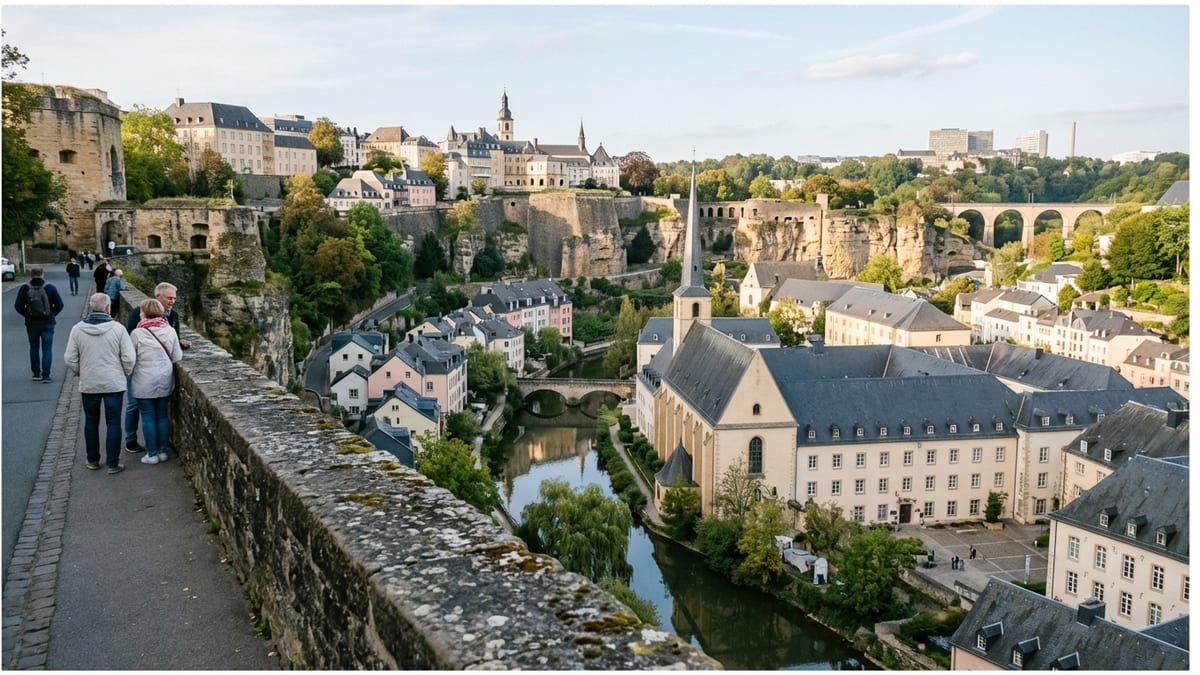
Luxembourg City’s Old Town is one of Europe’s most surprising historic centers, a place where sheer cliffs, looping rivers and clifftop ramparts combine to create a cityscape that feels part fortress, part storybook.
Recognized as a UNESCO World Heritage site since 1994, the “City of Luxembourg: its Old Quarters and Fortifications” preserves layers of Burgundian, Habsburg, Spanish, French and Prussian rule in a remarkably compact area. For travelers, this translates into an atmospheric district of stone walls, panoramic walks and village-like lower quarters that are easy to explore on foot yet rich in historic detail.
What the UNESCO World Heritage Listing Actually Covers
When UNESCO inscribed Luxembourg City’s Old Quarters and Fortifications on the World Heritage List in December 1994, it was not recognizing a single monument but an entire defensive landscape. The core of the site lies at the confluence of the Alzette and Pétrusse rivers, where a steep rocky outcrop gave rise to a fortified town from the 10th century onward.
Over the next 800 years, Luxembourg’s ramparts, bastions and underground galleries were continually adapted by successive powers, turning the city into one of the largest fortresses in early modern Europe. Many highlights sit in the Old Town, making it central to the things to do in Luxembourg City.
UNESCO’s designation highlights this evolution of military architecture rather than any single structure. Even though most of the fortifications were dismantled after the 1867 Treaty of London, the surviving elements remain extensive and legible. The Old Town plays a big role when evaluating if Luxembourg is worth visiting\. Visitors can still read the outline of bastions and curtain walls, follow the line of former ramparts and descend into the famous casemates, the network of rock-cut galleries that earned Luxembourg the nickname “Gibraltar of the North.” The Old Town’s narrow streets and irregular plots reveal how urban life had to adapt to the constraints of defense.
The World Heritage boundary extends beyond the compact, upper Ville Haute to include the lower quarters of Grund, Clausen and Pfaffenthal, along with sections of the Pétrusse valley. This reflects a shift from seeing the Old Town as an isolated historic core to understanding it as part of a wider fortified ensemble. For travelers, that means some of the most evocative heritage is found not only on the plateau but also down near the rivers and across in residential districts that retain a village identity within the modern capital.
A Fortress Above the Rivers: Geography and Urban Layout
Luxembourg’s topography is the key to understanding its Old Town. The historic center sits on a high sandstone promontory ringed by ravines carved by the Alzette and Pétrusse. On three sides, cliffs drop almost vertically to the riverbanks below. Only the western side needed heavy fortification to complete what nature had largely begun. This geography explains why so many of today’s classic viewpoints involve dramatic changes in level and why even short walks often include steep ramps, steps and viaducts.
The upper plateau, known as Ville Haute, concentrates political and religious power. Here you will find the Grand Ducal Palace, the Chamber of Deputies, Notre Dame Cathedral and a series of squares such as Place Guillaume II and Place d’Armes. While many buildings date from the 18th and 19th centuries, the street plan preserves a medieval framework shaped by the old ramparts and the promontory’s irregular outline.
Below, the lower quarters occupy the narrow river valleys. Grund spreads along a bend of the Alzette, overlooked by the Bock rock and the Corniche above. Across the river, the Rham Plateau rises with former barracks and hospital buildings. Pfaffenthal, further north, once housed craftsmen and workers tied to the fortress or river trade, while Clausen to the east developed around breweries and industry. Today these districts offer some of the city’s most atmospheric streets, where riverside houses and small bridges contrast with towering walls overhead.
Connecting these levels are a series of stairways, ramps, elevators and viaducts. Historic bridges such as the 19th century Pont Adolphe over the Pétrusse and the older stone spans in Pfaffenthal help knit together a terrain that might otherwise feel fragmented. Modern additions, including panoramic lifts and revamped parks, have focused on opening up views and making the steep topography more accessible to visitors with limited mobility without sacrificing the Old Town’s character.
The Bock Promontory and Its Casemates
The Bock rock is the birthplace of Luxembourg City and remains its most emblematic landmark. It was here that Count Siegfried established a castle in 963, taking advantage of a narrow neck of rock commanding the Alzette valley. Although the medieval castle was largely demolished, the site’s defensive potential was repeatedly exploited and reinforced. In the 18th century, Austrian engineers expanded the underground galleries into what are now known as the Bock Casemates, a honeycomb of tunnels carved into the rock.
Today, the Bock Casemates rank among Luxembourg’s most visited sights. The galleries, some over 100 meters long, were designed to shelter troops, store provisions and protect artillery. Looking out through the loopholes cut into the cliff face, you see precisely why this fortress was so hard to besiege. The casemates could once extend for many kilometers throughout the city’s substructure, but only a fraction is accessible. Even so, the combination of vaulted passages, side chambers and sudden windows opening onto the Grund below creates an experience that feels both intimate and monumental.
Visitor infrastructure has evolved rapidly in recent years. Timed tickets and guided tours help control numbers in the narrow tunnels, and safety regulations are enforced to manage uneven floors and low ceilings. Interpretation panels explain not only the military function but also the role of the casemates as wartime shelters in the 20th century. The adjacent archaeological crypt allows visitors to get a sense of earlier castle structures that predate the current galleries, including foundations from the medieval fortress that set Luxembourg’s history in motion.
Outside, the Bock rock forms a spectacular natural belvedere. From the upper platform, you can trace the sweep of the Alzette and pick out the rooflines of Grund, Neimënster Abbey and the Rham plateau, as well as the arches of the modern rail viaduct. For many travelers, this interplay between subterranean spaces and big-sky panoramas is the essence of Luxembourg’s World Heritage landscape.
The Corniche and the Classic Old Town Vistas
No exploration of Luxembourg’s Old Town is complete without walking the Chemin de la Corniche. Often described as one of Europe’s most beautiful balconies, this pedestrian promenade runs along the top of the old eastern ramparts, curving from near the Bock towards the Cité Judiciaire complex. Throughout, the path clings to the edge of the plateau, with near-constant views down to the Alzette and across to the lower quarters.
The Corniche reveals the Old Town both as a fortress and as a lived-in city. On the inner side, travelers pass townhouses, remnants of bastions and narrow streets that seem to vanish into the historic core. On the outer side, the panorama changes with every few steps. You look out over the tight urban fabric of Grund, the abbey complex of Neimënster, the high arches of the railway bridge and the hills beyond. The sheer drop from parapet to river underscores just how much the medieval city relied on topography for defense.
This route also provides one of the clearest visual entries into the logic of the UNESCO site. You can trace line of sight between the Bock, the Rham plateau and the lower quarters, understanding how the fortress controlled movement along the valley floor. Interpretation boards and guided Promenade UNESCO tours explain these relationships in greater depth, but even an unguided stroll delivers a strong sense of why so many European powers coveted this position.
Practical considerations matter here as well. The Corniche is paved and reasonably level, but access points at either end may involve steps or steep streets. The path can be narrow in places, especially during peak times. Morning and late afternoon light are particularly rewarding for photography, with softer shadows on the cliffs and façades below. In winter, low sun angles and sometimes fog in the valley create a different but equally atmospheric experience.
Grund, Neimënster and the Life of the Lower Quarters
While the clifftop vistas often dominate visitors’ first impressions, much of the Old Town’s charm lies in its lower quarters. Grund in particular feels like a separate village within the capital, tucked into a loop of the Alzette beneath the Bock. Stone houses line the riverside, their reflections mirrored in the slow-moving water. From almost any lane, you can look up to see the jagged profile of ramparts and casemates high above, a reminder of Luxembourg’s dual identity as both fortress and community.
Central to this district is Neimënster Abbey, a former Benedictine complex that has been repurposed as a cultural center and public meeting place. Its cloistered courtyards and sober stone buildings provide a dignified setting for concerts, exhibitions and festivals. The abbey’s history, from monastic foundation to military use to modern reconversion, closely mirrors the broader story of the city’s adaptation from fortified stronghold to international capital. Entering the courtyard, with cliffs and casemates towering above, gives a tangible sense of the different eras that have overlapped here.
Grund is also where you most fully experience the way waterways shaped the old quarters. Small bridges connect both sides of the Alzette, and walking routes run along the river toward Clausen and Pfaffenthal. Nighttime illumination highlights the arches and façades, while quieter daytime hours reveal details such as stone lintels, stepped gables and the subtle gradations of color in the sandstone. Cafés and small restaurants serve both residents and visitors, lending the quarter a lived-in feel even during the busiest seasons.
Exploring Grund inevitably brings you into close contact with the verticality of Luxembourg’s topography. Steep paths lead back up towards the Ville Haute, while elevators and funiculars provide alternatives for those who prefer not to climb. The constant sense of being watched over by the fortress walls is part of the district’s distinct identity and a major reason UNESCO viewed the Old Town and its fortifications as inseparable.
Palaces, Parliament and Sacred Spaces in Ville Haute
On the plateau above, the Old Town shifts from fortress architecture to the ceremonial and civic buildings of a modern European capital. The Grand Ducal Palace, with its ornate Renaissance facades and later extensions, serves as the town residence of the Grand Duke and remains one of Luxembourg’s most photographed landmarks. Its location in the heart of Ville Haute, close to the Chamber of Deputies, underscores the continuity between the city’s long military history and its present constitutional role.
The nearby Hôtel de la Chambre houses the national legislature. Together with the palace, it anchors a cluster of government buildings within the historic street grid. While many of these structures date from the 19th century, they respect the scale of the surrounding quarters, preserving the intimate street widths and enclosed squares that define the Old Town. In summer, guided tours occasionally open selected interiors to the public, but even from the outside the façades reward careful observation.
Notre Dame Cathedral stands slightly apart, its spires rising near the edge of the Pétrusse valley. Begun in the early 17th century as a Jesuit church and expanded over later centuries, it blends late Gothic forms with Baroque and Renaissance details. The cathedral houses the revered image of Our Lady of Consolation, patroness of the city and country, and plays a central role in religious and civic ceremonies. Its interior, with slender columns and stained glass, offers a counterpoint to the heavy masonry of the fortifications outside.
Public squares link these institutions into a coherent urban ensemble. Place Guillaume II, framed by the Town Hall and various historic façades, hosts markets and events. Place d’Armes functions as a more casual gathering place with terraces and seasonal kiosks. Both lie well within the World Heritage area and show how the Old Town has adapted its spaces from strictly defensive functions to civic and cultural life while still retaining the imprint of its fortified past.
Museums, Walking Trails and Experiencing the Heritage Today
Luxembourg City has invested heavily in helping visitors interpret its World Heritage site. The Lëtzebuerg City Museum, housed in a row of restored townhouses above the Grund, uses models, documents and multimedia installations to trace the capital’s development from a 10th century fortress to a modern financial hub. Its panoramic glass lift, which travels from street level down toward the rock foundations, offers literal and figurative insight into how the city grew layer by layer.
Beyond museum walls, the Old Town itself has become an open-air interpretation space. A signed UNESCO walking trail of roughly 2.5 kilometers allows visitors to complete a circuit of key viewpoints and fortification remains in around 90 minutes, while longer thematic routes delve into specific quarters or aspects of the site. In 2020, for the 25th anniversary of the UNESCO inscription, authorities introduced several new self-guided cultural tours, including options that prioritize accessibility so that more visitors can experience the terrain and vistas.
Guided tours add a further dimension. The Promenade UNESCO, for example, leads small groups from the Pétrusse valley up through parks and along the Corniche, explaining how each bastion and battery functioned. Specialized tours for families and school groups break down the story of the fortress into engaging narratives and hands-on activities. While the casemates remain a headline attraction, these walks underscore that the World Heritage designation covers a broader urban landscape and living community.
Cycling initiatives have begun to knit the heritage site into the wider city. Since 2019, a roughly 9.5 kilometer UNESCO-themed route allows visitors to explore much of the valley and former fortress perimeter by bike, passing through Pétrusse, Grund, Clausen and Pfaffenthal. This helps highlight how the old fortifications once ringed the city and how much green space has replaced former military zones. For many travelers, combining walking, museum visits and sections of these trails provides the most rounded introduction to Luxembourg’s Old Town.
The Takeaway
Luxembourg City’s Old Town is not a museum piece frozen in time but a complex, layered environment where fortifications, religious buildings, government institutions and residential quarters coexist. The UNESCO World Heritage listing recognizes that what makes the site exceptional is less any single monument than the interplay between the natural rock, the defensive works and the evolving city fabric. Walking from the Bock Casemates along the Corniche and down into Grund, then back up to Ville Haute, exposes this relationship in a matter of hours.
For travelers, the Old Town offers a rare chance to experience a fortress city that has survived the dismantling of its walls with its character intact. Sheer cliffs, underground galleries and river-hugging streets are balanced by animated squares, cultural centers and contemporary infrastructure that eases access without flattening the topography. The result is a cityscape where history feels both monumental and approachable, and where each bend in the path reveals another view that helps explain why Luxembourg once played such an outsized role in European power politics.
Whether you arrive for a weekend break or as part of a wider tour through the region, Luxembourg City’s Old Quarters and Fortifications reward unhurried exploration. Take time to look out from the ramparts and then look back at them from below, to compare museum models with the street scenes outside, and to let the rhythm of stairs, bridges and elevators guide you through the vertical layers of the city. In doing so, you will begin to see how this compact capital earned its World Heritage status and why its Old Town continues to captivate visitors long after they leave the plateau behind.
FAQ
Q1. What exactly is included in Luxembourg City’s UNESCO Old Town site?
The UNESCO site, officially titled “City of Luxembourg: its Old Quarters and Fortifications,” includes the historic Ville Haute on the clifftop, the lower quarters of Grund, Clausen and Pfaffenthal, key sections of the former ramparts and bastions, and parts of the Pétrusse and Alzette valleys where major fortification structures and historic urban fabric have been preserved.
Q2. How much time should I plan to visit the Old Town and main landmarks?
To see the essential highlights, including the Bock Casemates, the Corniche, Grund, Notre Dame Cathedral and the main squares, most travelers should allow at least one full day. Two days will let you add museum visits, guided tours and more relaxed time in the lower quarters without feeling rushed.
Q3. Are the Bock Casemates suitable for all visitors?
The Bock Casemates involve uneven floors, low ceilings, steps and at times narrow passageways, so they may not be suitable for visitors with limited mobility, severe claustrophobia or very young children. Safety regulations, lighting and signage are in place, but it is wise to wear sturdy shoes and check current access and health guidelines before your visit.
Q4. Is the Old Town of Luxembourg City walkable?
Yes, the Old Town is compact and designed for walking, but it is also very vertical. Expect steep streets, stairways and significant differences in level between Ville Haute and the lower quarters. Panoramic lifts, elevators and public transport help bridge the height differences, making it easier for a wide range of visitors to explore.
Q5. What is the best way to experience the UNESCO fortifications?
A combination of walking the Corniche, visiting at least one of the casemate systems and following a designated UNESCO trail gives the clearest picture of the fortifications. Guided tours such as the Promenade UNESCO add historical context, while self-guided routes and interpretation boards allow you to explore at your own pace.
Q6. When is the best time of year to visit Luxembourg’s Old Town?
The Old Town can be visited year round. Spring and early autumn often provide mild temperatures and pleasant light for photography, while summer brings longer daylight and more outdoor events. Winter visits can be atmospheric, with fewer crowds and moody landscapes around the ravines and fortifications, but you should be prepared for colder weather and potentially slippery surfaces.
Q7. Are there museums focused on the history of the Old Town and fortress?
Yes. The Lëtzebuerg City Museum offers a broad overview of the city’s development, with models and multimedia displays that explain the fortress and urban growth. Other institutions, such as the fortress-focused museum at Fort Thüngen on the Kirchberg plateau, complement what you see in the Old Town itself.
Q8. Can I explore the lower quarters like Grund and Pfaffenthal without a guide?
Absolutely. Both Grund and Pfaffenthal can be explored independently using city maps and wayfinding signs. Walking along the Alzette, crossing small bridges and using the elevators back to the plateau are straightforward, and the districts’ compact size makes it hard to get lost. Guided tours are available if you prefer more structured commentary.
Q9. Is Luxembourg City’s Old Town suitable for families with children?
Families often find the Old Town engaging thanks to its castle-like walls, tunnels and dramatic views. Children may particularly enjoy the casemates and the panoramic lifts. However, parents should be mindful of steep drops, steps and occasional crowding along narrow paths such as the Corniche, and supervise younger children closely.
Q10. How does the Old Town fit into modern Luxembourg City?
The Old Town functions as both a historic core and a living neighborhood within a modern capital. Government institutions, shops, residences and cultural venues all occupy historic buildings and streets, while newer districts such as Kirchberg and the railway quarter handle much of the city’s expansion. This balance between preservation and contemporary life is central to the site’s World Heritage value and to its appeal for visitors.