

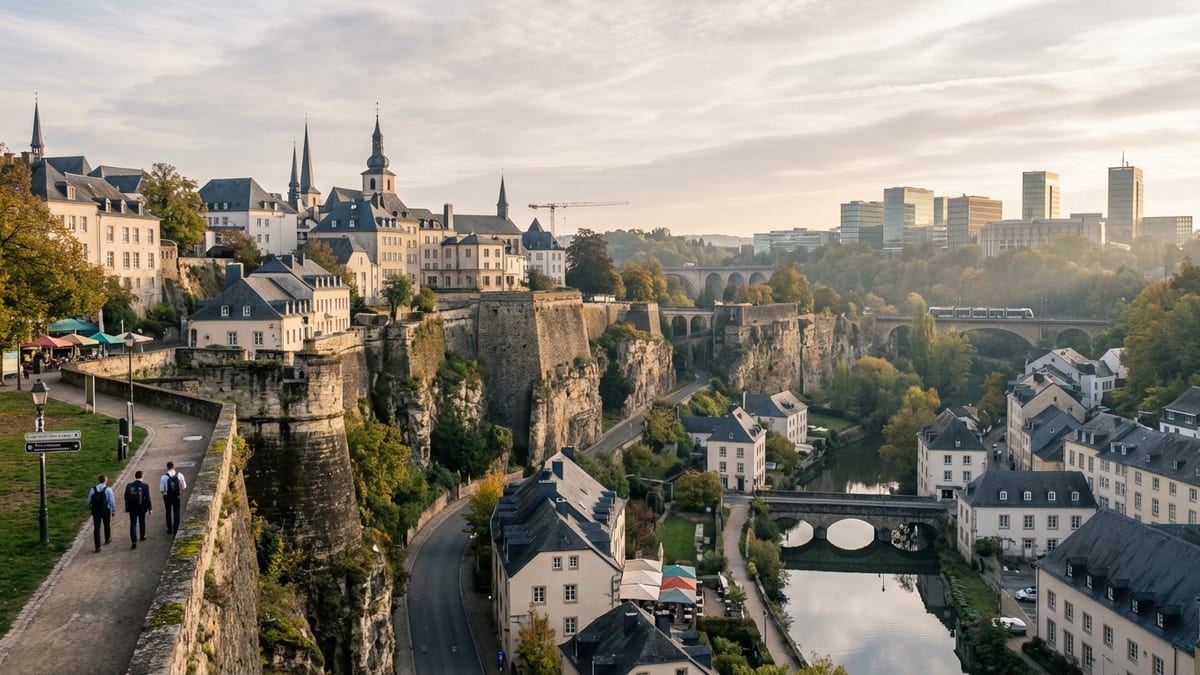
Luxembourg is one of those small countries that many travelers recognize on a map but know surprisingly little about. Wedged between Belgium, France and Germany, the Grand Duchy is smaller than the U.S. state of Rhode Island yet hosts one of the world’s most important financial centers, several core institutions of the European Union and a cosmopolitan society where multilingualism is part of daily life. To understand Luxembourg is to understand how a tiny state has leveraged history, geography and clever diplomacy to punch far above its weight in Europe and beyond.
From Medieval County to Modern Grand Duchy
The story of Luxembourg begins in the early Middle Ages. In 963, Count Siegfried acquired a rocky promontory above the Alzette River and built the fortress that would give the future country its name. Over the centuries, the strategic stronghold passed between powerful dynasties and foreign rulers, but its identity as a distinct political unit slowly took shape around the fortified city and its surrounding lands. Once you understand the background, it becomes easier to judge whether Luxembourg is worth visiting.
By the nineteenth century, that identity was strong enough for the Congress of Vienna in 1815 to elevate Luxembourg to a grand duchy in personal union with the Dutch crown. It was formally recognized as an independent state, but with its security guaranteed by the great powers that had an interest in maintaining a buffer between France and the German states. That precarious status shaped much of Luxembourg’s later history, including its language politics and careful balancing of neighbors’ interests. Historical context helps explain the most important things to do in Luxembourg City.
A crucial turning point came in 1839, when Luxembourg lost more than half its territory to the newly independent Belgium. In exchange, it gained greater autonomy and remained linked to what would become the German Confederation. The final step toward full sovereignty was the 1867 Treaty of London. European powers agreed that Luxembourg would be neutral and that all fortifications around the capital would be dismantled. The city that had been known as the “Gibraltar of the North” lost its walls but gained the foundations of modern independence.
Neutrality did not spare Luxembourg from occupation in either world war. German forces invaded in 1914 and again in 1940, demonstrating how vulnerable the country remained despite its treaties. The trauma of occupation, deportations and resistance had a lasting impact. After 1945, Luxembourg’s leaders drew a clear lesson: security would depend less on neutrality and more on deep integration with Western Europe and the North Atlantic alliance.
A Steel Powerhouse That Reinvented Itself
Luxembourg’s economic story is often told as one of remarkable transformation. For most of the twentieth century, it was a steel country before it was a finance country. Iron ore found in the red earth of the “Minett” region in the south fueled a heavy industry boom beginning in the late nineteenth century. Mines and blast furnaces sprang up across the region, and steel quickly became the backbone of the national economy.
By the early twentieth century, Luxembourg’s major steel company, ARBED, was a continental industrial heavyweight that operated mines, mills and finishing plants across Europe. The sector created tens of thousands of jobs and pulled waves of foreign workers to the Grand Duchy. That period forged much of the country’s self-image: a small but technologically advanced industrial nation integrated into world markets.
The steel crisis of the 1970s and 1980s, driven by global overcapacity, changing technologies and new competition, hit Luxembourg hard. Many industrial jobs disappeared, and the government faced painful decisions. Instead of endless confrontation between unions and employers, the country developed a structured model of social dialogue known as the “Tripartite.” Bringing government, labor and business to the same table, this mechanism negotiated restructurings, social safety nets and new investment, and it remains central to Luxembourg’s social model today.
While steel’s contribution to gross domestic product has since fallen to a small share of the economy, the sector did not vanish. Major facilities still operate in places like Belval and Differdange, now as part of ArcelorMittal, the global steel group headquartered in Luxembourg City. Production has shifted toward high-value products and greener technologies, with a strong emphasis on recycling. The country’s industrial legacy lives on not only in factories but in redeveloped sites, such as the Belval district, where university buildings and cultural venues rise beside preserved blast furnaces that remind visitors how a steel giant became a post-industrial knowledge hub.
The Rise of a Financial and Service Powerhouse
As steel went into decline, Luxembourg turned decisively toward services, especially finance. In the latter decades of the twentieth century, the country positioned itself as a stable, politically neutral, multilingual hub inside the European Community. Banking secrecy, favorable regulations and flexible company law attracted foreign capital, while membership in the European single market made Luxembourg an ideal base for cross-border activities.
Today the Grand Duchy is one of the world’s leading centers for investment funds, private banking and insurance. Its financial industry manages assets in the trillions of euros and employs tens of thousands of people in Luxembourg City and surrounding areas. Many of the world’s largest asset managers, law firms and professional services companies maintain significant operations here to serve European and global clients.
Luxembourg’s rapid success as a financial hub did not come without criticism. In the 1990s and early 2000s, some critics labeled the country a tax haven, arguing that its bank secrecy and tailored tax rulings allowed multinational corporations and wealthy individuals to reduce their tax bills elsewhere. Investigations such as the “LuxLeaks” revelations raised questions about aggressive tax planning and led to intense scrutiny from European partners.
In response, Luxembourg has spent the past decade aligning with new international standards on tax transparency and exchange of information. Bank secrecy for foreign residents has effectively been dismantled, and the government has supported reforms through the European Union and the Organisation for Economic Co operation and Development. The result is a financial center that remains highly significant, but is now more clearly framed as a regulated European hub rather than a secrecy jurisdiction. For travelers and observers, it offers an instructive case study in how a small state adapts to global rules while trying to safeguard its economic model.
Multilingual, Multicultural, Surprisingly Cosmopolitan
What surprises many first time visitors is how cosmopolitan Luxembourg feels for such a small country. With a population of a little over 670,000 people, it is among Europe’s most densely populated states, yet almost half of residents do not hold Luxembourgish citizenship. Foreign nationals from across the European Union and beyond live and work here, and every weekday hundreds of thousands of cross border commuters arrive from Belgium, France and Germany.
This diversity is especially visible in Luxembourg City, where around 70 percent of inhabitants are foreign nationals and more than 160 nationalities share the same compact urban space. Walking through the streets or riding a tram, you can hear conversations in French, Luxembourgish and German, but also Portuguese, English, Italian and many other languages. For a traveler, the effect can resemble a miniature United Nations, compressed into a leafy, walkable capital.
Language lies at the heart of Luxembourg’s identity. The constitution recognizes three official languages: Luxembourgish, French and German. In practice, each has its domain. Luxembourgish is the national language and increasingly the language of everyday conversation, schools and political life. French dominates in legislation and much of the administration, as well as in restaurants and daily transactions. German is still important in the media and some bureaucratic contexts. English, while not official, is widely spoken in the financial sector and by younger generations.
Multilingualism is not just a skill but a social expectation. Children grow up switching seamlessly among languages at school and at home, and adults often adapt their language choice depending on who they are speaking with. This linguistic flexibility helps explain how Luxembourg can function as a bridge between its neighbors and host so many European and international institutions. It also shapes the traveler’s experience: menus, museum panels and street signs often appear in multiple languages, making the country feel accessible even if you do not speak Luxembourgish.
Institutions, Diplomacy and Why Luxembourg Matters
Beyond finance and culture, Luxembourg matters because of its role at the heart of the European project. After the Second World War, its leaders were among the strongest advocates for closer European integration. Luxembourg was one of the six founding members of the European Coal and Steel Community in 1951 and of the European Economic Community in 1957, precursors to today’s European Union.
Over time, key EU institutions established major offices in the Grand Duchy. Luxembourg City hosts parts of the European Commission and the European Parliament, the Secretariat of the European Parliament, the Court of Justice of the European Union and the European Court of Auditors, among others. These bodies bring a large international workforce and anchor Luxembourg’s status as one of the EU’s three main capitals alongside Brussels and Strasbourg.
Membership in the European Union and the euro currency area has amplified the country’s voice well beyond what its size might suggest. Luxembourg has often worked behind the scenes as a mediator and consensus builder on issues ranging from budget rules to financial regulation. Its governments have tended to favor pragmatic compromise and a strong single market, reflecting the country’s dependence on open borders and cross border trade.
Luxembourg is also an active member of NATO and the United Nations, contributing modestly but reliably to defense and development initiatives. Its approach to foreign policy is shaped by historical vulnerability and a desire to anchor itself firmly in multilateral structures. When you see the flags outside the EU courts in Kirchberg or the international schools scattered around the capital, you are seeing part of a deliberate strategy: turning a once vulnerable buffer state into a hub of law, diplomacy and governance.
A Living Culture that Blends Old and New
Luxembourg’s cultural life reflects the same mix of tradition and cosmopolitanism that marks its history and economy. The older quarters of Luxembourg City, recognized as a UNESCO World Heritage site, showcase remnants of the former fortress integrated into a modern cityscape of glass fronted offices and international institutions. It is possible to stand atop a medieval bastion and look across to contemporary architecture in the Kirchberg business district within a single panoramic view.
Festivals and public holidays bring another layer of identity into focus. The national day in late June, known as the Grand Duke’s Official Birthday, fills the capital with concerts, street parties and a major fireworks display over the Alzette valley. In early February, the carnival season sees parades and costumed celebrations across the country. Religious traditions remain visible in village life, but secular, multicultural urban culture is just as prominent in the capital and larger towns.
Food offers its own introduction to the country’s character. Traditional dishes such as judd mat gaardebounen, a hearty smoked pork with broad beans, or kniddelen, soft dumplings often served with bacon and cream, echo the country’s rural and working class roots. At the same time, Luxembourg’s restaurants and markets reflect strong French, German and increasingly international influences. Bakeries sell French style pastries, while Portuguese cafes and Italian eateries are fixtures in many neighborhoods, a reflection of the migrant communities that helped build modern Luxembourg.
The cultural landscape extends beyond the capital. In the north, the Ardennes region is dotted with castles and hiking trails that hint at Luxembourg’s medieval and rural past. The Moselle valley along the eastern border has vineyards that produce crisp, aromatic white wines and sparkling crémant. In the former steel regions of the south, industrial heritage sites are being transformed into museums, concert halls and university spaces. Together, they offer travelers a compact but varied canvas that goes beyond the clichés of finance and EU offices.
Challenges of Success in a Small Space
Luxembourg’s prosperity and openness also bring real challenges, many of which are now central to domestic political debates. A booming financial sector and influx of international institutions have fueled rapid population growth, putting pressure on housing, transport and infrastructure. Property prices in and around Luxembourg City rank among the highest in Europe relative to income, making affordability a critical issue for young residents and newcomers alike.
Traffic congestion and the environmental footprint of so many daily commuters from neighboring countries have prompted policy experiments. The most visible is the introduction of free public transportation nationwide, a measure designed to encourage residents and visitors to shift from cars to buses, trams and trains. This policy, unusual even by European standards, illustrates how Luxembourg uses its small scale as a laboratory for solutions that other countries watch closely.
Social cohesion in such a diverse society is another ongoing concern. While multilingualism and internationalism are sources of pride, they can also generate tensions about who feels fully included in national life. Debates about civic education, access to nationality and the role of Luxembourgish in schools and public institutions reflect deeper questions about identity. The government has promoted naturalization and dual citizenship to make it easier for long term residents to acquire Luxembourgish nationality, but questions about integration and representation in politics persist.
At the same time, Luxembourg faces many of the same global issues confronting larger European states: climate change, the energy transition, and how to maintain competitiveness in an era of digitalization and geopolitical uncertainty. For a traveler trying to understand Europe’s future, the Grand Duchy offers an instructive microcosm of these broader dynamics, concentrated in a territory small enough to cross by car in under an hour.
The Takeaway
In a continent filled with famous capitals and large nation states, Luxembourg can be easy to overlook on an itinerary or in the news cycle. Yet the Grand Duchy’s importance is out of all proportion to its size. Its journey from fortified medieval stronghold to steel powerhouse and then to financial and institutional hub mirrors many of the forces that have shaped modern Europe: industrialization, war, integration and globalization.
For travelers, Luxembourg offers more than a passport stamp. It is a place where you can walk through centuries of history in a day, shifting from cliff top casemates and baroque churches to contemporary museums and EU courts. You encounter a society that is deeply rooted in its own language and traditions, yet open to the world in a way few other countries of similar size can match.
Understanding Luxembourg means recognizing how geography and history can be turned from constraints into assets. The country’s leaders have consistently sought security through alliances, prosperity through openness and cohesion through dialogue. In an era when many societies are questioning the merits of globalization and integration, Luxembourg stands as a reminder that small states can wield influence not only through resources or size, but through the example of how they organize themselves.
Whether you come as a weekend visitor or follow Luxembourg from afar, seeing how this modest grand duchy manages its success, diversity and challenges offers valuable insight into where Europe has been and where it might be headed next.
FAQ
Q1. Is Luxembourg really an independent country and not just part of another state?
Yes. Luxembourg is a fully sovereign state, officially the Grand Duchy of Luxembourg. It has its own constitution, government, parliament, courts and head of state, and it is a member of the United Nations, the European Union and NATO.
Q2. Why does Luxembourg have three official languages?
The three official languages reflect the country’s history and geography between France and Germany. Luxembourgish is the national language and everyday spoken tongue, French is the main legislative and administrative language, and German is important in media and parts of the bureaucracy. Most residents routinely use more than one language.
Q3. How did Luxembourg become so important in finance?
Luxembourg built its financial center from the late twentieth century by combining political stability, membership in the European single market, investor friendly regulations and a multilingual workforce. Over time it became a leading hub for investment funds, cross border banking and insurance serving clients throughout Europe and beyond.
Q4. Is Luxembourg still a steel producing country?
Yes, but steel now represents a much smaller share of the economy than it did in the mid twentieth century. Production continues at high value, specialized plants that are part of ArcelorMittal and other groups, with an emphasis on recycling and more sustainable processes, while services and finance dominate overall economic output.
Q5. How expensive is it to visit Luxembourg?
Luxembourg is generally in the higher price range for accommodation and dining compared with many European destinations, reflecting its high income economy and strong demand for housing. However, free nationwide public transport, compact distances and a wide range of outdoor activities can help visitors manage costs once they arrive.
Q6. What makes Luxembourg politically significant in Europe?
Despite its small size, Luxembourg is one of the founding members of the European Union and hosts several major EU institutions, including the Court of Justice and parts of the European Parliament and Commission. Its governments often act as honest brokers in European negotiations and its legal and financial expertise gives it a voice in shaping EU policy.
Q7. Is English widely spoken in Luxembourg?
English is not an official language, but it is widely used in the financial sector, European institutions and among younger residents. Many people in Luxembourg can switch easily between English and the official languages, so travelers who speak only English generally have little difficulty getting by.
Q8. How diverse is Luxembourg’s population?
Luxembourg is one of the most diverse societies in Europe. Almost half of residents are foreign nationals, with large communities from other EU countries such as Portugal, France, Italy and Belgium, as well as growing numbers from farther afield. In the capital, foreign nationals make up around 70 percent of the population.
Q9. What are the main things to see for a short trip?
For a brief visit, highlights include the historic center and fortress remains of Luxembourg City, viewpoints over the gorges, the modern European district of Kirchberg, and, time permitting, nearby sites such as the Moselle wine valley or the castles of the northern Ardennes. Former industrial areas like Belval, where heritage sits beside contemporary architecture, also offer a distinctive look at the country’s evolution.
Q10. Why should travelers care about Luxembourg’s story?
Luxembourg’s story illustrates how a very small country can adapt to major historical shifts and carve out an influential role in regional and global affairs. For travelers interested in European history, politics and culture, it provides a compact case study in resilience, integration and the creative use of geography, all within a destination that is easy to explore in just a few days.