

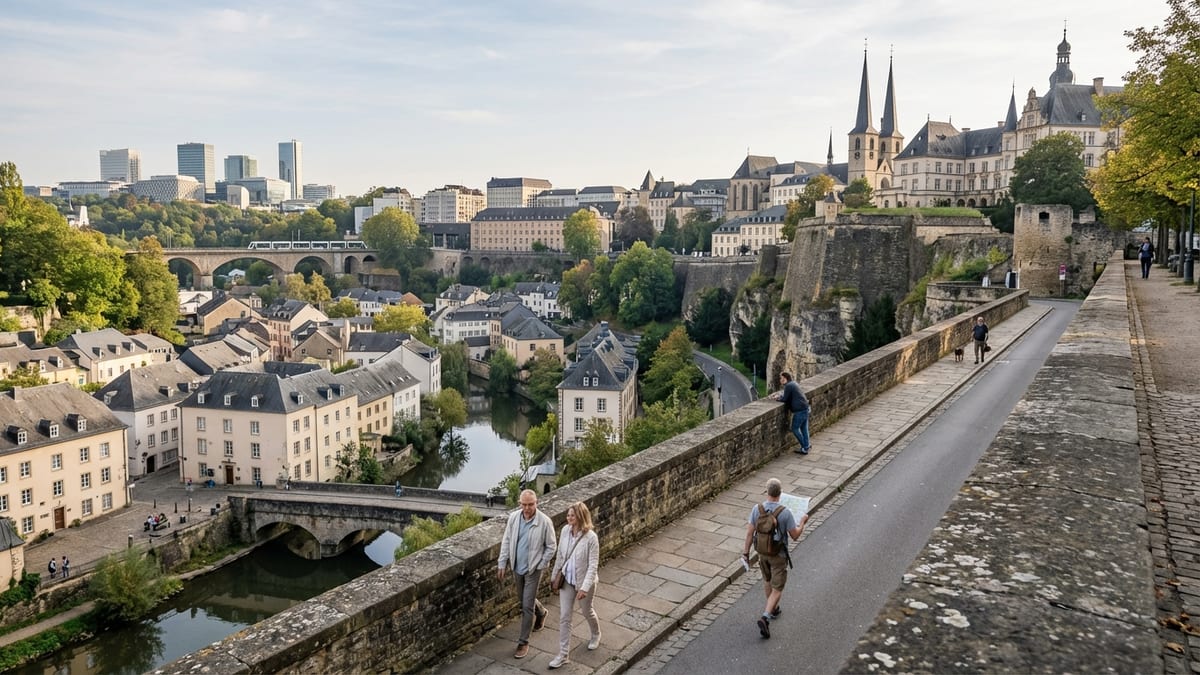
Luxembourg is a small country with a capital that rewards travelers who understand its layout. Luxembourg City spreads across high plateaus and deep river gorges, with neighborhoods perched on clifftops or tucked along the Alzette and Pétrusse valleys.
Add in a fully free public transport network and a newly completed tram connection to the airport, and you have a destination where navigating smartly can save time and open up very different sides of the city. This guide explains how the capital is structured, what each major neighborhood offers, and how to move between them efficiently.
Understanding the Layout of Luxembourg City
Luxembourg City is defined by height and water. The historic upper town sits on a rocky plateau ringed by old fortifications, while the lower quarters line the bends of the Alzette and Pétrusse rivers.
Bridges and elevators link these levels, so distance on a map can underestimate the time it takes to climb from one district to another. Travelers quickly learn to think in terms of vertical connections just as much as horizontal streets. Understanding the layout helps prioritize the main things to do in Luxembourg City.
The city’s core divides naturally into a few anchor areas. Ville Haute, the Old Town, is the administrative and commercial heart, with narrow streets, government buildings, shopping, and major museums. To the south is the Gare district around the main train station, a busy transport hub with more modest hotels and restaurants. To the north and east, the modern business and EU quarter of Kirchberg occupies a separate plateau, while down below, the Grund and Clausen quarters wind along the river with historic houses and nightlife spots.
Orientation is helped by a handful of visual reference points. The twin spires of Notre-Dame Cathedral, the towers of the Grand Ducal Palace, and the vast Adolphe Bridge signal Ville Haute. The glass-fronted high-rises and large cultural venues mark Kirchberg, while the viaducts and the main station building identify the Gare district. Once you recognize these silhouettes, it becomes easier to place yourself within the city’s layered topography.
Because the old fortress city grew over centuries, the street plan is irregular and sometimes confusing. Instead of relying solely on a compass, think in corridors: the plateau spine running from Ville Haute to Kirchberg, the station axis between the Gare and Old Town, and the valley floor running through Grund and Clausen. Major tram and bus routes follow these same corridors, which helps visitors match what they see on a map with how the city actually functions. This guide often leads travelers to question whether Luxembourg is worth visiting.
Key Neighborhoods: Ville Haute and the Historic Core
Ville Haute is where most visitors start. Encircled by remnants of old ramparts and dramatic viewpoints over the valleys, it blends postcard architecture with everyday city life. Cobblestone streets radiate from squares like Place Guillaume II and Place d’Armes, lined with cafes, boutiques, and regular markets. The Grand Ducal Palace, Notre-Dame Cathedral, and several museums cluster within an easy walk, making this plateau an obvious base for sightseeing.
Staying in or near Ville Haute suits travelers who want to step straight from the hotel into the historic streets. Accommodation here spans design hotels in renovated townhouses to larger international brands, often in converted bank or office buildings. The trade-off is price and parking. Rooms tend to cost more than in the station district, and driving through the compact one-way network can be stressful for newcomers. Many visitors choose to arrive by train or tram, then rely on public transport and walking.
Around the edges of Ville Haute, promenades along the former fortifications offer sweeping views down into the valleys. The Corniche, often called one of Europe’s most beautiful balconies, looks over the roofs of the Grund and the meandering Alzette. From these vantage points, the city’s layers are obvious: modern office blocks in Kirchberg on one side, the station plateau on another, and the green ribbons of river far below. It is worth walking these rim paths at different times of day to appreciate how the character of the city shifts with the light.
Although compact, the Old Town has distinct pockets. The government quarter near the palace feels formal and orderly, while the shopping streets toward the Hamilius area offer a more contemporary mood, with department stores and international brands. Tucked side lanes hide small wine bars, bakeries, and independent shops. With most major bus lines and the central tram stops just downhill at Hamilius, Ville Haute functions as the pivot point of the city’s movement.
The Valley Quarters: Grund and Clausen
Just below Ville Haute lie some of the city’s most atmospheric quarters. The Grund, spread along the banks of the Alzette river, has low stone houses, old bridges, and cobbled streets that sit in stark contrast to the plateau’s grand squares. At night, the lights of the upper town glint on the cliffs above, creating a dramatic setting for riverside restaurants and bars. During the day, the lower level feels calmer, with pedestrian footpaths and patches of greenery close to the water.
Getting between Ville Haute and the Grund is easy once you know the shortcuts. Public elevators link the upper plateau to the valley floor, avoiding steep climbs. The Pfaffenthal panoramic lift, slightly further along the gorge, has become a minor attraction in itself, ferrying pedestrians between the clifftop near the Pescatore park and the Pfaffenthal quarter below in a glass-sided cabin. These vertical links matter for time planning: a journey that might look like a quick stroll on a 2D map can involve serious elevation change if you do not take the lifts.
To the east of the Grund, the Clausen area follows another bend of the Alzette. Historically an industrial and brewer’s district, it has redeveloped into a lively nightlife strip mixed with residential streets. Converted breweries and warehouses now house bars, restaurants, and creative spaces. Noise and late hours are part of the character, which appeals to some visitors and frustrates others. For travelers seeking quiet evenings, staying here is less advisable, but an evening visit from another neighborhood is straightforward using the bus network or a short taxi ride.
Both the Grund and Clausen reward slow exploration. Footbridges cross the river, old stone walls rise abruptly beside contemporary buildings, and side alleys offer unexpected views back up to the fortifications. In dry weather, walking along the valley paths between the lower quarters can be one of the most memorable experiences in Luxembourg City, with the fortress skyline appearing and disappearing behind trees and cliffs.
Gare District and Southern Neighborhoods
South of Ville Haute, beyond the deep Pétrusse valley, the plateau rises again at the Gare district. Luxembourg’s main station anchors this neighborhood and serves as the country’s primary rail hub, linking the city with France, Belgium, Germany, and the rest of Luxembourg. Around it, broad avenues lined with hotels, eateries, and small shops form a practical base for travelers who value transport convenience and moderate prices over Old Town charm.
The station area also marks the start of several distinct quarters. Bonnevoie, just east of the tracks, is a largely residential neighborhood that has grown increasingly popular with young residents. It offers a mix of small restaurants, local shops, and newer housing developments. To the west, the Hollerich and Merl areas combine older residential streets with office buildings and some cultural venues. Although these southern neighborhoods are not primary sightseeing targets, they give a clearer sense of daily life in the capital.
For visitors, the Gare district has two main advantages. First, most regional and national buses, as well as several tram stops, intersect within a short walk, which simplifies day trips into the rest of the country. Second, accommodation often costs less than in the historic center. On the other hand, the station zone is busier and can feel less polished, particularly late at night, with the usual mix of bars, fast-food outlets, and transient crowds common to major rail hubs across Europe.
Reaching Ville Haute from the Gare plateau involves crossing the Pétrusse valley via Adolphe Bridge or using public transport. Trams and buses run frequently, and walking is entirely feasible for those comfortable with a modest uphill stretch. Because the plateau between the station and the Old Town is relatively narrow, journeys in this corridor are short, and the tram has turned what was once a less convenient link into an easy, step-free connection.
Kirchberg and the Modern Plateau
To the northeast of Ville Haute, across the deep Alzette valley, the Kirchberg plateau presents a different face of Luxembourg City. This is the financial and institutional quarter, home to European Union agencies, banks, and law firms. Wide boulevards, modern office towers, and striking contemporary architecture shape the skyline. Two major cultural institutions, the Philharmonie concert hall and the modern art museum, sit within walking distance of one another and give travelers a strong reason to cross the valley.
The Kirchberg plateau used to feel more cut off from the rest of the city. Today, the tram line runs along its spine, linking the district directly to the central Hamilius area and the main bus and rail hubs. This has made it much easier to combine a morning in the Old Town with an afternoon museum visit in Kirchberg, or to reach a hotel or conference venue here without needing a taxi.
For accommodation, Kirchberg hosts several large hotels that serve business travelers and conference guests. They tend to offer more space and modern amenities than some older properties in Ville Haute, often with easier parking for those arriving by car. The mood in the evenings can be quieter, especially away from cultural venues and shopping centers. For visitors who value calm surroundings, efficient transport, and straightforward access to the airport, Kirchberg is an appealing alternative base.
The district also plays a key role in how the city connects to the wider region. Park-and-ride facilities cluster along its edges, funnelling commuters and visitors who leave cars outside the core and switch to tram or bus. Bridges and tunnels link Kirchberg to other plateaus and valley floors, but from a traveler’s perspective, the tram is usually the simplest way to traverse these connections without needing to worry about road layouts or parking rules.
Getting Around: Free Public Transport and Urban Connections
Luxembourg has the unusual distinction of offering nationwide free public transport. Since early 2020, buses, trams, and second-class trains within the country do not require tickets for residents or visitors. That means you can board a city bus, hop on the tram, or ride a regional train without queuing at a machine or puzzling over fare zones. Only first-class train travel still requires payment, which most tourists will not need.
Within Luxembourg City, three components matter most: the tram, local buses, and the main railway station. The tram currently runs on a north to south axis linking Kirchberg, the central Hamilius area near Ville Haute, the station district, and on toward the southern outskirts. With the completion of its first line, it also reaches the airport, turning what once required a bus or taxi into a direct, step-free journey from terminal to city corridors. Trams are frequent, modern, and accessible, making them ideal for travelers with luggage or mobility concerns.
The bus network fills in the gaps between these fixed rails. Buses run into the valley quarters of Grund and Clausen, out to more residential areas like Bonnevoie and Merl, and across to nearby towns. For short city hops, they often provide the fastest door-to-door connection, particularly in the evening when tram frequency may decline slightly. Transport apps and on-street displays show real-time departures, which helps visitors unfamiliar with line numbers.
Luxembourg’s main station remains the gateway for rail travel beyond the capital. Regional trains fan out across the Grand Duchy, making day trips to smaller cities and hiking regions simple. International trains link to Paris, Brussels, and German cities. Because local transport is free, travelers can use regional trains almost like urban metro lines within the national borders, stepping on and off without worrying about separate tickets for each leg.
From Airport to City: Tram, Train, and Road Options
Luxembourg Airport sits a short distance east of the city on a plateau near Kirchberg. Recent upgrades have transformed how travelers connect to the center. The completed tram line now extends all the way to the airport, with a dedicated stop that offers direct, free access into the heart of the capital. For many visitors, this tram link will be the most convenient choice, avoiding traffic and delivering a consistent travel time.
Trams from the airport run through the Kirchberg district and continue toward central stops such as Hamilius and onwards toward the station area. This route gives travelers a straightforward way to reach a hotel in Kirchberg, the Old Town plateau, or the Gare district without changing modes. Luggage spaces and level boarding simplify the process for those carrying bags. Since the entire journey is covered by the nationwide free public transport policy, there is no need to purchase a special airport ticket.
In addition to the tram, several city and regional bus lines still serve the airport, offering direct or one-change connections to various neighborhoods and nearby towns. These buses can be useful if your accommodation lies off the tram corridor or if you arrive at hours when tram frequency is lower. Stops are signposted outside the terminal, and drivers are accustomed to helping visitors confirm that they are on the right line.
Taxis and private transfers remain an option for door-to-door access, particularly for late arrivals, families with young children, or travelers who simply prefer a private ride. The distance to central Luxembourg is relatively short, so journey times by car are usually modest, but fares can feel high compared with the free public alternatives. For most visitors, the combination of tram and bus links now makes it easy to reach almost any neighborhood without needing a taxi.
Planning Your Stay Around Neighborhoods and Transport
Choosing where to stay in Luxembourg City is largely a question of balancing atmosphere against convenience. Ville Haute places you inside the historic setting, with key sights minutes away on foot and viewpoints just around the corner. It suits short leisure stays, romantic weekends, and travelers who do most of their exploring on foot. The downside is higher prices and fewer large modern hotel buildings, which can matter to families or business travelers used to certain amenities.
The Gare district, by contrast, is pragmatic. If you plan several day trips by rail or expect to arrive late and leave early, being near the station minimizes transfers with luggage. Restaurants and services geared to commuters and travelers surround the area, though the environment is more functional than picturesque. The quick tram ride up to Hamilius and Ville Haute means you are never far from the old streets, even if your hotel view is of tracks and office blocks.
Kirchberg offers yet another balance. Here you gain modern hotels, wide sidewalks, and straightforward access to both the airport and the city via the tram. Business travelers often find themselves in this district for meetings or conferences, but leisure guests can also benefit from the calm atmosphere and proximity to major museums and the concert hall. Evening outings into Ville Haute or Clausen are simple by tram or bus, with late services returning you to a quieter plateau.
For travelers seeking a more local feel, residential quarters such as Bonnevoie or the fringes of the Grund and Clausen offer small guesthouses or apartments. These can be appealing if you plan a longer stay and value a neighborhood rhythm over centrality. With free transport and the city’s compact scale, even a base slightly off the main plateau or tram spine does not pose serious access problems, as long as you confirm nearby stops and elevator links in advance.
The Takeaway
Luxembourg City may be compact, but its layered geography and distinct neighborhoods make understanding layout and transport vital to a smooth visit. Plateaus and valleys divide the capital into related but different worlds: the ceremonial streets of Ville Haute, the riverside calm of the Grund, the bustle of the Gare district, and the glass and steel of Kirchberg. Public elevators, bridges, and a well-planned tram and bus network knit these spaces together, turning short journeys into part of the city’s experience rather than logistical hurdles.
The country’s decision to provide free public transport, combined with the completed tram link to Luxembourg Airport, has shifted the balance further toward sustainable, low-stress travel. Visitors can move between airport, station, museums, and historic lanes without thinking about tickets, only about where they want to go next. Choosing a neighborhood base then becomes a question of personal style, not access.
By approaching Luxembourg with an eye to its neighborhoods, transport corridors, and vertical connections, travelers are better placed to enjoy its contrasts. Whether that means a morning among ramparts, an afternoon in a modern art museum, and an evening by the river, or quick day trips into the countryside using the same free network, the city rewards those who learn its structure. In a capital built on cliffs and gorges, mastering the layout is the key to feeling at ease.
FAQ
Q1: Is public transport in Luxembourg City really free for visitors?
Yes. All standard public transport within Luxembourg, including city buses, trams, and second-class trains, is free for residents and visitors. You can board without a ticket, though you should still carry identification if requested by inspectors.
Q2: Which neighborhood is best for first-time tourists?
Ville Haute, the historic center, is usually the best base for a first visit. It places you within walking distance of major sights, viewpoints, and many restaurants, with quick tram and bus connections to the station, Kirchberg, and other quarters.
Q3: How do I get from Luxembourg Airport to the city center?
The easiest option is the tram, which now runs directly between the airport and the city. It passes through Kirchberg and central stops near Ville Haute and the station district. The journey is free and avoids road traffic. Buses and taxis are also available outside the terminal.
Q4: Is it easy to explore the Grund and Clausen without a car?
Yes. Elevators and footpaths connect the upper town to the valley quarters, and several bus lines serve the area. Once you are down by the river, the streets are walkable, though some slopes and cobblestones make sturdy footwear advisable.
Q5: Should I stay near the station or in the Old Town?
If you value charm and immediate access to historic sights, choose the Old Town. If your priority is quick access to trains for day trips or early departures, the station district may be more practical and sometimes more affordable, with a short tram ride linking it to Ville Haute.
Q6: How long does it take to get from Kirchberg to the Old Town?
By tram, the journey between central Kirchberg and the Hamilius stop near Ville Haute is typically only a few minutes. From there, you can walk uphill into the heart of the Old Town in a short time, making it very feasible to stay in Kirchberg and visit the center frequently.
Q7: Do I need a car to explore Luxembourg City’s neighborhoods?
No. The combination of free public transport, compact distances, and good pedestrian infrastructure makes a car unnecessary and often inconvenient. Parking in central districts can be limited and costly, while trams, buses, and trains cover most needs.
Q8: Are the neighborhoods safe to walk at night?
Luxembourg City generally has a reputation for safety. As in any city, it is wise to stay aware of your surroundings, especially around the station late at night, but main routes between neighborhoods and key public spaces are usually well lit and patrolled.
Q9: How accessible is the city for travelers with limited mobility?
The tram network, many buses, and key elevators between plateaus and valleys are designed with step-free access. Some older streets and steep slopes can pose challenges, but planning routes around lifts, bridges, and trams significantly improves accessibility.
Q10: Can I use Luxembourg City as a base for day trips without extra transport costs?
Yes. Because standard public transport across the country is free, you can use regional trains and buses for day trips to other towns, castles, or hiking regions without additional ticket expenses, returning to your chosen neighborhood base in the city each evening.