

More news on this day
Passengers traveling through London Heathrow are facing widespread disruption as publicly available flight tracking data shows more than one hundred departures and arrivals delayed and a series of cancellations affecting key long-haul routes to New York, Dubai, Paris, and several major United States cities.
Get the latest news straight to your inbox!
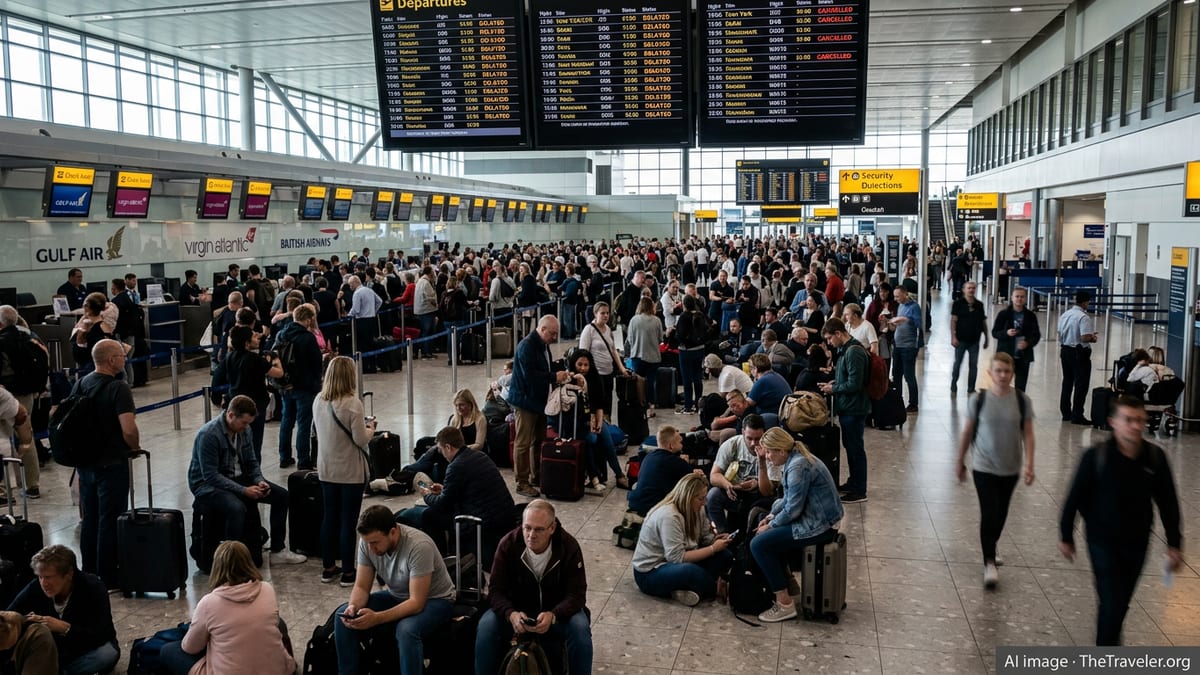
Widespread Disruptions Across Key Long-Haul Routes
Data compiled from live flight tracking platforms on March 15 indicates that operations at London Heathrow have been significantly affected, with around 126 flights experiencing delays and at least 17 cancellations across multiple airlines. Services involving New York, Dubai, Paris, and other major North American destinations are among the most affected, leading to extended waits and missed connections for many travelers.
The impact appears most visible on high-demand transatlantic and Middle East services. Flights to and from New York’s major airports, as well as key hubs such as Dubai International and Paris Charles de Gaulle, are showing knock-on delays stretching across much of the day’s schedule. Observers note that even moderate initial disruptions at Heathrow can quickly cascade because of tightly timed aircraft rotations and busy airspace.
The pattern of disruption suggests both departing and arriving services are under pressure. Travelers connecting through Heathrow to onward long-haul flights are particularly exposed, with tighter layovers proving vulnerable to even relatively short delays. Airport information screens and airline apps are showing a rolling series of revised departure times as operations teams attempt to recover the schedule.
Gulf Air, Virgin Atlantic, British Airways Among Affected Carriers
Among the airlines most visibly impacted are Gulf Air, Virgin Atlantic, and British Airways, along with several other European and North American carriers operating to and from Heathrow. Publicly available schedules show Bahrain-based Gulf Air experiencing delays on services linking London with key Gulf destinations, in some cases pushing departures well beyond their planned slots.
Virgin Atlantic’s long-haul network, including flights to New York and other US cities, is also showing extended delays, with some services departing significantly later than timetabled. Passengers on these routes are reporting longer queues at departure gates and crowded waiting areas as revised boarding times shift repeatedly throughout the day.
British Airways, Heathrow’s largest carrier, is contending with a mixture of pushback delays, late inbound aircraft, and cancellations on a portion of its European and transatlantic network. While many flights are still operating, the overall effect is a patchwork of adjusted timings, forcing travelers to monitor airline apps and airport displays closely for last-minute changes.
Other international airlines operating to US hubs such as Boston, Chicago, and West Coast gateways are also listed with delayed departures or late arrivals. The combined effect is a noticeable strain on both the airfield and terminal experience as peak travel periods overlap with disrupted flight banks.
Operational Pressures and Weather Complications
Reports from aviation data providers and airline operations updates point to a combination of factors behind the latest disruption. Weather-related constraints in parts of the UK and on the North Atlantic corridor, along with air traffic management measures, appear to be contributing to slower-than-normal handling of arrivals and departures.
Heathrow routinely operates near its declared capacity, which leaves limited buffer when several flights are delayed at once. Even modest restrictions on approach or departure rates can quickly create a backlog, especially on days with dense long-haul schedules. When inbound aircraft arrive late, outbound services are forced to wait for aircraft turnaround and crew duty time limits, further compounding the problem.
In addition to meteorological issues, routine operational factors such as runway sequencing, ground handling challenges, and congestion at busy transfer points can magnify the scale of delays. Once rotations fall behind by an hour or more, it becomes increasingly difficult to restore the timetable without resorting to select cancellations to free up capacity and reposition aircraft.
The situation highlights the sensitivity of global hub operations to even small disturbances. With many airlines scheduling tight turnarounds and complex wave patterns, Heathrow’s role as a major connecting airport means that disruptions can ripple outward to airports far beyond London.
Impact on Passengers Traveling to the United States, Gulf, and Europe
For travelers, the immediate impact is being felt in longer waits at departure gates, missed connections, and the need to rebook onward journeys. Flights linking Heathrow with major US cities such as New York, as well as services to Gulf destinations including Dubai and Bahrain, are key components of many multi-leg itineraries, so delays on these routes can leave passengers stranded between flights.
Transatlantic passengers with tight connections onto domestic US services are especially vulnerable. When an inbound flight from London arrives late into hubs like New York or other US gateways, rebooking options can be limited, particularly on busy travel days when later flights are near capacity. Travelers may find themselves re-routed through alternative hubs or facing overnight stays.
Short-haul routes to European capitals such as Paris also play an important role in feeding Heathrow’s long-haul departures. Delays on these feeder flights can mean missed onward connections to North America and the Middle East, adding further complexity for airline scheduling teams attempting to reunite passengers with their itineraries.
Anecdotal accounts posted on social media and traveler forums describe crowded seating areas, long lines at customer service desks, and frequent schedule updates via airline mobile apps. Some travelers report being advised to remain close to their gates, as departure times are adjusted repeatedly in response to evolving operational conditions.
Advice for Travelers Passing Through Heathrow
Travel industry guidance suggests that passengers scheduled to travel through Heathrow on affected carriers should monitor their flight status regularly on airline apps and airport information pages, as departure and arrival times may change with little notice. Allowing extra time at the airport and being prepared for potential re-routing can help reduce stress if further disruptions occur during the day.
Those with same-day connections, particularly to or from North America and the Gulf region, may benefit from proactively reviewing alternative options, including later flights or different routings, if their original service is significantly delayed. Some carriers allow limited changes via digital channels, which can help passengers avoid the longest queues at staffed service points inside the terminals.
Travelers are also being reminded to keep essential items such as medication, chargers, and a change of clothes in their carry-on luggage in case their journey is unexpectedly extended. For those whose flights are canceled, applicable passenger rights and assistance policies vary by airline and ticket type, so checking the conditions of carriage and any travel insurance coverage can be important before seeking refunds or compensation.
With Heathrow expected to remain busy across upcoming travel periods, observers note that similar waves of disruption are possible whenever weather, air traffic control measures, or operational challenges collide with already full schedules. For now, passengers heading to or from New York, Dubai, Paris, and other major US destinations are urged to stay alert to updates and be prepared for journeys that may take longer than planned.